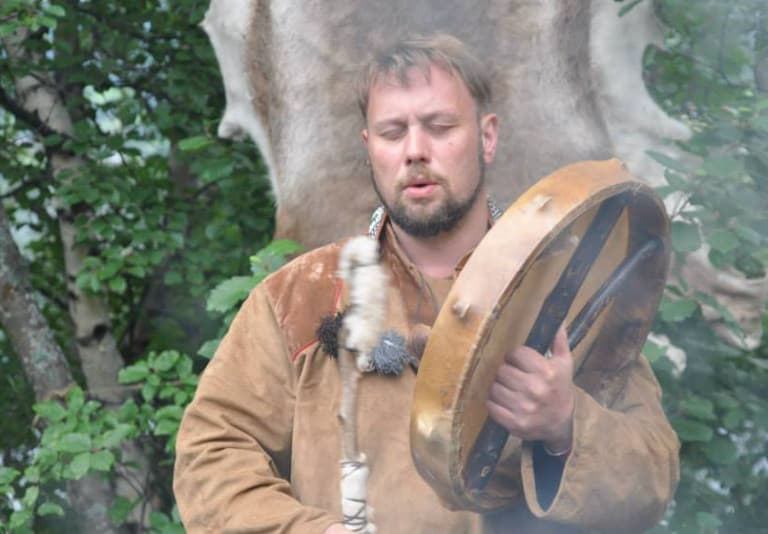
Sjamanistisk Forbund marks an important milestone in the development of modern shamanic practices in Norway. The federation was granted status as an official faith community by the County Governor of Troms, which gave it the right to perform life-stage rituals and to receive state financial support based on membership numbers.
Research on shamanism
Research in this field has been extensive, with contributions from both Norwegian and international scholars. Trude Fonneland, professor at Tromsø Museum - University Museum, has through her research illuminated the development of Sami shamanism in Norway. In her book "Contemporary Shamanisms in Norway: Religion, Entrepreneurship, and Politics" (2017), Fonneland points out that shamanism in Norway is not a unified, organised movement, but rather a diverse network of practices.
The American anthropologist Michael Harner has had considerable influence on the development of modern shamanism globally, including in Norway. Kyrre Gram Franck and Sjamanistisk Forbund acknowledge this influence, but have at the same time developed a more locally rooted approach with a focus on Sami and Norse traditions.
The Finnish researcher Valentina Punzi, in her study "Sami Shamanism and Indigenous Spirituality in Contemporary Norway" (2019), has examined how Sjamanistisk Forbund navigates between traditional practices and modern adaptations. She highlights how the federation has helped to revitalise and legitimise shamanic practices in a Norwegian context.
Asbjørn Dyrendal, historian of religion at NTNU, has also contributed to the understanding of modern shamanism in Norway. He points out that modern, Western neo-shamanism has a relatively simple history to trace, with roots in the work of Michael Harner, but that it has developed in various directions, including the distinct approach that Sjamanistisk Forbund represents.
Research shows that shamanic practices in Norway have undergone significant changes since the turn of the millennium. While earlier practices were strongly influenced by Harner's core shamanism, a more distinct Norwegian version of shamanism has gradually developed under the leadership of Gram Franck and Sjamanistisk Forbund. This has brought an increased focus on Arctic nature and culture, as well as an emphasis on local traditions and ancestors.
Teaching from the primary level
An interesting aspect of the development of shamanism in Norway is that the subject is now taught at all levels of education, from primary school to university. This has had a significant impact on the integration of shamanic ideas and practices into Norwegian society. At the primary school level, pupils are often introduced to basic concepts of nature-based spiritual practices as part of religious education. In upper secondary school this is developed further, often with a focus on Sami culture and traditional spirituality.
At the university level, courses and programmes dedicated to the study of shamanism are now offered, often within religious studies, anthropology or cultural studies. This academic focus has helped to legitimise shamanism as a serious field of study and has increased general understanding and acceptance of shamanic practices in society.
What consequences has it had that shamanism is part of the curriculum?
Increased cultural awareness: It has contributed to a greater understanding and respect for indigenous spiritual traditions, especially Sami culture.
Interdisciplinary approach: Shamanism is now studied from various academic perspectives, which enriches the understanding of the phenomenon.
Normalisation: By including shamanism in the curriculum at all levels of education, it has helped to normalise and demystify the practice.
Cultural revitalisation: It has supported efforts to revitalise traditional practices and knowledge.
Critical thinking: It has encouraged critical reflection on spirituality, nature and cultural heritage.
This development has led to shamanic elements now being observable in various parts of Norwegian society. For example, shamanic principles have found their way into the healthcare system, where some health institutions now offer complementary treatments inspired by shamanic practices. In the tourism industry, shamanic experiences are becoming part of the cultural offering, especially in Northern Norway.
Kyrre Gram Franck has stated that Sjamanistisk Forbund has one main tenet: "Everything is ensouled". This reflects the federation's focus on promoting the intangible cultural heritage of various peoples in Scandinavia. This philosophy has resonated with the growing environmental awareness and interest in sustainability in Norwegian society.
At the same time, it is important to note that the integration of shamanism into Norwegian social life is not entirely without controversy. Some critics claim that it represents a form of cultural appropriation, while others are concerned about potential conflicts with established religious and secular values.
In conclusion, we can say that the inclusion of shamanism in the education system and the subsequent integration into various spheres of society has contributed to a broader cultural understanding and acceptance of diversity in Norway. It has also opened up important discussions about cultural heritage, spirituality and identity in a modern, multicultural society.