On a sunny spring day in March 2019, we travel to Asker to visit the shaman woman Anita Biong. We are excited ahead of the meeting, and very much look forward to getting to meet her and getting to know her a little. We have both heard others speak about her, we have seen her sitting at a stand at the alternative fairs in Lillestrøm, read about her, and followed her a little from a distance over many years. We believe that Anita has been an important person for the development of shamanism in Norway, and that is precisely why we want to introduce her to our members in the SF newsletter. Anita is also one of our "elders," and we wish to show her respect by "honoring" her shamanic work. Anita Biong is a role model and an inspiration for many who walk the shamanic path. Perhaps especially for us women, since she has been one of the very few visible female shamans in Norway during the time she has practiced publicly.
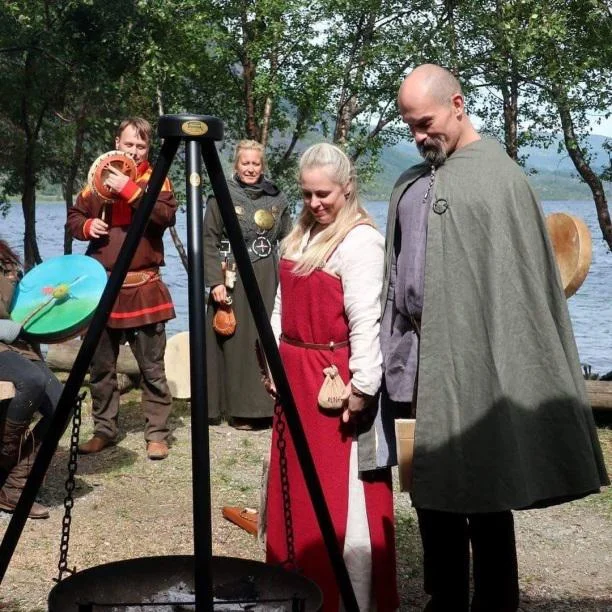
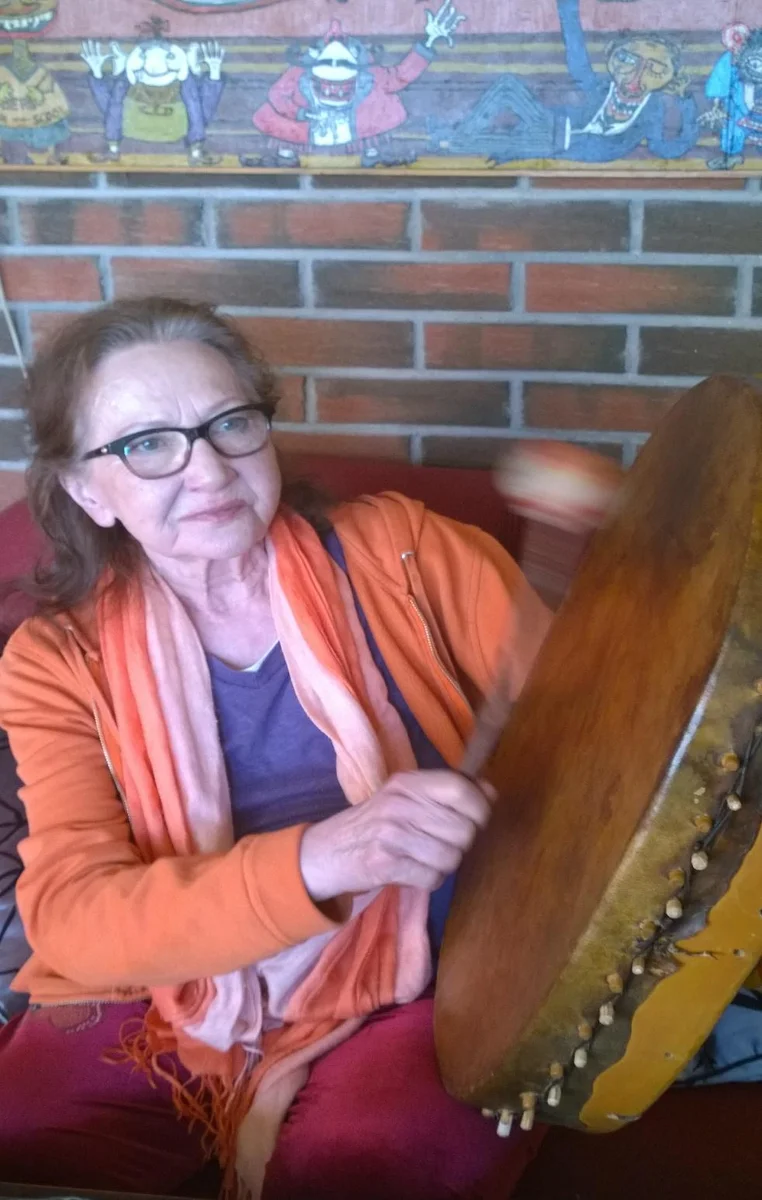
The meeting with Anita turns out to be very pleasant, and also instructive. When we arrive at her home, we are received with open arms by a warm and funny woman. Almost before we have managed to sit down and start the audio recorder, she begins to share with us. She wants to show us a way of "journeying." A journeying method that turns out to be unfamiliar to both of us. She wants one of us to try journeying, so it ends with Inger Lise journeying, while Anita drums and Cecilie shakes one of Anita's rattles. This became a powerful experience, and we are grateful that she shared this knowledge with us.
 .jpg)
.jpg)
Anita made this rattle of ox horn herself. It produced a special sound, which became like a blend of rattle and drum.
Anita tells us that it was she and Ailo Gaup who had explored this way of journeying together. They were often together, and she and Ailo had a special bond between them. We understand from the stories she tells that Ailo meant a great deal to her, and she to Ailo. But we knew that already, as Ailo is one of those who has spoken a great deal about her.
Anita is now 73 years old, and has practiced shamanism actively throughout her adult life. She comes from a family in Finnmark that has upheld the shamanic tradition for many generations. She grew up in Havøysund, with parents who were constantly contacted by people who needed help. Both in their home and by telephone. Her father helped people from all over the Karasjok area, and he cured many. Her mother was afraid of all this, but Anita says she was very clairvoyant. And she remembers that her grandmother was skilled at foretelling. Women came from far away to have their fortunes told.
Over the years, Anita has become known for her clairvoyance, her healing abilities, and her ability to help other people. She has had clients who come from all over the country to receive treatment from her. Beyond working with clients, she has also held courses and training for others, and she has been the principal of the Academy of Metaphysics. Today she still helps people by telephone from home.
We had given some thought beforehand to what it must have been like for Anita to be a female shaman in her time, and we asked her about precisely this – what it has been like to be a female shaman. Whether she has experienced it as positive or negative, whether she has experienced discrimination, unequal treatment, or the like. Anita tells us that an article was written about her in Norsk Ukeblad, and there they used the headline "Norway's only female shaman." She had herself asked them not to write this, but received the reply that they had investigated the community and found that she was the only woman who practiced the way she did. And the magazine was already out for sale when Anita discovered what they had written. She has kept this article with her at her stand when she has been at fairs, and she was anxious about how people would react after the article in the weekly magazine, but she has not heard anything negative. That people have talked about her behind her back, of that she is certain. And that many have not believed in her and the abilities she says she has. But she does not care about that.
Anita tells us that when she was younger, she was not interested in this herself. She found it difficult when the family was talked about in the local community. Her father was called a witch doctor, and people talked about her mother and grandmother. In addition, it was forbidden to be Sami at that time, to be Kven was a shame, and to be Finnish was no better. It was tough to be from a different kind of family and to stand out, so a lot of guilt and shame came with the upbringing. She was also subjected to the Norwegianization process that was in full force at that time.
But Anita experienced much that was inexplicable herself as she grew up, and eventually she understood that she too had abilities. She does not remember herself when she began helping others with her abilities, but she remembers that from an early age she had always had sympathy for people who struggled with various problems. Anita was quite young, before her teens, when she understood that she had abilities. The adults said she was a "difficult child" when the power within her awoke. Those her own age would often exploit her abilities once they discovered what she could do.
Anita tells us that she became preoccupied with why people became ill, what the underlying cause of illness was. She therefore chose to educate herself in order to gain knowledge about this. She is trained as a physical aromatherapist, NLP Master Practitioner, timeline therapist, and coach. She has, among other things, studied shamanism with many well-known shamans in Norway and abroad, the Inca traditions, the mysticism of the tarot, Arabic number magic, herbal medicine, and she has practiced Qi gong and danced 5 Rhythms for many years.
For those who work with clients, she tells us that she herself treats a client 3 times first, then has a conversation, and they agree to try a couple more times. If no change has occurred during these sessions, they agree to try a couple more times. After this, she refers them to another form of therapy, or to a doctor.
Many wish to see her for years, and this is most often because they want and need conversations as part of the treatment. Anita says she has spent a lot of time on many of her clients, and much of that time she has not charged for. She began by not charging, or charging low prices, but eventually found out that she could not live on buttons and trinkets. She also became unpopular among other practitioners because she charged such low prices. Today she says that it is perfectly fine to charge for the work one does, and especially when one has spent a lot of time on expensive training. But she does not approve of charging several thousand for a treatment.
She tells a story from the first fair she took part in. She remembers that she was terrified to take part, and that she had her reindeer horns lying on the table at the stand. One of the astrologers at the fair had come over to her stand together with a friend who was very skeptical. The friend had pointed at the horns and asked mockingly what she used them for. "For healing," she had answered cautiously. "Well then, you can take my shoulder, which hurts so much," he had continued in the same mocking tone. She had taken the horn and gently patted his shoulder 2-3 times, and said, "now it's done." She later heard that this man had gone around to several fairs afterward, asking for "the Sami woman who healed my shoulder." It turned out that this man was a doctor.
As a continuation of this story, Anita shares that she uses reindeer horn for healing, since they strengthen or extend the power and "draw out" what is wrong. And that she uses a lot of crystals and stones too, since they draw illnesses to themselves.
We as women have few older female shamans to turn to for advice and guidance in the community. So we took the opportunity to talk with Anita about whether she feels there is an imbalance between the sexes in any way in the practice of shamanism in Norway. Anita answers that she understands that we may carry a feeling that an imbalance exists, and that it is precisely because of this imbalance that she keeps away from the community. She says she can be quite tough when she gets going, and we understand it to mean that this has perhaps not always been well received among the men in the community. She goes on to speak about "the correct historical picture, in which it is said that it was women who originally practiced shamanism. That it is said, and has been written down, that the first to engage in shamanism and shamanic ceremonies were women. They disappeared, their drums were burned, and then it was quiet for a long time. And then it appeared again, but then it was men who had dressed in women's clothing who performed as shamans or noaidis. She tells us that she had mentioned this once when she was with Ailo, and that he had answered that then he understood why he had felt so feminine the first time he wore the gákti (Sami dress). So the question had come up regarding why the Sami men wore dress-like gákti. And, further, priests in cassocks, and so on.
It was good to raise this topic with Anita. Not to create distance and discord between the sexes by raising the subject and writing about it, but to create awareness in us of how we can address what we experience as challenging about being women in the shamanic community, and women who visibly practice shamanism in society today. Anita radiates such a sense of security and power, and it is inspiring and gives courage to those of us who follow in her footsteps.
Anita shared many stories with us during the hours we visited. She has unfortunately struggled a great deal with her health, especially over the past year. In connection with this, she has been on a rehabilitation stay at Valle. She shares an experience with us from the period she was there. Every afternoon/evening she received visits from Native Americans. They were gone during the day, but at a certain time later in the day they appeared. They were splendid, beautiful Native Americans, dressed in white. Every afternoon they opened their tent, came out, and stood around her. The last evening she saw them, they flew off, with white silk ribbons fluttering around them in the air. She thought it was so beautiful, and she had called out into the room, "Don't you see the Native Americans?" Those around her had laughed at her, for they of course saw no Native Americans. She has not seen the Native Americans since that time. She was told that she could not go with them when they flew off, that it was not her turn this time.
She tells us that she had many wonderful journeys while she was at Valle. Something that led to it being written in her records that "she easily slips into another state of mind." Anita laughs at this, and says that it would be strange if she didn't, when she has worked with such things her whole life.
Along the way, we also asked Anita whether she has any advice or guidance to offer those who are younger and who walk the shamanic path. Among other things, she mentions in the conversation that she learned early on, from both her father and her grandmother, that one should be careful about foretelling others' futures and giving clairvoyant messages. That it can influence the person one tells to make life choices that may not be in their best interest. She experienced this herself in her own life, when both her grandmother and her father gave her messages that she sees strongly influenced her.
We thank her for a very pleasant and instructive visit, and look forward to the next time we meet this wonderful shaman woman. We experience her as a powerful and humble woman, who perhaps does not quite understand that she has been important for shamanism in Norway. She has truly gone ahead and "cleared the way" for many of us who come after, by daring to be as open and visible as she has been.