Some of you may remember Regös from the Shaman gathering. Here is an interview with him. Regös does not speak English, so the interview is translated from Hungarian
My journey began in my childhood, although it was not conscious at the time. I was born in a village (Öskü) at the foot of the Bakony mountains in the Transdanubian highlands of Hungary, and I still live here today. I have loved nature since childhood, and it has always drawn me to it. I was 12 years old when I began to take an interest in indigenous peoples. That was when I made my first shaman staff. Part of this staff still exists today. Later we founded a historical archery association (Zúgó Nyilak Historical Archery Association). This association focused on reviving Hungarian traditions from the 10th century.
That is where I first held a shaman drum in my hands. My first encounter with the drum was decisive, because when I struck it, it made a deep impression on me. That was when I understood my childhood love of nature and the longing for the ancient. I had already written poems and song lyrics earlier, but this was reinforced by the influence of the drum. I have written around 500 poems and songs so far. I became increasingly interested in this subject and began to research ethnographic descriptions, mainly Asian shaman culture because of the origins of the Hungarians.
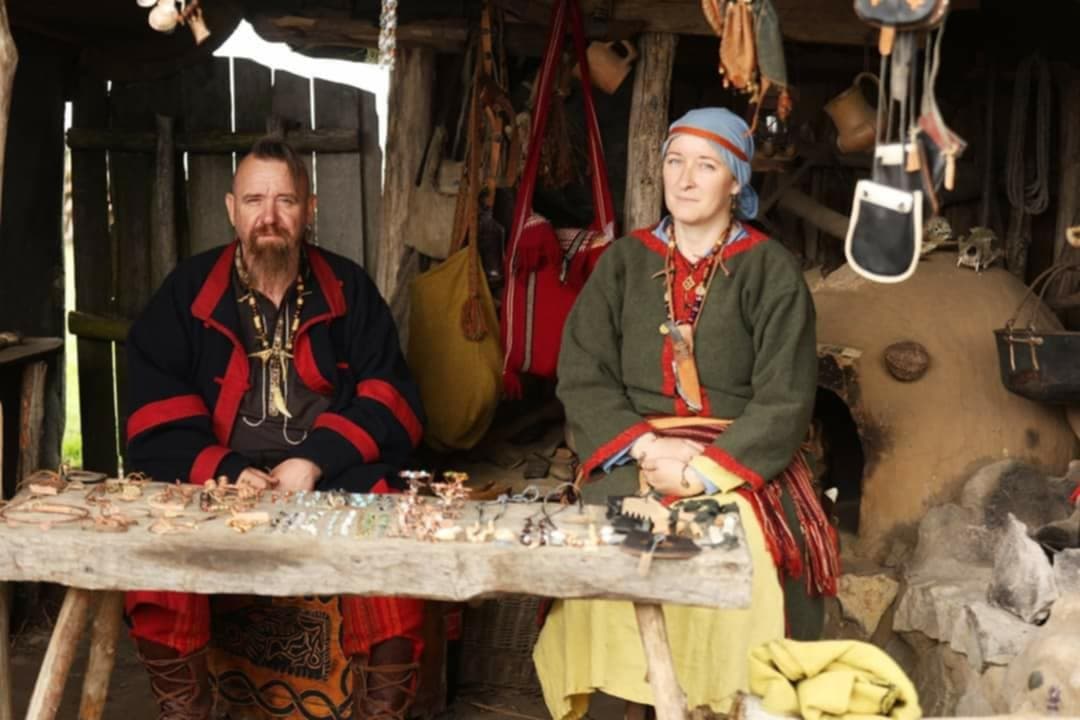
Today I also take part in archaeological excavations as a civilian helper in order to study this even more thoroughly. I consider myself a tradition-keeper because I try to live everyday life in this way. A foundation asked me to take part in the construction of a 20th-century village. I took part in more and more archaeological excavations, and through this I learned more and more. I would like to say about myself: I do not consider myself a shaman or a "táltos" (Hungarian shaman). I see myself as a "regös" (a traditional Hungarian singer and storyteller), but I also work with shamanic elements and practices. I both research it and live it. I believe one has to be born to be a shaman, but I will write more about this later. I would also like to say about the shamanic world that many people mistakenly call it a religion, but I believe it cannot be called a religion, rather a way of life or a worldview, an outlook on the world.
How would you characterise the role of shamanism in Hungary today compared to earlier times?
Today Christianity is the official religion in Hungary. Unfortunately the shamanic worldview disappeared or was partly transformed after the introduction of Christianity. In modern times this movement has re-emerged with varying degrees of success. I would divide it in two: One part is the esoteric approach, where traditions, cultures, eras and religions are mixed - in short, "New Age". Unfortunately there is more of this. The problem with this direction is that it partly ignores research findings and partly adapts the offering to demand, so that the essential message is lost. The other, which follows the path of tradition, is more difficult because if you want to remain authentic, it requires thorough research work. Tradition is not always flexible; it depends on the person.
What similarities and differences do you see between Hungarian shamanism and shamanic traditions in other parts of the world?
My answer is partly contained in the answer to the previous question. If we look at the "New Age" line, the mixture produces interesting similarities. If we approach it from the side of tradition, we can first and foremost say that the shamanic attitude to life itself developed from the thinking and experiences of natural peoples, so here I discover many similarities, primarily the dependence on nature, which determines our lives and on which our lives depend. Seen from this perspective, the elements of life (fire, water, earth, air) show similarities. Furthermore, natural phenomena also show similarities (mountains, wind, sun, moon, lightning, living beings that occur in nature, plants, animals, etc.), in short, the centring on nature.
What role do you think shamanism can play in facing modern challenges, such as environmental problems and the management of mental health?
At the moment I see no significant influence on the world when it comes to environmental problems. The economic factor is so strong that we small people cannot act effectively against it. In the future it depends on whether groups with a similar mindset can connect and show significant strength in the protection of nature. But the road there is long, and there is a lot of work behind it. But anything is possible. A modern widespread illness is stress and depression as a result of lifestyle, and within this theme shamanic practices could be used effectively.
How does your experience as a musician and artist influence your shamanic practice, and vice versa?
I think I owe this ability to it. It gives me the imagination, the intuition, the core; of course there is learned knowledge alongside it too, but the capacity for intuition is quite strong in me.
Can you tell us about concrete ways in which you integrate music and art into your shamanic rituals and ceremonies?
My whole life revolves around this; it is my faith, it is part of my everyday life, I have even furnished my home this way, so we always hold festivals (winter solstice, summer solstice, spring equinox, autumn equinox) or rituals. For example, at the winter solstice celebration we keep vigil from sunset to sunrise. It is primarily drum, song and throat singing that are present in my ceremonies; in addition I also play string instruments (koboz, dombra) and wind instruments (kaval, tilinkó). Through these I try to come as close as possible to the authentic soundscape
What role does traditional Hungarian music and art play in your approach to shamanism?
Hungarian folk music is very diverse and far-reaching. As far as I know, more than 20,000 hours of material have been collected and digitised. That is enormous! The Carpathian Basin is divided into five regions also from a folk music perspective, and each region has its own characteristics (from a musical point of view). Over time folk music has changed a great deal, because the Hungarians have also been exposed to many external influences. That is why it is very difficult to search for shamanic elements in Hungarian folk music. It is possible that one can find something, but one can rather discover the ancient in it, as in the folk music from Moldova.
How do you use creative forms of expression to convey shamanic concepts and experiences to a modern audience?
If the internet counts as this, then I publish some of my things there, such as on my website (regosjoco.hu), or on the YouTube channel (Regös Sziránszki József), SoundCloud, or perhaps Facebook. But what I want to get people to understand is that we should strive for personal relationships, personally experienced things, because that is what gives lasting experiences. That is why I am happy to meet and talk with people, or they can even visit me at home (of course it is necessary to arrange this in advance).
Have you had any visions or spiritual experiences that have directly inspired your art or music?
I think that some of my songs and poems were created in this way, but most of my craft comes about like this. Not long ago I made a shaman costume for myself, which I worked on for four months. I made everything by hand, and this also came from such a vision. I also have some songs that were created in a similar way.
It is also difficult to answer this: For what do we mean by modern art? Avant-garde art? Or a more conservative art of our time? If by modern we mean today's digitised modern art, then I do not look for any connection between the two. Although personally I keep myself quite far away from overly modern things.
Can contemporary art be a conveyor of shamanic experiences?
I think it can be. Let us look at my case. My songs are partly about remembering and honouring the past. Sometimes this creates feelings in the audience as if they were written and preserved a thousand years ago, transporting them to the past. But they were written in our time. Seen that way, I am also a contemporary artist.
Have you collaborated with other musicians or artists to create works inspired by shamanism?
Yes, there have been some initiatives, and one that was actually realised. The band's name is Kama Tarkhan. Can you tell us about these experiences? This band mixed the shamanic worldview with today's music world. We had fantastic concerts. The sound and style resembled a band famous today called "Vágtázó Halottkémek" (Galloping Coroners).
How do you balance the role of preserver of shamanic practices with the role of innovative artist?
Actually I integrate these elements and symbols into all my works, not only shaman symbols, but also Asian Scythian symbols.
What significance do Hungarian nature and landscape have in your art and shamanic practice?
Hungary today is a densely populated area, full of magical places, but the ones that touch me most are always the untouched areas. Unfortunately such untouched areas are rare here in Hungary. But the country is full of historical memories and sacred sites. When I can, I go out into nature. I regard nature as my parents.
Do you have any thoughts on how modern technology can be used in connection with shamanic practices or to convey shamanic ideas?
I do not want modern technology to interfere in this shamanic world, even though it is already there, since this is present on the internet and various video-sharing channels. If you are thinking of practices, then I do not want that; in fact I would encourage everyone to be brave and seek out their fellow human beings, talk together and spend meaningful time together.
How do you view the relationship between personal creativity and the traditional aspects of shamanism?
According to my belief, everything is connected to everything, everything depends on everything. So my personal creativity also depends on the moral order of the ancient world, which I strongly project onto today's world as well. For me it is important to hold on to and remember the past, for if we do not know who we are and where we come from, we cannot adequately determine the direction forward.