Kven and Forest Finn shamanism represent unique traditions within Finno-Ugric culture that have existed in Norway. These traditions have roots in pre-Christian times, but have also been influenced by the encounter with Norse and Sami culture.
Central Gods and Goddesses
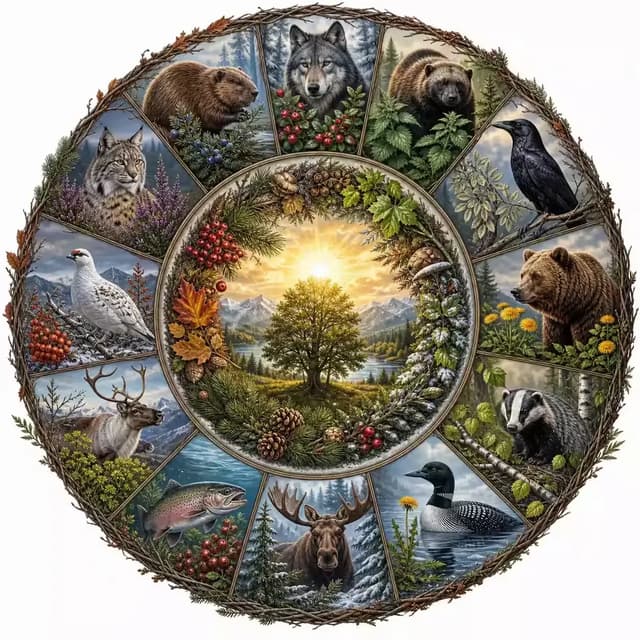
In both Kven and Forest Finn shamanism we find references to several central gods and goddesses from Finnish mythology:
Ukko: The supreme god, god of the sky and thunder.
Akka: Ukko's wife, goddess of the earth and protector of women and fertility.
Tapio: The god of the forest, protector of hunters and animals.
Mielikki: Tapio's wife, goddess of the forest and protector of wild animals and plants.
Kven tradition
The Kven are a Finno-Ugric minority group who have lived in Northern Norway for several hundred years. Kven shamanism has many similarities with Sami and Finnish shamanism, but has also developed its own distinctive features. Central elements include:
Use of the rune drum (kannus): To enter a trance and communicate with the spirit world.
Sacred places in nature: Such as sacrificial stones (sieidi) where offerings were made.
Belief in nature spirits and ancestor spirits: Spirits that protected and guided the community.
Healing rituals and divination: Rituals to heal illnesses and predict the future.
Forest Finn tradition
The Forest Finns are descendants of Finnish immigrants who settled in the forest areas of Eastern Norway in the 1500s and 1600s. Forest Finn culture has preserved several elements that can be linked to older Finno-Ugric traditions
Use of the sauna for purification and well-being
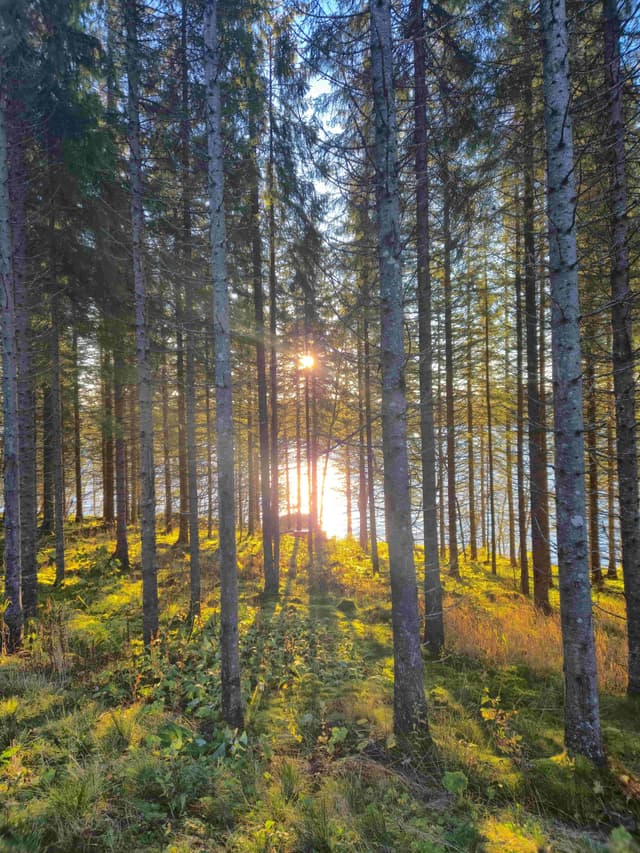
Belief in forest spirits and other nature beings
Traditional formulas and incantations
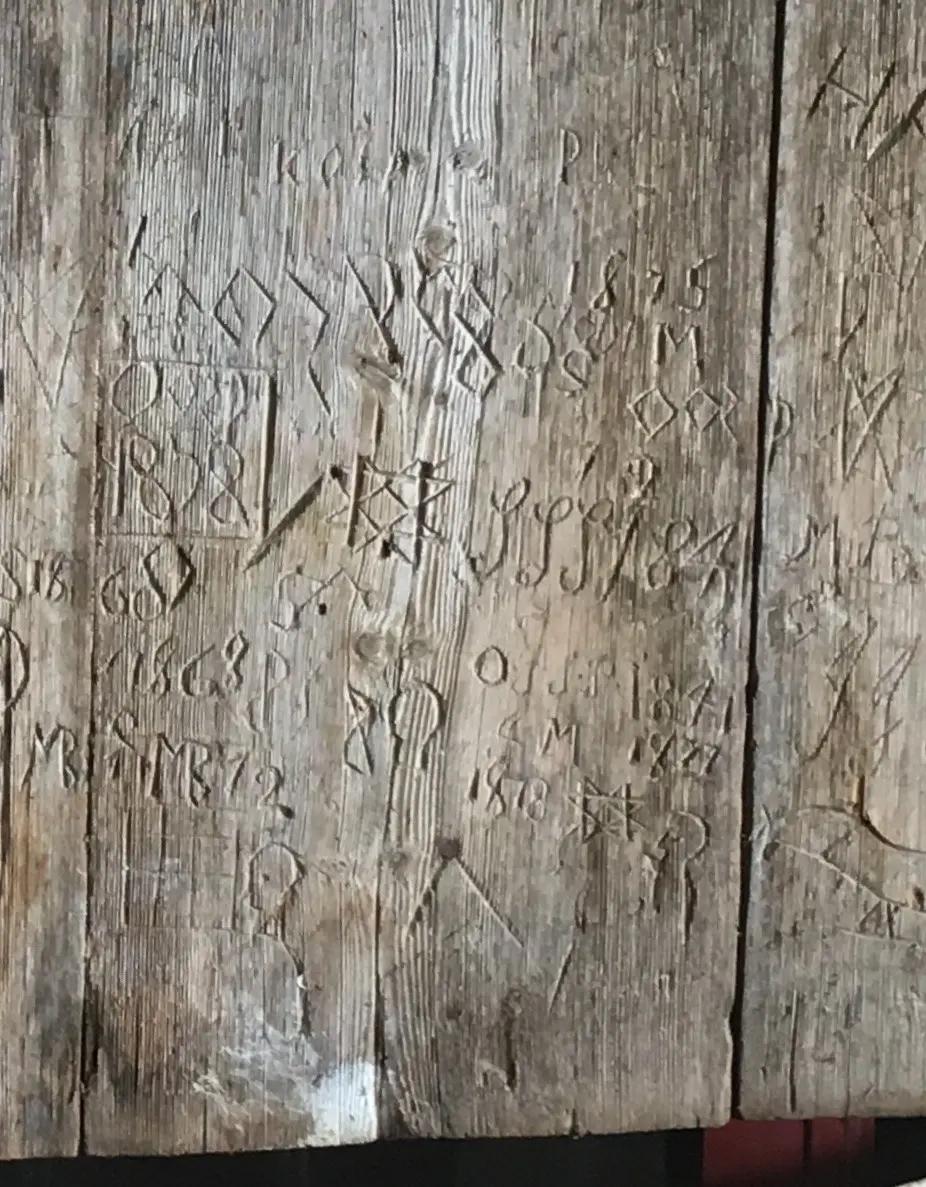
The barn at Peistorpet
Photo: The Directorate for Cultural Heritage The barn at Peistorpet, also known as Piesala, is a unique cultural monument that represents an important part of the Forest Finn cultural heritage in Norway. This barn, located deep in the forest near the Swedish border, is covered with a rich diversity of magical symbols carved into the walls. These symbols are a rare and valuable manifestation of the Forest Finns' nature belief and magical practice, with roots in Finno-Ugric shamanism and Finnish mythology. The symbols had a protective function and were carved into valuable buildings to protect them and their contents. The Directorate for Cultural Heritage has recently protected the barn in order to preserve this unique part of Norwegian cultural heritage. The protection ensures that the magical symbols are preserved as living conveyors of Forest Finn nature belief, and gives us the opportunity to experience and learn about an almost erased part of Norwegian history.
Modern research and revitalisation
Kjell Gove In recent times there has been a growing interest in exploring and revitalising these cultural elements as part of Kven and Forest Finn identity. Sjamanistisk Forbund has a ceremony leader, Kjell Gove, who is actively researching Kven and Forest Finn shamanism. His work helps shed light on these traditions and their place in modern Norwegian culture.
Sjamanistisk Forbund has also published a ceremony book that represents a collected body of knowledge about ceremonies based on various forms of shamanism in Norway, including Kven and Forest Finn traditions. This book is the result of ten years of work and helps to preserve and pass on these traditions.
It is important to note that much of the knowledge of these traditions has been lost through centuries of assimilation and cultural suppression. Research in these areas, including the work of Kjell Gove and others in Sjamanistisk Forbund, is ongoing, and our understanding of Kven and Forest Finn shamanism and folk religiosity continues to develop as new studies are carried out.
Much of Kven and Forest Finn culture has been lost through the Norwegianisation process, but there has been a growing interest in revitalising these traditions. The Directorate for Cultural Heritage, in cooperation with Forest Finn organisations, has ensured that a selection of Forest Finn cultural monuments are protected, such as the barn at Peistorpet with its magical symbols.
Rydving, H. (2010). "Tracing Sami Traditions: In Search of the Indigenous Religion among the Western Sami during the 17th and 18th Centuries". Instituttet for sammenlignende kulturforskning.
Pentikäinen, J. (2007). "Golden King of the Forest: The Lore of the Northern Bear". Etnika.
Kulturminnefondet. (2021). "Skogfinske kulturminner". https://kulturminnefondet.no/skogfinske-kulturminner/
Sjamanistisk Forbund. (2022). "Seremonibok". https://www.sjamanforbundet.no/seremonibok
Riksantikvaren. (2023). "Fredning av låven på Peistorpet". https://www.riksantikvaren.no/siste-nytt/fredning-av-laven-pa-peistorpet/
Wedin, M. (2007). "Den skogsfinska kolonisationen i Norrland". Finnbygdens Förlag.
Niemi, E. (2010). "Kvenene: Fra innvandrere til nasjonal minoritet". Orkana Akademisk.
Solbakk, J.T. (2007). "Árbevirolaš máhttu ja dahkkivuoigatvuohta". Sámi Allaskuvla.
Pulkkinen, R. (2014). "Suomalainen kansanusko: samaaneista saunatonttuihin". Gaudeamus.
Siikala, A-L. (2002). "Mythic Images and Shamanism: A Perspective on Kalevala Poetry". Suomalainen Tiedeakatemia.