Shamanism has deep roots in both Sami and Norse culture, where female shamans have played significant roles, even though their contributions have often been understated in historical sources. A comparative analysis of female shamans in these traditions provides valuable insight into pre-Christian spirituality in the Nordic region and its development over time.
In Sami society, the noaidi (shaman) was a central figure, and female noaidis held an important place. They were considered to possess special abilities related to healing, childbirth and women's health, but their role was not limited to these areas. Female noaidis could also perform rituals and practices that were traditionally associated with male shamans, such as leading important ceremonies and communicating with powerful spirits.
In Norse culture we find the völvas, who in many ways can be compared to female shamans. The völvas were highly respected seeresses who practised seid, a form of magic that has many features in common with shamanic practices. They were consulted for divination, healing and for influencing fate.
In both Sami and Norse culture, women generally held a stronger position in society compared to many other contemporaneous cultures. This is reflected in their religious and spiritual roles. Women had rights related to property, divorce and inheritance, and could hold significant positions in society.
Trude Fonneland, professor at Tromsø Museum, has through her research shed light on the importance of female shamans in both Sami and Norse tradition. She points out that women's role in shamanic practices has often been overlooked or downplayed in historical sources, partly because of Christian influence and the male missionaries who recorded much of the early history of Nordic shamanism. There may be several reasons for this downplaying.
The influence of Christian missionaries: From the Middle Ages onwards, it was mainly Christian missionaries and clergy who documented shamanic practices in the Nordic region. Their perspective was often shaped by a Christian worldview that could lead to misinterpretations or deliberate devaluation of women's roles in shamanic practices.
Male-dominated historiography: Most of the authors and explorers who documented shamanic practices were men, which often resulted in a male perspective and focus in the sources.
Cultural and religious limitations: In many Nordic societies, women had limited access to public religious roles, especially after the arrival of Christianity. This may have reduced their visibility in shamanic practices that were observed and recorded.
Misunderstandings and prejudices: Christian observers may have misunderstood or overlooked women's roles because of their own cultural and religious prejudices. Shamanic practices performed by women may have been interpreted as "witchcraft" or "sorcery" and thus condemned or ignored.
Focus on male shamans: In some Nordic cultures, male shamans were more visible in public rituals, while female shamans may have had more private or domestic roles that were less visible to outside observers.
Language barriers: Terms used to describe female shamans in Nordic languages may have been overlooked or misinterpreted in translations and records made by Christian missionaries who often did not fully master the local languages.
Christian influence on local cultures: The arrival of Christianity in the Nordic region often affected local cultures and reinforced patriarchal structures, which may have marginalised female shamans further.
Loss of oral traditions: Much knowledge about female shamans in the Nordic region may have been passed on orally and lost over time, especially after the introduction of Christianity and the suppression of traditional practices.
Recent archaeological finds and re-analyses of historical sources have begun to cast new light on women's importance in both Sami and Norse shamanism. Grave finds of women with shamanic objects have challenged earlier assumptions that the shaman's role was primarily reserved for men in both cultures.
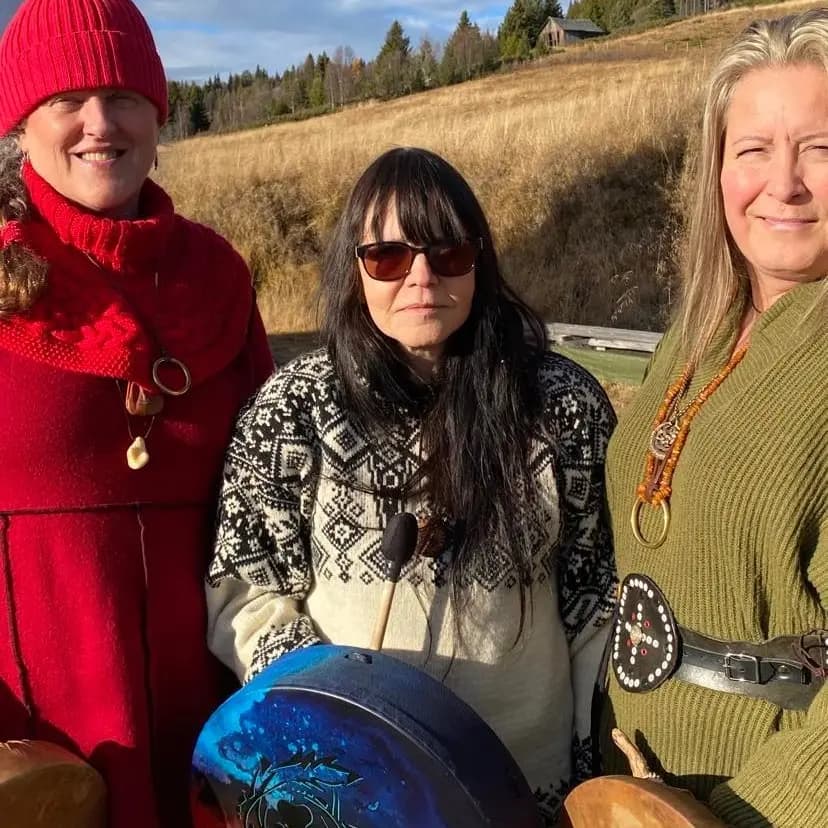
In modern times there has been a revitalisation of shamanic practices in both a Sami and a Norse context, and women have played a central role in this movement. Sjamanistisk Forbund, founded in 2012, represents a modern interpretation of these traditions and emphasises both Sami and Norse elements.
It is interesting to note that the modern shamanic movement in Norway has seen a gradual development towards a more distinct Sami and Norse version of shamanism. This can be seen as a form of cultural rediscovery and a recognition of the local traditions that included strong female shamanic roles.
Compared with the role of women in pre-Christian Scandinavia, where they held considerable power and influence, especially within the spiritual domain, we see that modern shamanic movements strive to restore some of this balance. Women in today's shamanic movements often take leading roles as healers, teachers and spiritual guides, in many ways reflecting the position of the old völvas and noaidis.
The exploration of the role of female shamans in both Sami and Norse tradition provides valuable insight into the development of spiritual practices and gender roles over time in the Nordic region. It also underlines the importance of including diverse perspectives and experiences in our understanding of historical and contemporary religious movements. By acknowledging and studying the importance of the female shaman in both cultures, we gain a more complete picture of Nordic shamanism and its place in both a historical and a modern context.
references
Fonneland, T. (2017). Contemporary Shamanisms in Norway: Religion, Entrepreneurship, and Politics. Oxford University Press.
Price, N. (2002). The Viking Way: Religion and War in Late Iron Age Scandinavia. Uppsala University Press.
Heide, E. (2006). Gand, seid og åndevind. Bergen: Universitetet i Bergen.
Rydving, H. (1993). The End of Drum-Time: Religious Change among the Lule Saami, 1670s-1740s. Uppsala University Press.
Bäckman, L., & Hultkrantz, Å. (1978). Studies in Lapp Shamanism. Stockholm Studies in Comparative Religion.
Blain, J., & Wallis, R. J. (2000). The 'Ergi' Seidman: Contestations of Gender, Shamanism and Sexuality in Northern Religion Past and Present. Journal of Contemporary Religion, 15(3), 395-411.
Dubois, T. A. (1999). Nordic Religions in the Viking Age. University of Pennsylvania Press.
Mundal, E., & Steinsland, G. (1989). Kvinner og medisinsk magi. In Kvinnors rosengård, 97-121.
Solli, B. (2002). Seid: Myter, sjamanisme og kjønn i vikingenes tid. Pax Forlag.
Fonneland, T. (2010). Samisk nysjamanisme: i dialog med (for)tid og stad. Din: Tidsskrift for religion og kultur, (1-2), 6-26.
Kraft, S. E. (2015). Sami Indigenous Spirituality: Religion and Nation-building in Norwegian Sápmi. Brill.
Ahlbäck, T., & Bergman, J. (1991). The Saami Shaman Drum. Almqvist & Wiksell International.