In the rich and complex world of Norse mythology, Odin, the all-knowing and mysterious god, is a figure who is forever seeking wisdom and insight. His many names, roles, and dwellings reflect his deep connection to the cosmos and the spiritual. While Valhalla is the most famous of his halls, there are also two other significant places: Sokkvabekk and Valaskjalf. These halls are not merely physical spaces, but also symbolic representations of Odin's quest for knowledge and his role as a shamanic figure.
Odin as shaman
Before we delve into the details of Sokkvabekk and Valaskjalf, it is important to understand Odin as a shamanic figure. Shamanism is about being a bridge between worlds – between the earthly and the divine, between the conscious and the unconscious. Odin is an archetypal shaman; he sacrificed his own eye to drink from Mimir's well and attain wisdom, he hung himself upon Yggdrasil to learn the secrets of the runes, and he travels between the nine worlds to gather knowledge. His ability to transform himself, to communicate with spirits (such as Huginn and Muninn), and to use magical techniques makes him one of the most prominent shamanic figures in Norse mythology.
Valaskjalf
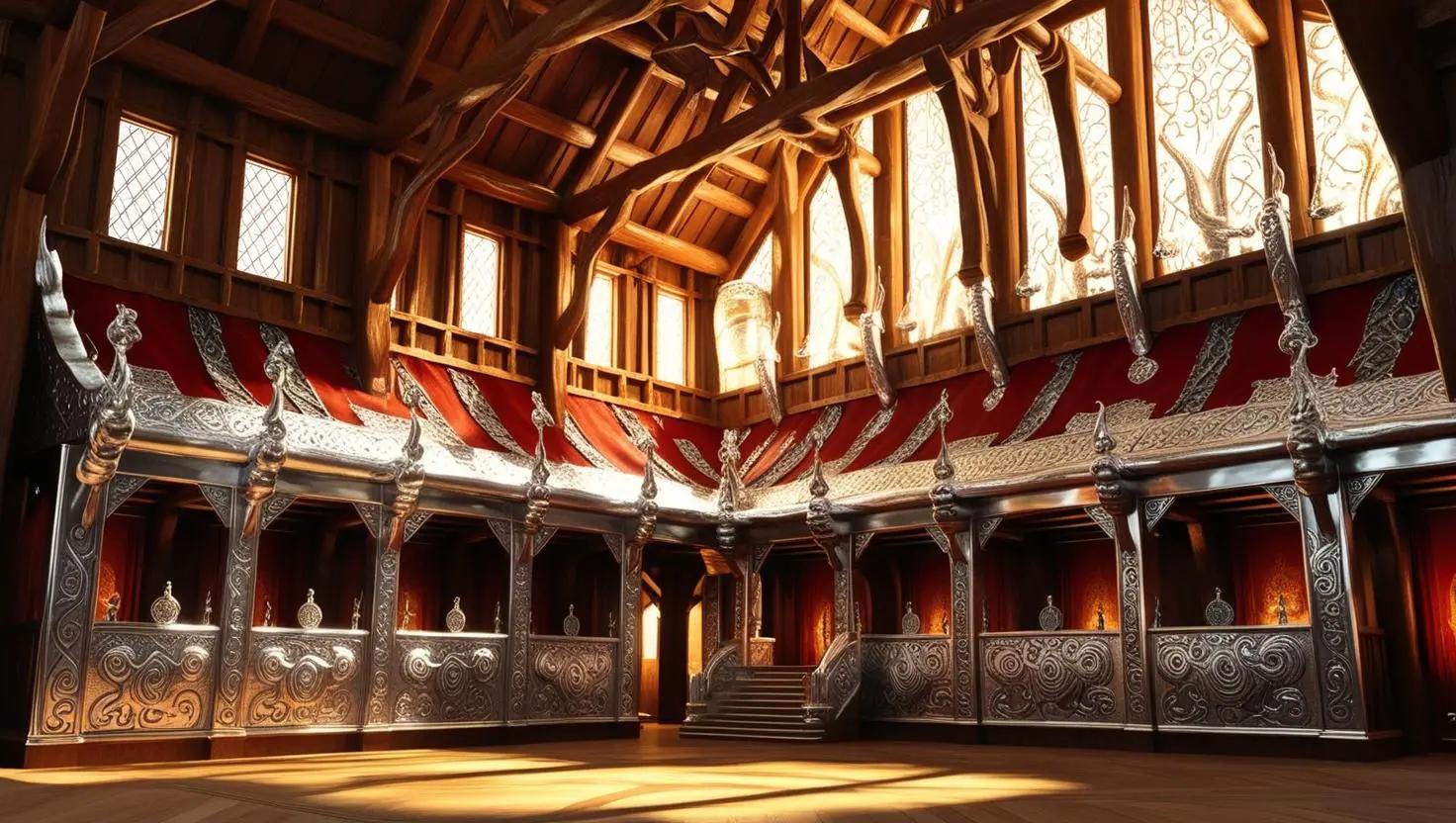
Valaskjalf, which can be translated as "The Shelf of the Slain", is one of Odin's most mysterious halls. It is built of silver and contains Hlidskjalf, the high throne from which Odin can look out over all the nine worlds. This hall is described in several Norse texts, among them Grímnismál from the Poetic Edda:
"From Hlidskjalf I saw
the world teeming with fates,
every thread in Urd's weave
trembling like an incantation."
Valaskjalf is not merely a physical place; it is also a symbol of Odin's ability to observe and understand the deepest secrets of the universe. Hlidskjalf functions as a kind of cosmic observatory from which Odin can look into the weave of fates – the same weave the Norns spin at Urd's well.
Valaskjalf, with its silver-clad splendor and the majestic throne Hlidskjalf, is first and foremost known as Odin's dwelling and observation post. From here he can look out over all the nine worlds. But Valaskjalf also serves as a place where other gods gather to discuss cosmic questions and make crucial decisions.
Frigg, Odin's wife, is often present in Valaskjalf. She shares Hlidskjalf with Odin in certain myths, as in the tale of Geirrod and Agnar. Here she uses the throne to observe the world and take part in Odin's strategies. Frigg's role in Valaskjalf underscores her status as a wise woman and an important counselor to Odin.
In another myth, Freyr sits on Hlidskjalf and looks out over the nine worlds. He catches sight of Gerdr, a beautiful giantess, in Jotunheim. This sight awakens an intense love in Freyr, leading him to send his servant Skirnir to win her. This story shows how Valaskjalf can also be a place of personal discovery and fateful encounters.
Although Loki is not directly mentioned as a guest in Valaskjalf, he often plays an indirect role in the myths connected to the hall. For example, Odin uses Hlidskjalf to find Loki after Balder's death, when Loki has gone into hiding following his treacherous deeds.
Valaskjalf is therefore not only a place for Odin's own observations, but also a forum where other gods may use the throne or take part in decision-making processes that affect the entire cosmos.
From a shamanic perspective, Hlidskjalf can be interpreted as a tool for astral projection or deep meditation. Shamans often use various techniques to reach trance states in which they can "travel" to other worlds or gain insight into hidden truths. Hlidskjalf grants Odin this ability on a divine level. The silver that covers the hall can also be interpreted symbolically; silver has often been associated with the moon, intuition, and reflection – qualities that are essential to both shamanism and Odin's role as a seeker of wisdom.
Sokkvabekk
Sokkvabekk, which means "The Sinking Stream", is another of Odin's halls. Here he meets Saga, the goddess of history and stories, every day to drink from golden cups while the water murmurs beneath them. In Grímnismál, Sokkvabekk is described thus
"Sokkvabekk flows quietly;
there Odin sits with Saga
each day beside the waves
while golden cups are filled."
Saga, a lesser-known goddess in Norse mythology, has been interpreted by many scholars as another name for Frigg, Odin's wife and the foremost among the goddesses. This interpretation rests on similarities between their roles, dwellings, and mythological descriptions. Saga is associated with the hall Sokkvabekk, where she and Odin drink from golden cups while cooling waves flow beneath them. Frigg, for her part, dwells in Fensalir, a hall that is also described as rich in water.
Sokkvabekk represents an entirely different side of Odin than Valaskjalf. While Valaskjalf is about external observation and control, Sokkvabekk is about introspection and reflection. Here Odin shares knowledge with Saga, who, as her name suggests, is connected to stories and memories. The golden cups they drink from can be interpreted as symbols of the source of wisdom – perhaps a parallel to Mimir's well or other mythological sources of knowledge.
From a shamanic perspective, Sokkvabekk can be seen as an arena for ritual introspection. The water that flows beneath the hall symbolizes the flow of time and the cycle of life – elements that often play central roles in shamanic ceremonies.
A duality
Valaskjalf and Sokkvabekk represent two sides of Odin's quest for knowledge: external versus internal wisdom. In Valaskjalf he looks out over the universe, observes fates, and makes decisions based on what he sees. In Sokkvabekk he turns inward, reflects on the flow of time, and shares stories with Saga.
This duality is also central to shamanic practice. Shamans must balance between external observation – understanding the world around them – and inner introspection – understanding themselves and their place in the cosmos. Odin masters both of these aspects through his halls.
The story of Geirrod
Frigg challenged Odin to test King Geirrod's hospitality, since she believed he was cruel to strangers. Odin sat upon Hlidskjalf to observe the king's actions, but decided to go further than mere observation – he chose to become part of the situation by donning the disguise of Grimnir.
As Grimnir he was captured by Geirrod's men and tortured for several days between two fires. In the end he was helped by Prince Agnar, Geirrod's son, who gave him water from his own horn. This activated Grimnir's true nature; the fire tore away his disguise, and Odin revealed his divine identity with thunderous power.
This story shows how Hlidskjalf grants not only insight, but also the possibility of direct intervention through transformation – an ability that strongly recalls shamans' use of trance states to influence the world around them.
Shamanic techniques reflected in Odin's halls
Valaskjalf and Sokkvabekk contain several elements that resonate with shamanic practice
Vision journeys: Hlidskjalf's function as an observation post resembles shamans' use of drums or other techniques for astral projection.
The symbolism of the elements: The flow of water beneath Sokkvabekk represents the cycle of time; the silver in Valaskjalf reflects light (intuition).
Transformation: Odin's ability to change form (as Grimnir) recalls shamanic rituals in which one "becomes" one's power animal or spiritual guide. So-called shapeshifting (hamskifte).
Cosmic balance: The duality between external observation (Valaskjalf) and inner introspection (Sokkvabekk) mirrors the balance between bodily action and spiritual understanding.
Odin's halls Valaskjalf and Sokkvabekk give us deep insight into his role as both warlord and hunter of wisdom – but perhaps even more importantly, they show us his nature as a shamanic figure. Through Valaskjalf he observes the fates of the universe from his high throne Hlidskjalf; through Sokkvabekk he shares stories with Saga while the water murmurs beneath them.
These halls represent two sides of the quest for wisdom: external control over the cosmos versus introspective reflection on the flow of time. Together they give us a picture of Odin not only as a divine ruler, but also as a bridge-builder between worlds – just as the shaman functions in traditional cultures.
Source references
Grímnismál (The Poetic Edda)
Snorri Sturluson: Gylfaginning (The Prose Edda)
Lindow, J. (2001). Norse Mythology: A Guide to the Gods, Heroes, Rituals, and Beliefs
Simek, R. (1993). Dictionary of Northern Mythology
Hultgård, A. (2017). "Odin shamanicus" in Shamanism and Northern Ecology
Vikingr.org (2023). Hlidskjalf and Valaskjalf: The High Seat and Hall of Odin
Mythopedia (2023). Odin: The Allfather in Norse Mythology
Germanic Mythology Project: The Poetic Edda: Grímnismál