Sámi culture and tradition has a rich heritage of myths and stories that explain the origin of the world and of humankind. These creation stories vary between different Sámi groups and geographical areas, and they often reflect the natural surroundings and ways of life of the people who have preserved them.
The children of the sun and the earth
One of the most widespread Sámi creation stories involves the sun (Beaivi) as the father and the earth as the mother of all life. This myth forms the basis of a cosmology in which everything in nature is related and connected. In some versions of this myth, the son of the sun is the ancestor of the Sámi, which underscores the close relationship between the Sámi people and the forces of nature.
This creation story reflects a deep respect for nature and an understanding of humanity's place in the larger ecological context. It stands in contrast to more anthropocentric worldviews, and instead promotes an ecocentric perspective in which the human being is an integral part of nature.
Gabba, the white reindeer
Another fascinating Sámi creation story concerns Gabba, the white reindeer. This myth, which is especially well known among the Northern Sámi, tells of how the world was created through the sacrifice of a sacred animal.
According to this account, the Great Spirit, Ipmil, called upon his son Beaivi (the sun) and asked him to bring Gabba, the white reindeer, down from the heavens. Gabba was then sacrificed, and various parts of its body were used to create the elements of the world:
The antlers became a bridge between the underworld and the upper world
The bones formed the skeleton of the earth, the mountains and the cliffs
The fur became vegetation and trees
The blood became rivers and lakes
The eyes became the morning star and the evening star
The skull became the vault of the heavens
The heart was placed at the core of the earth
This myth illustrates the deep connection between the reindeer and the Sámi people, as well as the idea that everything in nature is connected and has a sacred origin. It also emphasises the importance of sacrifice in Sámi cosmology and ritual practice.
The creation of the human being
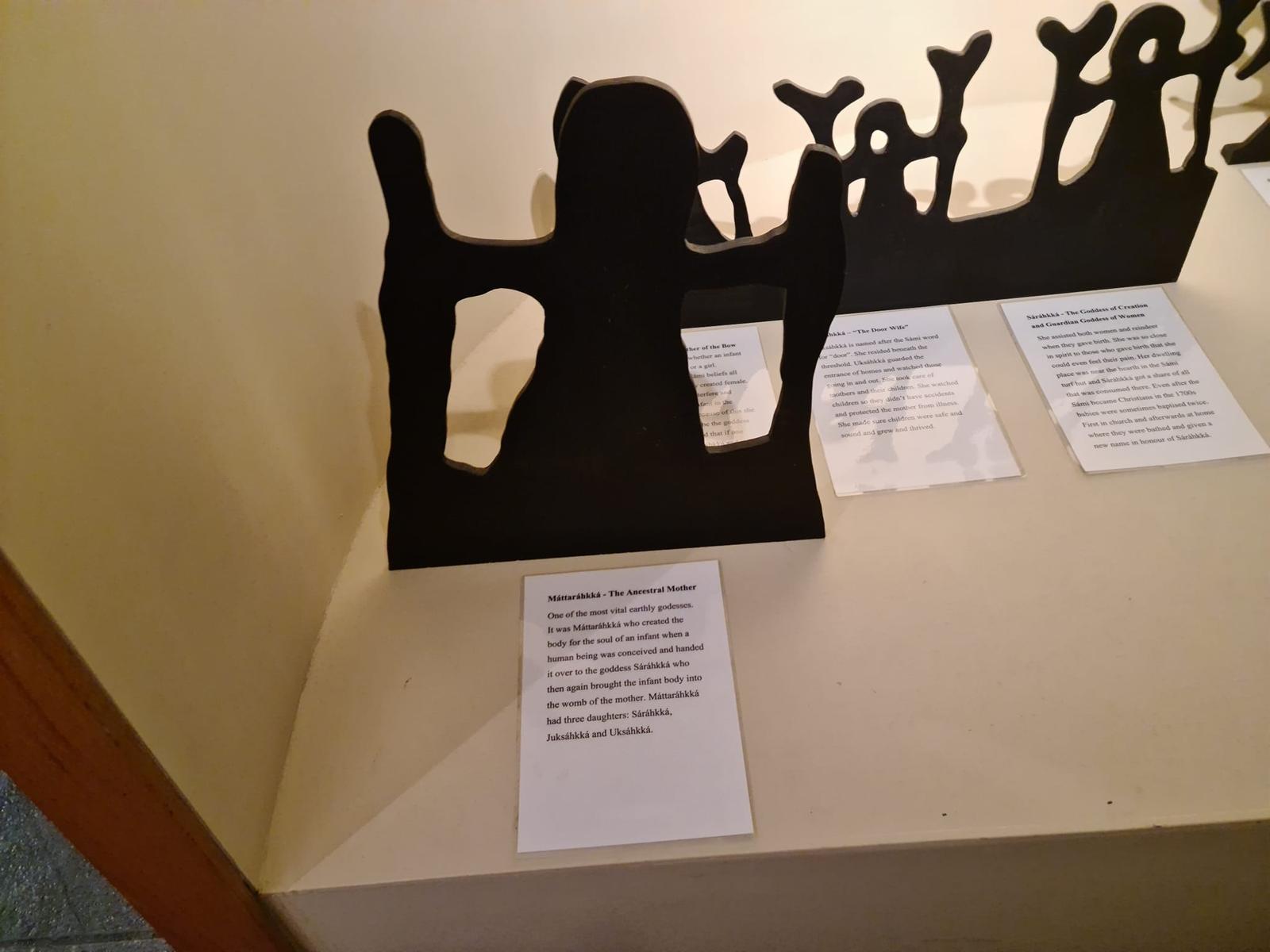
As for the creation of the human being, there is a detailed Sámi myth that involves several deities. This myth, which is especially well documented, describes a complex process in which various deities contribute to the creation of a new human being:
Raedie (the Ruler) gives power to his son Tjåervieraedie (the Horn Ruler) to create a soul.
The soul is handed over to Maadteraahka (the Primal Mother), who creates a body around it.
Maadteraahka gives the embryo to Maadteraaja (the Primal Father).
Maadteraaja carries the embryo in his belly and travels around the sun on its rays.
The embryo is handed over to one of Maadteraahka's daughters to determine its sex:
Saaraahka (the mother of fire and of birth) creates girls
Jueksaahka (the Bow Mother) creates boys
The foetus is given to the earthly woman who is to give birth to the child.
When the birth draws near, Saaraahka and Maadteraahka come to help.
After the birth, Oksaahka (the Door Mother), the third of Maadteraahka's daughters, steps in as the child's protector.
This myth reveals a complex understanding of the creation process and emphasises the importance of both male and female deities in bringing forth new life. It also reflects the Sámi belief that every human being has both a heavenly and an earthly nature.
The son and daughter of the sun
Another important Sámi creation story involves the son and daughter of the sun. This myth, known from several Sámi areas, tells of how the children of the sun explore the world and create new peoples:
The sun and the earth existed first, as the father and mother of all life.
The sun and the earth had a son and a daughter.
The son of the sun set out to explore the world and found a land beyond the sun and the moon.
In this land he met a girl from the giant people.
The son of the sun mixed his blood with the giant girl and created the Gállá-bártnit, the hunting sons, the ancestors of the Sámi.
The Gállá-bártnit later rose up to the heavens and became stars.
This myth explains not only the origin of the Sámi, but also their connection to the starry sky. It shows an openness to other creative forces in the universe and an understanding that the Sámi have a special, divine descent.
Regional variation in Sámi creation stories
It is important to note that Sámi creation stories can vary considerably between different regions and Sámi groups. Some examples of regional variations include:
Northern Sámi areas
In the Northern Sámi areas, which encompass parts of Northern Norway, Northern Sweden, and Northern Finland, the sun (Beaivi) is often central to the creation stories. Here we find myths such as the one about Gabba, the white reindeer, and accounts of how the reindeer came to earth along the rays of the sun.
Southern Sámi areas
In the Southern Sámi areas, which stretch from Trøndelag in Norway to Dalarna in Sweden, one can find variants of creation stories that place greater emphasis on the role of the earth in creation. Here one can also find myths involving Horagállis (the thunder god) in the creation process.
Eastern Sámi areas
In the Eastern Sámi areas, which include parts of Finland and the Kola Peninsula in Russia, the creation stories may be influenced by Finno-Ugric traditions. Here one can find myths involving the sky god Ukko or other deities that are not as prominent in the Western Sámi traditions.
Sámi creation stories and Christian influence
It is worth noting that many of the Sámi creation stories preserved to this day may have been influenced by Christian missionary work and cultural exchange over time. For example, some sources note that by the beginning of the 17th century there had already been contact with the Catholic Church for many hundreds of years, and that some of the speculations of the noaidi (Sámi shamans) bore Christian traits.
This does not necessarily mean that the Sámi creation stories are less authentic, but rather that, like all living culture, they have developed and adapted over time. The fundamental elements of Sámi cosmology, such as the close connection between humans and nature, and the belief in multiple worlds, remain central features of these myths.
The significance of Sámi creation stories today
Although traditional Sámi religious practice almost disappeared as a result of Christian missionary work in the 18th century, many Sámi myths and beliefs have survived to our own day. These creation stories continue to play an important role in Sámi culture and identity.
Cultural heritage and identity: The creation stories are an important part of Sámi cultural heritage and help strengthen Sámi identity in relation to the majority society.
Ecological awareness: The Sámi myths, with their emphasis on humanity's connection to nature, can contribute to greater ecological awareness and sustainable thinking.
Artistic inspiration: Sámi artists, writers, and filmmakers often draw inspiration from these myths in their work, which helps keep the traditions alive.
Educational value: In Sámi education, these myths are used to teach children about traditional values and worldviews.
Spiritual practice: Some Sámi integrate elements from these myths into modern spiritual practice, often in combination with religious or new-religious elements. Some also hold fast to the old faith.
Research and academic interest: Sámi creation stories are the subject of growing academic interest, especially in fields such as religious studies, anthropology, and ecocriticism.
Sámi creation stories in a modern context
In recent times there has been a growing interest in Sámi culture and tradition, both among the Sámi themselves and in the majority society. This has led to a revitalisation of Sámi myths and stories, including the creation stories.
Literature and art
Sámi writers and artists have increasingly begun to explore and retell traditional myths in modern contexts. For example, writers such as Marry A. Somby and Sissel Horndal have incorporated elements from Sámi mythology into their children's books. This helps make the old stories relevant to new generations.
Film and popular culture
Sámi culture and myths have also found their way into modern popular culture. One example is the Disney film "Frozen 2" (Jikŋon 2), which includes elements inspired by Sámi culture and myths. This has helped raise awareness of Sámi culture on a global scale.
Academic interest
There has been a growing academic interest in Sámi creation stories, especially within the field of ecocriticism. Researchers such as Ruth Seierstad Stokke have analysed how Sámi myths and stories portray the relationship between nature and culture. This helps shed new light on the significance of these myths in a modern, environmentally conscious context.
Challenges and opportunities
The preservation and transmission of Sámi creation stories face both challenges and opportunities in today's society:
Challenges:
Linguistic diversity: The Sámi languages are many and varied, which can make it challenging to preserve and convey myths across language boundaries.
Modernisation: In the face of modern lifestyles and technology, traditional stories may lose their relevance for younger generations.
Source criticism: Many of the recorded versions of Sámi myths originate from non-Sámi researchers and missionaries, which raises questions about authenticity and interpretation.
Opportunities:
Digital dissemination: Modern technology provides new opportunities to document, preserve, and convey Sámi myths and stories.
Interdisciplinary research: Growing interest from various academic disciplines can contribute new insight and understanding of Sámi creation stories.
Cultural revitalisation: The growing interest in Indigenous culture and knowledge provides opportunities to strengthen and revitalise Sámi traditions.
Sources
2 https://ndla.no/r/religion-og-etikk/et-dypdykk-i-samiske-myter-og-ritualer/23092a8b78
3 https://www.vaajma.org/post/the-s%C3%A1mi-creation-story-of-the-white-reindeer
4 https://religioner.no/ressurser/fagartikler/samisk-religion/
5 https://en.wikipedia.org/wiki/S%C3%A1mi_history
6 https://sh.pedit.no/web/NettskoleRessurs.axd?id=755d011e-5904-4893-ae9e-ecb6f952f84d