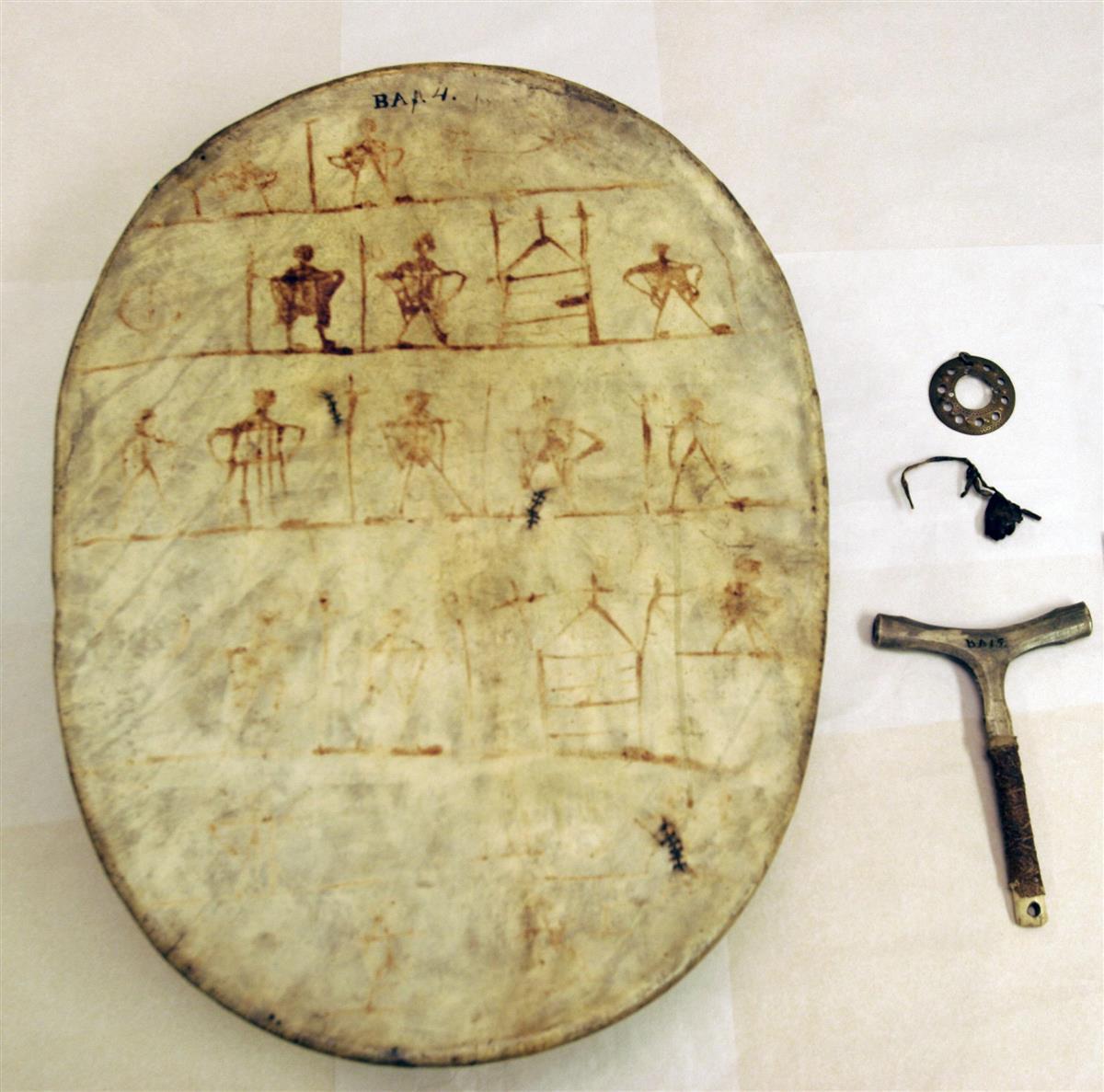
The Symbols on Anders Poulsen's Shaman Drum Anders Poulsen was a Sami noaidi (shaman) from Tysfjord, Norway, who lived in the 17th century. His drum, which was confiscated during the witch hunts and today is held at the Sami Collections in Karasjok, is one of the best preserved and most well-known Sami shaman drums. The symbols on Poulsen's drum provide a unique insight into Sami cosmology and the spiritual practice he carried out.
Overarching Structures Poulsen's drum is divided into several zones that reflect the threefold cosmology: the Upper World, the Middle World and the Lower World. Each zone contains symbols that represent different aspects of the universe and spiritual life.
A Symbol Analysis
Upper World (Bovde-godde)
The sun cross represents the sun and is a universal symbol of life, power and divinity. In Sami belief, the sun is an important deity that gives life and protection.
Radienattje and Radienacce
These deities are the creator and his son, who are often depicted in the upper part of the drum. Radienattje is a sky god, while Radienacce is his son, who has a direct connection to human beings.
Middle World (Váimmu-godde) Reindeer:
The reindeer on Poulsen's drum symbolize prosperity and survival, as they are essential to the Sami way of life. The reindeer may also represent sacrificial animals that are important in shamanic ceremonies.
The lavvu is a traditional Sami tent, and its presence on the drum symbolizes the home and security. It also represents the material aspect of life. Human figures:
Symbols of people show daily life, interactions and Sami culture. These figures may also represent the ancestors who are present in the here and now and who guide the living.
Boats symbolize travel and movement, both physical and spiritual. They indicate the shaman's ability to navigate between different worlds and dimensions.
Lower World (Jábme-godde)
Figures in the lower part of the drum represent the spirits of the dead and the ancestors. These symbols reflect the belief that the dead are still present and can influence the living.
Shadows or ghosts
These may represent the darker aspects of the spirit world, which the shaman must navigate and understand in order to carry out healings and other ceremonies. Specific Symbols on Poulsen's Drum
Celestial Rings
These may be circular symbols that represent celestial spheres or dimensions. They indicate levels of spiritual enlightenment or the path to the gods. Sacred Mountains and Trees:
These symbols represent sacred places in nature that are important for shamanic rituals. The mountains may serve as a point of connection between earth and sky, while the trees symbolize the tree of life, an axis that connects all levels of existence. Animal figures:
Other animal figures such as wolves, bears or birds may also be present and represent different spiritual forces or helpers that the shaman can invoke during rituals.
Use and Meaning The drum is used by the shaman to enter a trance and communicate with the spirit world. The symbols function as maps or guides that help the shaman navigate between different levels of existence. The sound of the drum is considered to be a bridge between the physical and spiritual world, and the symbols on the drum are the key to understanding this connection.
The symbols on Anders Poulsen's shaman drum provide a rich insight into Sami cosmology and spiritual practice. Through the symbols we can understand how the Sami perceived the world, nature and spiritual life. These symbols are not merely decorative, but function as tools and guides for the shaman in his work of healing, protecting and guiding his people. The drum and its symbols represent a profound and holistic understanding of the universe, one that still holds great significance for Sami culture and identity today.
Sources Solbakk, A. (2007). Sjamanisme og runebommer i samisk tradisjon. Davvi Girji.
This book provides a comprehensive overview of Sami shamanism and the significance of the runic drums, including detailed information about the symbols used on the drums. Mebius, H. (2003). Blodsymbolik i den samiska trummans värld. Centrum för Samisk Forskning, Umeå Universitet.
Mebius examines the ritual and symbolic significance of the runic drums in Sami shamanism, with particular focus on Anders Poulsen's drum. Hætta, O. M. (1996). Samene: en håndbok. Cappelen.
A comprehensive guide to Sami culture and history that includes information about shamanism and the use of runic drums. Rydving, H. (1993). The End of Drum-Time: Religious Change among the Lule Saami, 1670s-1740s. Uppsala University.
This dissertation provides an in-depth analysis of religious change among the Sami in the 17th and 18th centuries, including the persecution of shamans and their drums. Petersen, H., & Åhren, E. (2004). Sami Culture in a New Era: The Norwegian Sami Experience. University of Washington Press.
The book includes a broad discussion of Sami culture and identity in modern times, as well as the revitalization of traditional shamanic practice. De Samiske Samlinger (RiddoDuottarMuseat). "Anders Poulsens Tromme."
The museum's exhibition and documentation of Anders Poulsen's drum provide direct insight into the symbols and their meaning. Pollan, B. (1993). Sjamanisme i nord: en studie i noaidevuohta og åndetro. Universitetsforlaget.
An in-depth study of shamanism in the northern regions, including the use of symbols on Sami shaman drums.