Shamanism, a living culture in Norway?
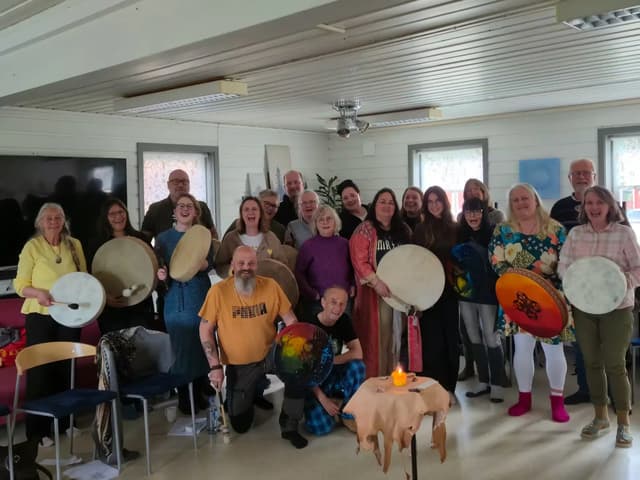
One of Sjamanistisk Forbund's clearly stated goals is to create a living shamanic culture in Norway. To give life to old traditions, our cultural heritage. Across Norway this is exactly what is happening, and not only under the auspices of Sjamanistisk Forbund. Other organisations and individuals are also helping to fan the flames. The drums are coming out of the cupboard together with knowledge that has been hidden, concealed because it was forbidden. Three hundred years ago the drum was banned and prohibited; in 2012, together with the official recognition of Sjamanistisk Forbund, the drum was once again accepted. Even in the church the drum has in some cases been invited in, thanks to good ambassadors for shamanism. Some voices have cried loudly about constructionism only to forget that shamanism and animism are the oldest traces we have of faith, here in Norway too. In Europe as well, we see that the old traditions are being reclaimed and that similar organisations and groupings are emerging.
Shamanism as spiritual cultural heritage
Some will surely choke on their coffee when I claim that what we do is cultural heritage, but according to UNESCO's definition of intangible cultural heritage, this includes, among other things: "Language, performing arts, social customs, traditional craft skills, rituals, and knowledge and skills connected to nature are examples of intangible cultural heritage. For many groups of people, the intangible heritage is a source of identity rooted in history. Philosophy, values and ways of thinking are passed on through oral traditions, through language and other forms of non-material communication, and form the foundation of community life."
The Arts Council further defines intangible cultural heritage thus: "Intangible cultural heritage means practices, representations, expressions, knowledge, skills - as well as the associated instruments, objects, artefacts and cultural spaces - that communities, groups and, in some cases, individuals recognise as part of their cultural heritage. This intangible cultural heritage, transmitted from generation to generation, is constantly recreated by communities and groups in response to their environment, in interaction with nature and with history, and gives them a sense of identity and continuity, thereby promoting respect for cultural diversity and human creativity. For the purposes of this convention, consideration is given only to intangible cultural heritage that is compatible with existing international human rights instruments and with the requirements of mutual respect among communities, groups and individuals, as well as of sustainable development."
The convention further emphasises that the right of definition lies with the culture-bearer themselves: "The convention's definition points out that intangible cultural heritage is expressions and practices '[...] that communities, groups and, in some cases, individuals recognise as part of their cultural heritage.' With this it is emphasised that the right of definition lies with the culture-bearer themselves. By creating and carrying on the cultural expression, and thereby defining and recognising its function and value, the culture-bearer has ownership of it. External parties have neither the right nor the ability to define this, UNESCO specifies. [40] The democratic aspect is therefore a precondition in every phase of the process of making visible and safeguarding."
Can a faith community such as Sjamanistisk Forbund be an intangible culture-bearer?
To be able to answer that, we must take the definitions above as our starting point. Shamanism is an intangible cultural expression in the following ways:
- It is based on oral traditions and transmissions passed down from generation to generation (in modern times also in writing)
- It is constantly recreated by communities and groups in response to their environment, in interaction with nature and with history, and gives them a sense of identity and continuity, thereby promoting respect for cultural diversity and human creativity
- It is recognised by groups as part of the cultural heritage.
If we then look at the objects clause of Sjamanistisk Forbund, which states that "SF is a faith community that wishes to promote a shamanic worldview, and to safeguard the right of individuals and groups to seek and practise a shamanic practice." Practice can in this context also be seen as the carrying out of shamanic traditions.
In this context Sjamanistisk Forbund thus becomes an organisation that safeguards an intangible spiritual culture. But does shamanism as a spiritual cultural expression need safeguarding? Shamanism has been a culture-bearer that has historically been marginalised and subjected to attempts at eradication; it had to be practised in secret, and much knowledge has been lost. History has not quite managed to wipe it out, and the spiritual and religious traditions have been passed down through families and in some cases also to other inheritors. Thanks to modern shamanism, the original has also enjoyed a renaissance. Government White Paper 73 (2005-2006) also establishes that "the need to safeguard the intangible cultural heritage is greater for our Sami indigenous population and national minorities, and that this does not only encompass defined ethnic groups, but also other marginalised groups of a religious or social-historical nature." (Emphasised by the Ed.)
The Church of Norway is also recognised as an intangible culture-bearer, so the basis for other faith communities to be recognised is there. The work of rebuilding a living shamanic spiritual and religious culture has begun, and official recognition of shamanism as intangible cultural heritage is something we in Sjamanistisk Forbund will work towards.