Shamanism and animism are closely related concepts within many Indigenous cultures, but they are not necessarily synonymous. Animism refers to a broader belief that all things in nature—including animals, plants, stones and geographical features such as rivers and mountains—have a spirit or soul. Shamanism, on the other hand, is a specific practice in which a chosen person, the shaman, acts as a link between the human world and the spirit world. Although shamanic practices are often based on an animistic worldview, animism can exist without shamanism. This article explores the relationship between shamanism and animism, how animistic belief manifests itself in shamanic rituals, and how these two concepts overlap and diverge.
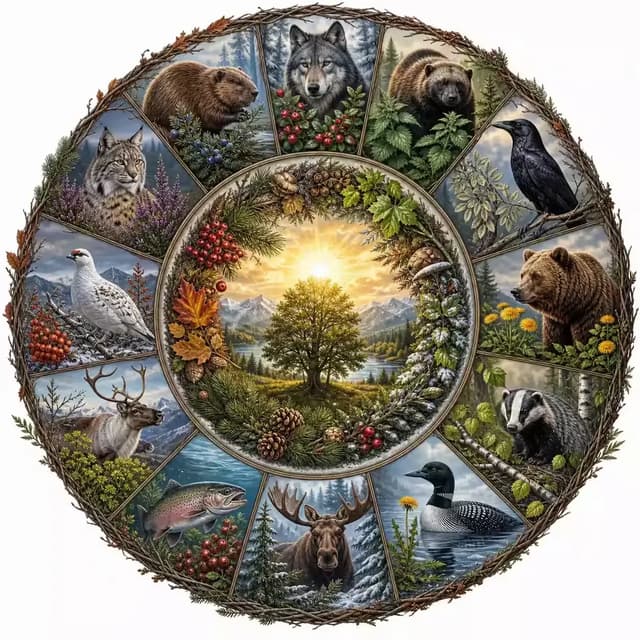
Animism, the belief that everything has a spirit Animism is a worldview in which it is assumed that all elements of nature are alive and ensouled. This includes not only animals and humans, but also plants, stones and natural phenomena such as rivers and mountains. This belief is found in many traditional societies around the world, from the Sami of northern Scandinavia to Indigenous peoples in the Amazon and Australia. In animism, spirits are seen as inherent in everything, and they can be either good or evil, protective or threatening. People who live in an animistic society often have ceremonies and rituals to maintain harmony with these spirits.
Shamanism as a manifestation of animism Shamanism is a form of religious practice in which the shaman acts as a mediator between humans and the spirit world. In many societies where animism is a widespread belief, shamanism takes shape as a practical way of communicating with the various spirits. Shamans use their skills to heal, to foretell the future, and to resolve problems that may arise from disturbances in the balance between humans and spirits. This practical exercise of animistic belief makes the shaman a central figure in many animistic cultures.
Shamanic rituals and practices Shamanic rituals vary from culture to culture, but they often share certain common features that reflect an animistic worldview:
Drumming and Song: In many shamanic traditions, drumming and song are used as tools for making contact with the spirits. The drum, which in itself can be regarded as a living being, helps the shaman enter a trance in which he or she can communicate with the spirits and travel to other worlds.
Spirit Journeys: Shamans often undertake spirit journeys, in which they leave their physical body to travel to the spirit world. On these journeys they seek counsel, healing or spiritual insight. The spirit journeys are a clear expression of the animistic belief that the world is divided into several levels or dimensions, each inhabited by its own spirits.
Worship of Nature Spirits: Many shamanic rituals are directed at worshipping or appeasing nature spirits. This may include offerings, prayers and ceremonies held at sacred places in nature. In these rituals, animism is expressed through the belief that nature itself is ensouled and must be respected and honoured.
Ritual Objects: Shamans often use ritual objects such as masks, amulets or statues that represent the spirits they work with. These objects have their own spiritual power and are used to attract or ward off particular spirits during rituals.
Shamanism and animism While shamanism is often based on animistic belief, animism can exist independently of shamanism. In some societies, animism is part of everyday life, where people live in harmony with the spirits they believe are present in their surroundings, without necessarily having a shaman as an intermediary. For example, in many African societies the belief in ancestral spirits and the spirits of nature is central, but the shamanic figures who mediate between humans and spirits can vary in importance.
On the other hand, shamanism is almost always rooted in an animistic understanding of the world. The shaman operates within a framework in which spirits are a natural part of reality, and their practice is directed at maintaining the balance between these spirits and humans.
Examples from various cultures
Sami shamanism
In Sami culture, the shaman, or noaidi, has traditionally played an important role as a link between humans and the spirit world. With the help of the drum, the noaidi can travel to the spirit world to obtain help and guidance. This practice is a clear manifestation of animistic belief, in which nature and everything in it is ensouled.
African shamanism
In many African cultures, the belief in spirits such as ancestors and the spirits of nature is central. Shamans, often known as healers or medicine men/women, work with these spirits to heal illnesses and maintain the wellbeing of the community. The use of masks in rituals, which are believed to possess spiritual power, is a manifestation of animistic belief, but not everyone who practises animism is necessarily a shaman.
Siberian shamanism
In Siberia, the shaman is a healer and spiritual leader who communicates with nature spirits through trance and spirit journeys. The drum and other musical instruments are used to contact the spirits, and the shaman can move between different worlds to obtain counsel and perform healings. Here we see animistic belief and shamanic practice in close interplay.
Hultkrantz, Åke. Shamanic Healing and Ritual Drama: Health and Medicine in Native North American Religious Traditions. Crossroad Publishing, 1992. Eliade, Mircea. Shamanism: Archaic Techniques of Ecstasy. Princeton University Press, 1964. Vitebsky, Piers. The Shaman: Voyages of the Soul, Trance, Ecstasy and Healing from Siberia to the Amazon. Duncan Baird Publishers, 1995. Ingold, Tim. The Perception of the Environment: Essays on Livelihood, Dwelling and Skill. Routledge, 2000. Hammond-Tooke, David. Rituals and Medicines: Indigenous Healing in South Africa. Ohio University Press, 1989. Gaski, Harald. Noaidi: The Sami Shaman. Sami Culture, 1993.