Shamanism's fundamental worldview
Shamanism is based on the premise that the visible world is permeated by invisible forces or spirits that influence the lives of the living. This animistic worldview forms the basis for the shaman's role as an intermediary between the physical and the spiritual world.
Animism and the spirit world
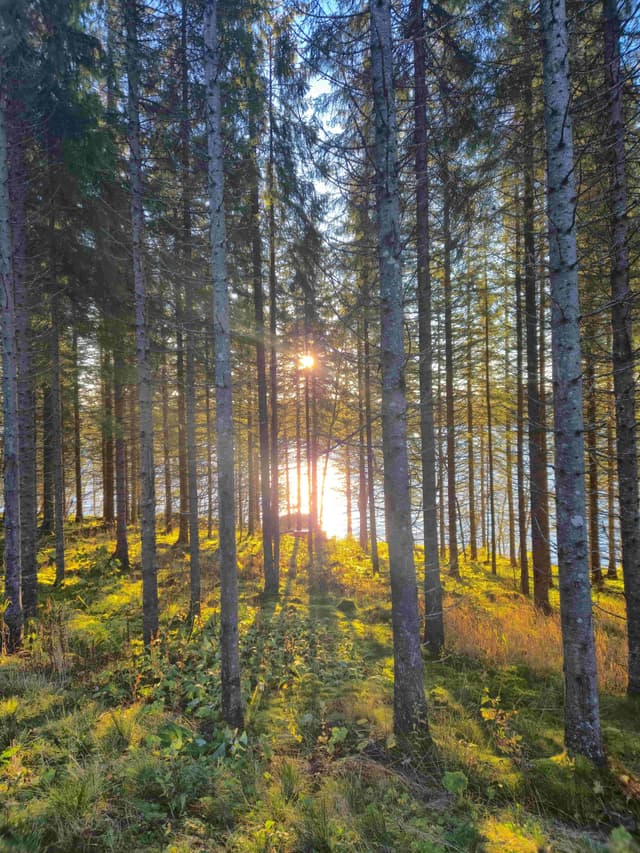
In shamanic tradition, nature is considered to be ensouled. Every tree, every stone, every river and every animal has its own spirit that influences the surroundings and the lives of humans. This deep connection with nature and the spirit world is central to shamanic practice and understanding.
The soul in shamanic tradition
Shamanism's understanding of the soul is often more complex and multifaceted than the Western conception of a single, immortal soul.
The components of the soul
In Norse tradition, the soul was considered to have several components:
Hugr: Thought, mind or consciousness
Hamingja: Luck or fate
Fylgja: A personal attendant spirit
Hamr: The physical body or form
These different aspects of the soul could have different fates after death. For example, the hugr could be reincarnated in a relative, while the hamingja continued to exist in the family.
Soul journeys and soul flight
A central part of shamanic practice is the shaman's ability to undertake soul journeys or soul flight. This means that the shaman enters an altered state of consciousness in which their soul is considered to leave the body in order to journey to other worlds or dimensions.
During these journeys the shaman can:
Communicate with spirits and deities
Retrieve lost soul energy
Seek knowledge and wisdom
Perform healing
Soul journeys are considered a fundamental technique within shamanism and are practiced in various forms all over the world.
Sami shamanism and the spirit world
Sami shamanism, known as noaidevuohta, has a rich tradition connected to the understanding of the soul and the spirit world.
The noaide - the Sami shaman
The noaide, the Sami shaman, served as an intermediary between the world of humans and the world of spirits. With the help of the drum and joik, the noaide could enter a trance to seek guidance or healing from the spirits.
Sami cosmology
Sami cosmology divides the world into three levels:
The upper world: The realm of heaven
The middle world: Our physical world
The underworld: The realm of the dead
The noaide had the ability to travel between these worlds in order to communicate with spirits and deities.
The threefold soul
Sami spirituality sees the human being as consisting of three essential components: life, spirit and soul. This belief forms the basis for the understanding of life after death and for the spirit's ability to return to the earthly world.
Central to Sami animism is the concept of "sielu," which can be translated as "the soul" or "the life force." Yet the Sami understanding of sielu is far more multifaceted than these translations suggest. Sielu is not only present in living beings, but permeates all of nature, including stones, rivers and even natural phenomena such as the northern lights.
The sielu concept includes the belief that each person has several souls, each with a specific function:
• The body soul gives life to the physical form.
• The free soul can leave the body during dreams or shamanic journeys.
• The breath soul is connected to consciousness and vitality.
Nature connection and animism
Sami spirituality is deeply rooted in nature and animism. All natural objects and phenomena are considered to have a spirit or soul. This worldview is reflected in traditional practices and rituals, which often involve offerings to nature spirits and ancestors.
Norse shamanism and seiðr
In Norse tradition we find the practice known as seiðr, a form of shamanism associated with the god Odin and the goddess Freyja.
Völvas and seiðr practitioners
The völvas, the female practitioners of seiðr, were especially attuned to the spirit world. They played an important role in facilitating communication between humans and spirits. Through trance, song and rituals they could call upon spirits to seek guidance, healing and insight.
Fylgja - the personal attendant spirit
The concept of the fylgja, a personal attendant spirit, was central in Norse animism. These spirits were considered shape-shifting creatures that followed individuals throughout life. They served as guides, protectors and reflections of a person's personality and fate.
Hamskifte and soul journeys
In Norse tradition we also find the concept of hamskifte, the ability to change one's hamr or form. This was associated with shamanic practices and soul journeys, in which the practitioner could take the form of an animal or a bird in order to journey to other worlds.
Kven shamanism
Kven shamanism, which has roots in Finno-Ugric tradition, shares many similarities with Sami shamanism, but also has its own unique aspects.
Tietäjä - the Kven wise one
In Kven tradition we find the tietäjä, a wise man or woman with shamanic abilities. The tietäjä had knowledge of healing, divination and communication with the spirit world.
Loitsut - magical incantations
A central part of Kven shamanic practice was the use of loitsut, magical incantations or songs. These were used to call upon spirits, perform healing and manipulate the forces of nature.
General directions within shamanism
Although shamanism has many local variations, there are some general features and directions that recur in different cultures.
Core shamanism
The anthropologist Michael Harner developed the concept of core shamanism, which attempts to distill universal elements from various shamanic traditions. This approach focuses on:
Drum journeys to enter altered states of consciousness
Communication with power animals and spirit guides
Healing through soul retrieval and power animal work
Core shamanism has become popular in Western countries as a way to rediscover shamanic practices.
Neoshamanism
Neoshamanism is a modern movement that attempts to revive and adapt traditional shamanic practices to a modern context. This direction often incorporates elements from various cultures and spiritual traditions.
Shamanism's view of the spirit world
Across various shamanic traditions we find some common features in the view of the spirit world.
The three worlds
Many shamanic traditions, including Sami and Norse, divide the world into three levels:
Upper world: Often associated with celestial beings and ancestral spirits
Middle world: Our physical reality, but also home to nature spirits
Lower world: Associated with the interior of the earth and often seen as the source of power and wisdom
The shaman has the ability to travel between these worlds in order to communicate with spirits and retrieve knowledge and power.
The belief that everything is ensouled
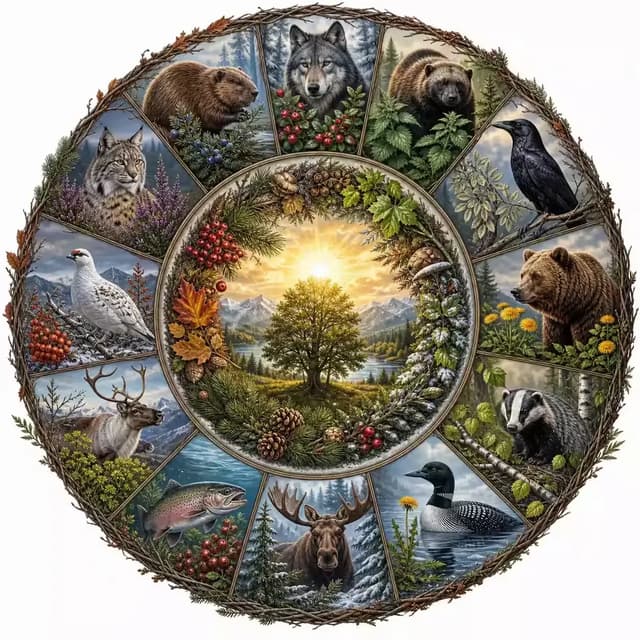
Animism, or the belief that everything is ensouled, recurs in shamanic traditions. This applies to stones, trees, landscapes, and to the idea that everything found in nature has its inherent power and is sacred.
Spirits and helpers
In shamanic tradition, spirits play a central role. These can include:
Nature spirits: Associated with specific places, plants or animals
Ancestral spirits: Deceased relatives or tribal members
Power animals: Spiritual manifestations of animals that serve as guides and protectors
Teachers: Sources of wisdom in the spirit world
The shaman often develops a close relationship with specific spirits that serve as helpers and guides in their work.
Illness and healing
In shamanic understanding, illness can often be caused by spiritual imbalances or interventions. This can include:
Soul loss: Where parts of the soul have become separated from the body
Spiritual intrusion: Where foreign spirits have taken up residence in the body
Violation of spiritual laws: Which can lead to punishment from the spirit world
The shaman's role is to diagnose the spiritual cause of the illness and perform appropriate rituals to restore balance.
Modern interpretations and scientific perspectives
In modern times there have been attempts to understand shamanic practices and experiences through scientific lenses.
Neurological perspectives
Some researchers, such as Michael Winkelman, have suggested that shamanic practices activate specific neurological systems. Trance states induced through drumming, dance or plant medicine can lead to an integrative state of consciousness that allows communication between different mental systems.
Evolutionary perspectives
It has been argued that shamanism developed as an adaptive mechanism in human societies. The shaman's ability to "predict" events, resolve group conflicts and provide guidance may have given evolutionary advantages to groups that practiced shamanism.
Psychological perspectives
Jungian psychology has drawn parallels between shamanic practices and concepts such as the collective unconscious and archetypes. Both shamanism and Jungian psychology emphasize the importance of inner journeys and encounters with symbolic figures for personal growth and healing.
Ethical and cultural considerations
In the face of growing interest in shamanism in Western societies, it is important to be aware of ethical and cultural considerations.
Cultural appropriation
There is an ongoing debate about the line between respectful adoption of shamanic practices and cultural appropriation. It is important to approach traditional practices with respect and acknowledgment of their cultural origin.
Preserving traditional knowledge
Many Indigenous groups are working to preserve and revitalize their traditional shamanic practices. It is important to support these efforts and to acknowledge Indigenous peoples' rights to their cultural and spiritual heritage.
Responsible practice
For those who wish to explore shamanic practices, it is important to do so in a responsible way. This can involve:
Thorough research and training
Respect for traditional protocols and ethics
Acknowledgment of the limitations of one's own knowledge and experience
Shamanism's view of the soul and the spirit world is rich and diverse, with deep roots in many cultures, including Sami, Norse and Kven tradition. Common to these traditions is an understanding of the world as ensouled, where spirits permeate nature and influence human lives. The shaman serves as a bridge between the physical and the spiritual world, with the ability to undertake soul journeys and communicate with spirits.
In modern times there has been a renewed interest in shamanic practices, both as a source of personal growth and as a way to rediscover a deeper connection with nature and the spiritual. At the same time, scientific perspectives have attempted to understand the neurological and psychological mechanisms behind shamanic experiences.
However one chooses to interpret or practice shamanism, it is important to do so with respect for the cultures and traditions that have preserved this knowledge through millennia. Shamanism's rich understanding of the soul and the spirit world continues to fascinate and inspire people all over the world, offering an alternative perspective on our place in the universe and our connection with all that lives.
References:
Eliade, M. (1964). Shamanism: Archaic Techniques of Ecstasy. Princeton University Press.
Price, N. (2019). The Viking Way: Magic and Mind in Late Iron Age Scandinavia. Oxbow Books.
Pentikäinen, J. (1998). Shamanism and Culture. Etnika.
Harner, M. (1990). The Way of the Shaman. HarperOne.
Hultkrantz, Å. (1992). Shamanic Healing and Ritual Drama: Health and Medicine in Native North American Religious Traditions. Crossroad.
Winkelman, M. (2000). Shamanism: The Neural Ecology of Consciousness and Healing.