The little people, also known as the underground folk, wights or hidden folk, have a long history in Norwegian folk belief. These mysterious beings, who according to tradition live in nature, have been part of Norwegian culture since pre-Christian times. The belief in the little people has led to the development of many customs and rituals, all of which have in common that they are about showing respect for these hidden forces in nature.
Giving warning before throwing out water One of the best-known customs connected with the little people is to give warning before throwing out water or refuse, especially in the evening. This was done by calling out "Watch out!" or "Look out, little people!" in order to avoid harming the invisible inhabitants who were believed to be out at this time of day. The belief that misfortune could befall anyone who unwittingly harmed the little people was widespread. This practice shows how the little people were integrated into everyday life, and how respect for these invisible beings was expressed in simple but important actions.
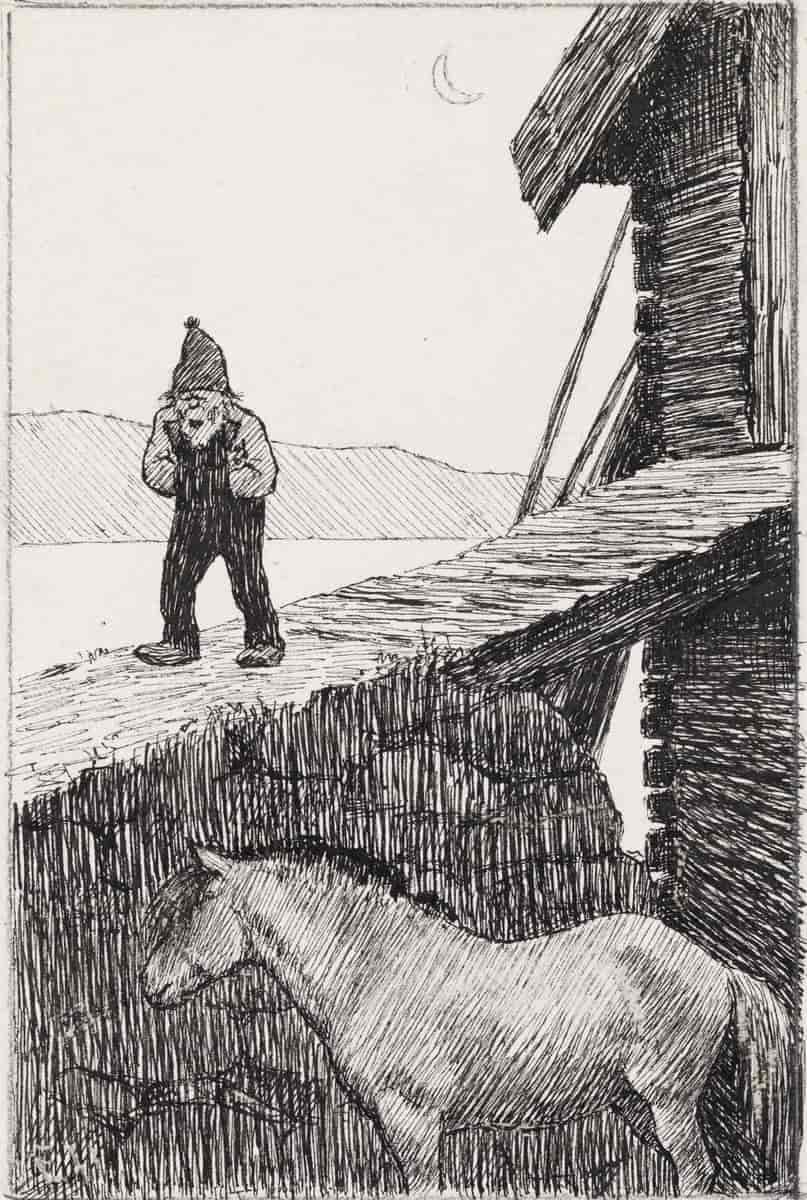
The barn nisse, the farm's guardian The barn nisse, or farm nisse, is one of the best-known figures in Norwegian folk belief. This small, grey-clad figure with a red cap was regarded as the protector of the farm. It was the nisse who ensured that the farm was fertile and that the animals thrived. But the nisse was also known for his hot temper, and if he was not treated with respect, he could bring misfortune upon the farm. To appease the nisse, it was common to set out a bowl of porridge on Christmas Eve, preferably with a knob of butter on top. Even today, this tradition lives on in many Norwegian homes, as a symbol of gratitude and respect.
The mound farmer, nature's guardian The mound farmer (haugbonden), another central figure in folk belief, was the invisible owner of mounds, forests and other natural formations. The mound farmer was known for protecting his territory, and it was important to show respect for his property. If anyone were to build on or dig into a mound, it might be necessary to offer food or drink to the mound farmer in order to avoid misfortune. In pre-Christian times, these offerings were seen as a way of entering into a pact with the underground folk, so that humans could live in harmony with the forces of nature.
Historical examples of contact with the little people History is full of accounts of people who have had contact with the little people. One of the best-known tales comes from the Middle Ages, when it was said that the little people helped to build Nidaros Cathedral in Trondheim. According to legend, it was the underground folk who laid the first stones of the cathedral, but they were frightened away by the church bells that marked the arrival of Christianity.
In other tales, such as those from Telemark and Setesdal, the little people have been described as helpful, but dangerous if offended. In these regions there were reports of farm folk who received help with heavy work on the farm from the little people, as long as they were offered food or some other form of thanks.
Another well-known tale dates from the 18th century, when a man in Gudbrandsdalen reportedly received help from a mound farmer. The man was to build a new barn, but the work was going slowly. One evening he set out a bottle of spirits and a little food by the mound where he knew the mound folk lived. The next morning the barn was more or less finished, and it was said that the mound folk had done most of the work during the night.
Other customs and traditions In addition to giving warning before throwing out water, there were other traditions connected with the little people. For example, it was considered important never to disturb or damage old trees and stones that were regarded as dwellings for the little people. Many believed that oak trees in particular were sacred and inhabited by wights. To fell such a tree without first asking permission or making an offering could lead to serious consequences, such as illness or misfortune.
In pre-Christian times it was also common to make offerings to the little people to ensure a good harvest or to obtain help in the hunt. These offerings could consist of food, drink or small gifts, and they were usually placed at special places in nature, such as by a mound or a sacred spring.
The little people in the transition to Christian times With the arrival of Christianity in Norway, the view of the little people changed somewhat. The Church often sought to demonise these beings, and many of the old traditions were forbidden. Nevertheless, the belief in the little people managed to survive, often in the form of adapted rituals that found a place within the framework of the new religion. For example, the custom of setting out porridge for the barn nisse was retained, but it now also came to be seen as a way of celebrating the spirit of Christmas.
Modern perspectives Although the belief in the little people has declined, many of the associated traditions live on in Norwegian culture. The tales of the little people remind us of a time when people lived closer to nature and believed in its hidden forces. Today the little people represent an important part of Norway's cultural heritage and our connection to the traditions and beliefs of the past.
The traditions connected with the little people continue to fascinate, and they provide a unique insight into how our ancestors viewed the world around them. The respect for nature's forces, represented through the little people, is a legacy that can still teach us much about how we should relate to the environment today.
Sources:
1 Kvideland, Reimund, and Henning K. Sehmsdorf (eds.). Scandinavian Folk Belief and Legend. University of Minnesota Press, 1988.
2 Hodne, Ørnulf. Norsk Folketro. Universitetsforlaget, 1997.
3 Bø, Olav. Norsk Rit, Sed og Folketru. Det Norske Samlaget, 1987.
4 Christiansen, Reidar Thoralf. The Migratory Legends: A Proposed List of Types with a Systematic Catalogue of the Norwegian Variants. FF Communications No. 175, Suomalainen Tiedeakatemia, 1958.