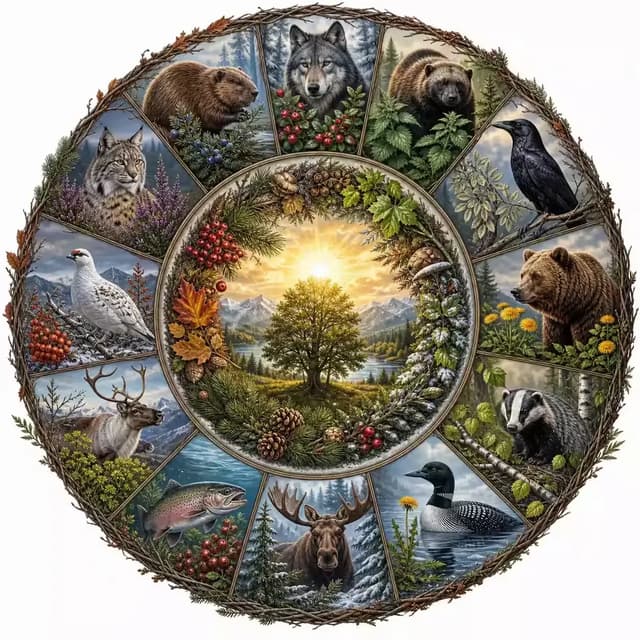
Sami cosmology represents a rich and complex worldview, shaped by centuries of traditions, myths and rituals. It offers insight into how the Sami view the universe, humanity's place within it, and the interplay between the spiritual and the physical. This article will explore the various aspects of Sami cosmology, including its structure, central deities and spirits, creation stories, as well as the significance of nature and the starry sky.
Sami cosmology can be divided into three main regions that mirror the threefold model of the world:
Upper World (Bovde-godde)
This is the heavenly realm or spiritual dimension where the highest gods and spirits dwell. It is a sphere of light, power and divinity.
Middle World (Váimmu-godde)
The visible, physical world where humans and animals live. This is a sphere of material and earthly existence, where daily life unfolds.
Lower World (Jábme-godde)
The underworld or the realm of the dead. This is the place where the ancestors and the souls of the dead reside, a sphere of shadows and memories.
Central Deities and Spirits In Sami cosmology there are a number of deities and spirits that play important roles. Some of the most central include:
Radienattje and Radienacce
Radienattje is the creator, the highest deity who dwells in the Upper World. Radienacce is his son, who has a more direct connection with human beings and can bring divine power to the earth.
Beaivi
The sun goddess Beaivi is one of the most important deities in Sami mythology. She is associated with the sun, life, growth and healing. Beaivi is celebrated during the winter and summer solstices with sacrifices and rituals to ensure the return of the sun and the fertility of the earth. Madder-Attje and Madder-Ahkká:
Madder-Attje is "the Great Father" and Madder-Ahkká is "the Great Mother," who are the parents of humankind and stand as protectors and guides. The Ahkká goddesses represent different aspects of women's lives and the fertility of nature.
The Saivo Spirits
Spirits from the Lower World who can help or hinder human beings. The Saivo spirits are often ancestors who have chosen to remain in order to protect their descendants.
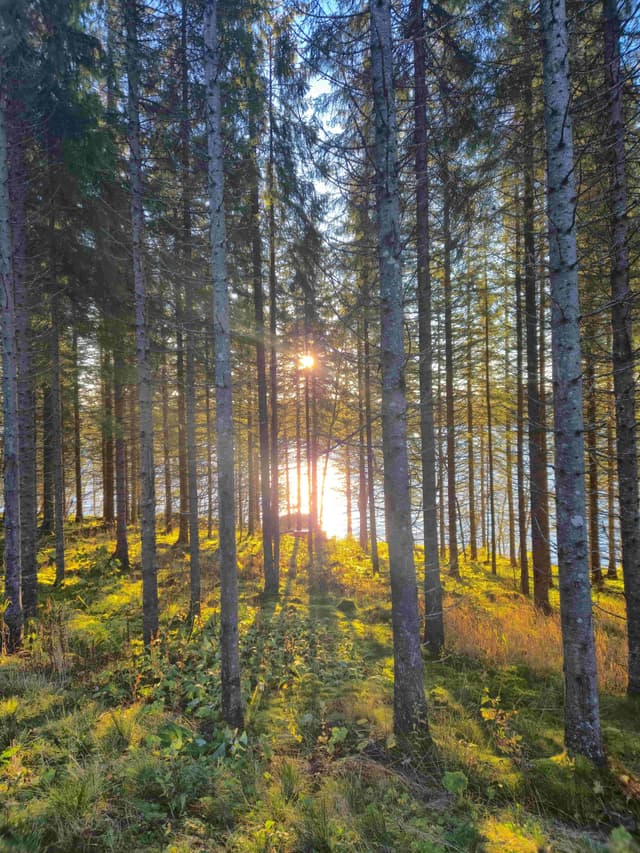
The Significance of Nature Nature plays a fundamental role in Sami cosmology. Mountains, lakes, rivers and trees are not merely physical elements, but sacred places where spirits and deities may dwell. Some of the most important natural symbols include:
The mountains are considered sacred and are often seen as dwelling places for spirits and deities. They serve as a link between heaven and earth.
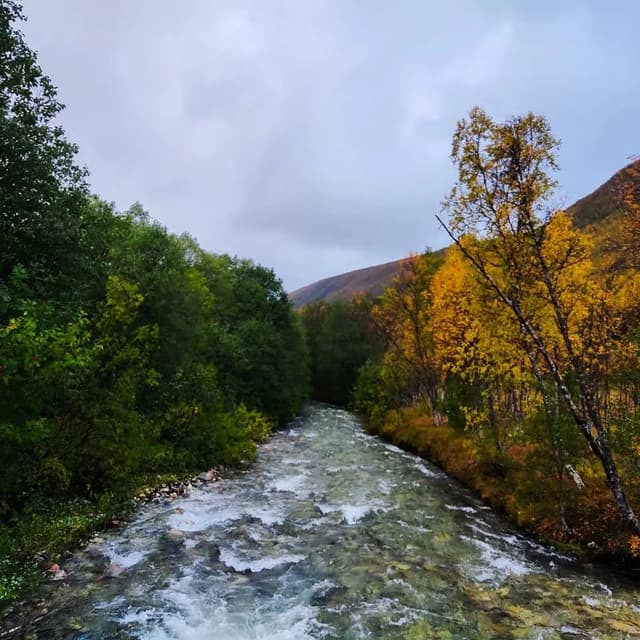
Water, especially lakes and rivers, holds special significance as a cleansing and healing element. They are also portals to other worlds, particularly the underworld.
Trees, especially the tree of life (the World Tree), symbolize the connection between the three levels of the world. The trees also represent continuity and the cycle of life.
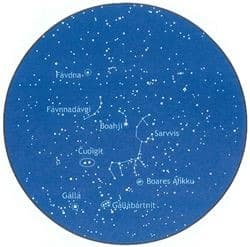
The Starry Sky The starry sky is also an integral part of Sami cosmology. The stars and constellations are seen as guides and as symbols of various deities and myths.
Saivo is a mythical place in the sky, where the souls of the dead may travel after death. It is also seen as a source of spiritual wisdom and power. Sarvvis:
Sarvvis, or the Big Dipper, is an important constellation in Sami belief. It is often seen as a reindeer or a boat that carries souls between worlds.
Dávggas, known as Orion, is another important constellation that is associated with hunting and war. It depicts the shaman's journeys and battles in the spirit world.
The Role of the Shaman The shaman, or noaidi, is a key figure in Sami cosmology. The shaman acts as an intermediary between the various worlds and has the ability to communicate with the spirits through trance states and the use of the shaman drum (the runic drum). The shaman's tasks include healing, divination, and ensuring harmony between humans and the spirit world.
Shamanic Rituals
With the help of drumming, the shaman enters a trance and travels to the different worlds to gain insight or help from the spirits. Sacrifices and Ceremonies:
The shaman performs sacrifices to deities and spirits, often at sacred places in nature. These ceremonies are intended to ensure balance and protection. Healing:
The shaman uses his connection with the spirits to carry out healings. This may include the use of herbs, drumming and rituals to remove the causes of illness.
Sami cosmology is a profound and complex belief system that integrates the spiritual with the physical, and humans with nature and the starry sky. The threefold model of the world provides a structured understanding of the universe, while the many deities and spirits reveal the rich mythological tradition. The creation stories offer insight into the Sami worldview and their connection to nature and the stars. The shaman plays a crucial role in maintaining balance and harmony through his ritual practices. Through this cosmology we gain insight into a culture that values interaction, respect and balance between all parts of life and the universe. It is important to emphasize that Sami cosmology had great variations from region to region.
Sources Solbakk, A. (2007). Sjamanisme og runebommer i samisk tradisjon. Davvi Girji. Mebius, H. (2003). Blodsymbolik i den samiska trummans värld. Centrum för Samisk Forskning, Umeå Universitet. Hætta, O. M. (1996). Samene: en håndbok. Cappelen. Rydving, H. (1993). The End of Drum-Time: Religious Change among the Lule Saami, 1670s-1740s. Uppsala University. Petersen, H., & Åhren, E. (2004). Sami Culture in a New Era: The Norwegian Sami Experience. University of Washington Press. De Samiske Samlinger (RiddoDuottarMuseat). Pollan, B. (1993). Sjamanisme i nord: en studie i noaidevuohta og åndetro. Universitetsforlaget.