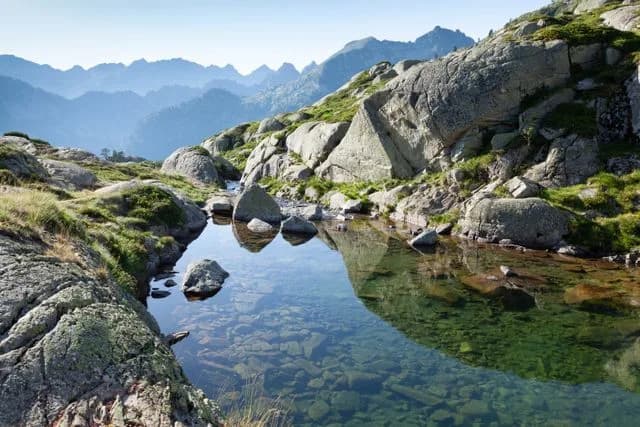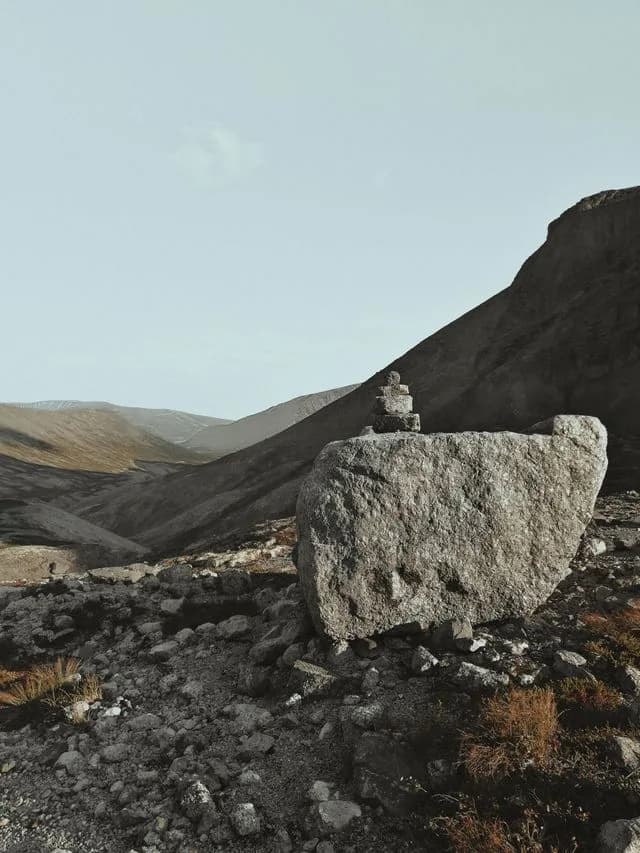
On the shore of a lake in Porsanger, Johan Andreas Friis found fish bones inside a stone mound. The mound was hollow, built from rounded stones, and animal bones were also lying in the space within. At the top was a depression. He believed that this was where the sacred image itself had once stood. Yet it is the small bones that hold my attention when I read his account from 1871. He had to try to work out what kind of image had stood there. The fish bones, however, were there for him to see with his own eyes.
Still, there is a danger in beginning with the bones. Those of us who come afterwards easily notice what has survived weather and time. A stone structure can stand for hundreds of years. A little drink that a woman ladled into the fire for Sáráhkká may have disappeared before her children had finished eating. If we were to trust only what we could pick up from the ground, the largest offering sites would occupy most of the story. The woman beside the hearth would barely have a place in it. So I want to begin where Friis had to stop, and follow the offerings back to the people who still held them in their hands.
Before the salmon was divided
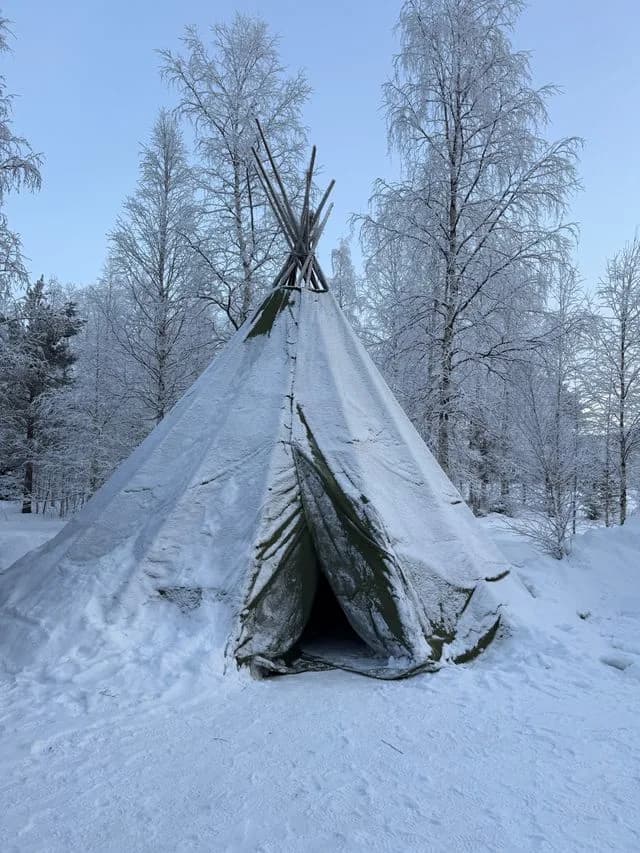
Far east of Porsanger, on the Kola Peninsula, the Iokanga River flows into the Barents Sea. From the people living along this river, the Russian ethnographer Vasily Alymov received an account of the first salmon fishing of spring. People gathered at a stone some distance from their settlement to pray for a good catch. An old fisherman took a cup, filled it with river water and drank. Then the others drank too. Nobody has told us what the fisherman said. The person who passed on the story remembered the cup.
From the first catch, they took two salmon. One was divided so that everyone could taste it. The other was placed whole before the stone. While each person ate their mouthful, there was a whole salmon within reach that nobody expected to receive. It belonged to the sieidi, the sacred stone. Perhaps that is why the image stays with me. The storyteller from the Iokanga did not need to explain to the fishermen what a sieidi was. It was enough to tell how they divided the salmon.
People could also gather around the same stone to share a reindeer. They chose a fine animal that nobody had yet ridden and took care not to damage its bones. They cooked the meat in a communal pot. Only after everyone had eaten did the part of the work begin that gives us a sense of what Friis may have missed beside the lake in Porsanger. The bones had to be collected and placed beside the stone, arranged as though the reindeer were whole again. The hide was laid in front. It was the hide and bones that belonged to the sieidi, according to Alymov's local account. What met the eye afterwards was therefore the result of careful work. Nothing in the sight of a pile of bones alone would have told us that.
Further west, someone actually asked why the bones had to be treated with such care. Erik Jessen, as quoted by Friis, describes a sacrificial meal at which the noaidi placed the bones in their proper order in a trough or a container made of birch bark. The answer he records is that the god could give the animal its flesh and limbs back. The reindeer would even become larger and more beautiful than before. I do not want to put that explanation into the mouths of the people at the Iokanga. But read side by side, the two accounts make it easier to understand the seriousness of the simple act of searching for a bone after the rest of the company had finished eating.
A ladleful for the fire
At home, beside the hearth, there was rarely any need to wait for a large gathering. In Friis's chapter on the áhkka goddesses, it is the women who give Sáráhkká a share of what is eaten and drunk during the day. He is quite specific about the drink: it was ladled into the fire. Uksáhkká, who lived by the doorway, also received a little food and drink at every meal. In other words, one could learn quite a lot about who belonged to a household simply by noticing where the person serving turned before putting down the ladle.
Sáráhkká was also present when a child was about to be born. Before the birth, the woman drank what Jessen called Sáráhkká's wine. Afterwards, she ate porridge with the women who had been with her, Friis recounts from Jessen's account. Here, I am particularly glad that someone remembered the porridge. It allows the women to remain in the story a little while after the child has been born. We do not know what they talked about, or which of them brought out the food. We know that the woman who had given birth did not eat alone.
One day, the family would move on. If they had fared well in a place, they poured a little milk soup onto the ground as thanks, Friis writes in his account of offerings to Sáráhkká. When they arrived, nobody could know how their stay would turn out. When they left, they did. Now it was possible to give thanks for that particular place, with a little of the food they had enjoyed while living there. In those few words about the milk soup, we can see the difference between breaking camp and simply leaving.
Along a migration route at Offerskalet in Vilhelmina, we know of a stone that families passed both in spring and autumn. They used to make offerings there along the way. This might easily have been forgotten had it not been for the lynx and wolf hunter Jon Andersen Neiner. According to his own child, he was the first to break with the custom, around 1860. Rolf Kjellström preserved this detail in his study of older Sámi religious practices. We are not told what the father chose not to give. Yet the child knew which stone was meant and what people before him had traditionally done there. Even an offering that was not made could be remembered within a family.
What did it take to have a good summer of milk?
There is another story from Vilhelmina about people who failed to make an offering. This time it was early summer, and the reindeer had been driven into the enclosure for the first milking of the year. An elderly woman reminded the people by the fence that they should give the spirit a little something. Nothing came of it. Some time later, a buck began to limp, and only then did the person who had ignored the woman's advice think of her words again. This is how the incident was told when Torkel Tomasson wrote it down in 1917. It would be easy to place a bowl of milk in the elderly woman's hands. The storyteller simply said "a little". We must allow that much to remain open.
The long preparation for the first milking began out on the land. Knud Leem describes the spring offering to Ruona-Nieid, the figure associated with the grass and leaves that emerge in spring. People asked that the reindeer might soon reach fresh pasture. The account does not say what they gave her. But we recognise what they were asking for when we come to the sun porridge around Midsummer. Sigvard Kildal describes a ring of leaves or grass hung up in honour of the sun, along with a porridge made from flour and butter. At Friis, who calls the annual sun porridge jubtse, women and men ate together and asked Beaivi for the well-being of their animals and a good summer of milk.
A good summer of milk. There is more to be found in that old expression than in a long explanation of why the sun mattered. The rain might pass, and the days might be bright enough, but it was only among the herd and at milking time that people knew what kind of summer they had been given. Further east, in Inari, the sun was called Piäiváž. Offerings were made to her both at midsummer and in autumn. But on Midsummer night itself, people also went down to the rapids to pray to Čäcialmai, the Water Man, according to Ilmari Mattus's account of Inari Sámi traditions for the Sámi Museum. Here, the salmon must remain at the Iokanga. Mattus tells us that people prayed beside the rapids. He says nothing about them placing fish in the water.
Towards the end of summer, in the Pite Sámi area, a reindeer was sometimes given to the earth. Margareta Bengtsson told Emilie Demant-Hatt about the custom, which she called Boaldon vieron. The reindeer was adorned before being slaughtered, and after it had been burned, its bones were buried, as Kjellström recounts from Bengtsson's testimony. The old priest in Silbojokk, Petrus Noræus, wrote about another offering in the same general region, this time at the autumn rut. A wooden figure sprinkled with the animal's blood was placed above the meat. People thanked the earth because she was the first to provide food for the reindeer. They also asked that the herd might grow and be spared the illnesses that could affect the animals during summer, as religious historian Louise Bäckman explains from Noræus's account.
I like reading Bengtsson's words before the priest's. She tells us who the reindeer was for. In his account, we find a reason so ordinary that it could have been spoken beside a reindeer enclosure: the earth had fed the animal first. Now it was the people who had something to give in return. And while the rut occupied people and animals that autumn, their thoughts were already turning towards the herd that would go out to pasture the following year.
The boat that was never meant for water
Before the autumn slaughter, someone had an errand in the birch forest. Every autumn, the thunder god Horagales was to receive a new wooden image, "so that the God might have a new, beautiful dwelling", writes Samuel Rheen, quoted by Friis. How does one make a head and a body from a birch stump? Pehr Högström, another of Friis's sources, explains that the lower part of the trunk was used, with the root left attached. The root was shaped into a head, and the trunk became the body and legs. In this way, the birch stood upside down compared with how it had grown. Only for the images of Radien the Father and Radien the Son does Jessen state that the root was to point downwards. Someone who had only seen a drawing of a face on a drum would hardly have guessed that one difference between two divine images could lie in which end of the tree touched the ground.
For Christmas, Rheen describes a much more delicate piece of work with birch bark. In the Lule Sámi area, people took small portions from the food they ate. They made a boat out of birch bark to hold them. The boat had a mast, a sail and oars. A little fat was poured over the food before someone carried it away from the tents and placed it in a tree. There it was to remain for those whom Rheen called the wandering Christmas folk. Phebe Fjellström, who reproduces the seventeenth-century account, understands these Christmas visitors as the dead returning to their former homes at Christmas.
It is the oars that keep bringing me back to this little boat. The food could have been placed in a bowl, and a vessel in a tree would never need oars to stay afloat. Yet someone had taken the time to make them. There was also another Christmas offering, carried outside in a simpler roll of birch bark. Högström recounts that Rutu received a little of every kind of food eaten on Christmas Eve and Christmas morning. If there was flour, people baked a small cake filled with milk and cheese over the embers. Two spade-shaped wooden splinters were pushed through the birch bark, and the food was hung in a tree near the dwelling. To a stranger passing by, both might have looked like Christmas food hanging in a tree. But the person who had sat beside the fire making the boat knew exactly whom it was meant for.
After the winter darkness came another opportunity to give, and this time it was possible to see what became of the offering. Friis mentions the custom of smearing butter on a wall so that the sun could melt it when she appeared again. I think of the wish for a good summer of milk and of those who had eaten the porridge together. When the sun reached the wall, it was the butter, of all the things that could have been offered, that received the warmth. Further south, where the sun could be seen again on New Year's Day, the same author describes a custom in some places: each member of the family gave a brass ring to the sun, dropping it into a well or a stream. They watched how the light fell upon the rings in the water. Friis wondered whether people further north might have done this on the day the sun first appeared above their own horizon again. He did not know.
When I visit a sieidi myself, I offer brass rings, money, herbs and sometimes liquor. I will leave the place I visit unnamed. The fact that a brass ring appears both in my own practice and in an old account gives me no right to tell what the people beside the well were thinking when they released theirs. But it makes it easier for me to recognise the moment just before: the ring is still in the hand. A person can still take it home.
This is where I wanted to return from the stone mound in Porsanger. Friis found the bones. In other accounts, some people were fortunate enough to preserve what happened before something was left on the ground: a ladle turned towards the fire, hands that placed a reindeer back into its proper form, a child who many years later still remembered which stone their father had passed by. And further east, beside the Iokanga, there were people who remembered an old fisherman with a cup and two salmon from the first catch of spring. Of one, we know that everyone was given a taste. Of the other, we also know who received it.