An Encounter with Hmong Shamanism
It is early morning in a Hmong village in the mountains of northern Laos. Mist hangs low between the hills, and smoke from the cooking fires rises straight into the still air. From one of the houses comes a sound unlike any other: a gong striking in a steady, hypnotic rhythm, accompanied by a rattling metallic sound reminiscent of a thousand tiny bells. Inside, a man sits on a narrow wooden bench, his face covered by a black cloth. He sings, softly at first and then more forcefully, and his body begins to move as though he is riding.
And he is riding. The bench is his horse, and he is travelling into another world.
The man is a txiv neeb, a Hmong shaman. The term roughly means “father of the helping spirits”. At this moment, he is searching for something that has been lost: the soul of a child who has been ill for several days.
A People of Mountains and Stories
The Hmong are one of the most fascinating peoples of Southeast Asia. Their ancestral homelands lie in southern China, where related groups still live in provinces such as Guizhou and Yunnan. Over several centuries, Hmong families migrated south and settled in the highlands of Vietnam, Laos and Thailand. In Laos, they are now one of the country's largest ethnic groups and have an established place in the cultural diversity of which Laos is so proud. The country recognises nearly fifty official ethnic groups, and the Hmong belong to the group traditionally known as Lao Sung, meaning “people of the highlands”.
The anthropologist William Geddes titled his book about the Hmong in Thailand Migrants of the Mountains (1976). The title says a great deal. For the Hmong, the mountains have never been merely a place to live. They are a landscape filled with life, memories and spirits. Rice and maize are cultivated here, and the forests are home to the spirits. The graves of the ancestors also lie here, and they continue to watch over their descendants.
The British anthropologist Nicholas Tapp devoted much of his life to understanding Hmong culture. He described Hmong tradition as a living system in which kinship, rituals and stories are closely interconnected. To be Hmong is to belong to a clan, a xeem, and each clan has its own customs, from weddings to funerals. There are approximately eighteen clans, and even today, when Hmong people meet for the first time, one of the questions they often ask is precisely this: Which clan do you belong to?
Many Souls, One Body
To understand what the shaman does, we must first understand how the Hmong traditionally view the human being. In Western thinking, it is common to speak of a single soul. In Hmong tradition, a person has several souls, known as plig. The number varies from family to family and from region to region. Some say three, others seven or even more.
The souls are connected to the body, but they are not firmly attached to it. They can be frightened away by a loud noise, a fall or an unexpected encounter in the forest. They may be lured away by beautiful places, or captured by a spirit. When a soul leaves the body, the person may become ill, exhausted, depressed or unwell in ways that are difficult to explain.
The American anthropologist Patricia Symonds lived for many years in a Hmong village in northern Thailand. Her book, Calling in the Soul (2004), explores how the movements of the soul accompany a person throughout life. As early as three days after birth, a ceremony is held in which the child's soul is called in and welcomed. The child is given a name, and white threads are tied around the wrists. These threads, called khi tes, bind the soul to the body and the family. Symonds describes how women and men have different, but equally important, roles in maintaining the balance of life's circle.
The ceremony for calling the soul back is known as hu plig. It is not reserved for shamans. Many elderly family members can perform a simple version of it: they stand in the doorway and call the soul home, often offering an egg, a chicken and incense as gifts. It is an everyday act, warm and familiar, almost like calling a child home after they have wandered off at dusk.
But when the soul has travelled too far, or when a spirit is holding it captive, more is needed. That is when the txiv neeb is called.
The Shaman's Tools
The French ethnologist Jacques Lemoine is among those who have written most extensively about Hmong shamanism. In his work Entre la maladie et la mort (1987), he describes the shaman's journey between illness and death as a carefully mapped passage through an invisible landscape. The shaman does not simply guess. He follows paths he knows and brings helpers with him.
His tools are few, but each has deep significance:
The black face cloth. When the shaman covers his face, he stops looking at this world and opens his vision towards the other one.
The ring rattle. An iron ring with pieces of metal that produce a rattling sound. It helps him maintain the rhythm and drive away anything that should not be there.
The gong. Struck by an assistant, it gives the journey speed and direction.
The finger bells. Their sound is said to resemble the hoofbeats of the horse he rides.
The bench, rooj neeb. During the ritual, the bench becomes the shaman's flying horse.
Inside the house, the shaman also has a dedicated altar, called thaj neeb, often decorated with patterned paper, water and incense. This is where his helping spirits, the neeb, reside. They are his companions, protectors and guides.
What often strikes Western visitors is how physical the ritual is. The shaman does not sit motionless in deep meditation. He jumps, shakes and sings, and sometimes leaps backwards onto the bench while his assistants stand ready to catch him. He is in motion. He is travelling.
A Calling One Does Not Choose
One of the most recognisable features of Hmong shamanism is the calling. In many traditions around the world, people do not become shamans simply because they want to. In Hmong tradition, it is the spirits who choose.
Often, it begins with an illness. A young man or woman – women can also become shamans – develops an illness that does not go away. Dreams, restlessness and trembling may follow. The family visits an experienced shaman, who may explain that the neeb wish to work through this person. The illness is a calling.
This is followed by a long period of apprenticeship under a master. The new shaman must learn the songs, the pathways through the spirit world, the names of the spirits and the appropriate offerings. It is a demanding calling, but also a great responsibility. Those who accept it become servants of their community for the rest of their lives.
Many Hmong shamans do not charge in the way we understand payment in the Western world. They often receive a symbolic gift, perhaps a portion of an animal that has been sacrificed, a small amount of money or a bottle of rice liquor. It is not a profession in the Western sense. It is an obligation to the spirits and to the people.
The Long Journey Home
Perhaps no part of Hmong tradition is as beautiful and moving as what happens when a person dies.
At Hmong funerals, a long song is performed, known as qhuab ke, meaning “showing the way”. An experienced singer sits beside the deceased and explains in detail how the soul must find its way back to the ancestors. The song follows the soul backwards through life, visiting all the places where it has lived and all the houses it has inhabited, all the way back to the place of birth. There, the soul must retrieve the placenta, the “jacket” it wore when it entered the world, which was buried beneath the floor of the house where it was born. Clothed in this, the soul can then continue its journey to the land of the ancestors.
At the same time, the qeej is played, the Hmong people's distinctive instrument made from bamboo pipes. The sound of the qeej is not merely music. Musicians explain that the instrument actually speaks. Its notes form words that the living may not understand, but which the deceased can hear. As the musician plays, he dances in circles with slow, flowing movements. He guides the soul through a landscape of mountains, rivers and dangers.
There is something profoundly human about this. A culture that does not abandon its dead to the darkness, but accompanies them with song and music, step by step, all the way home.
Needles That Tell Stories
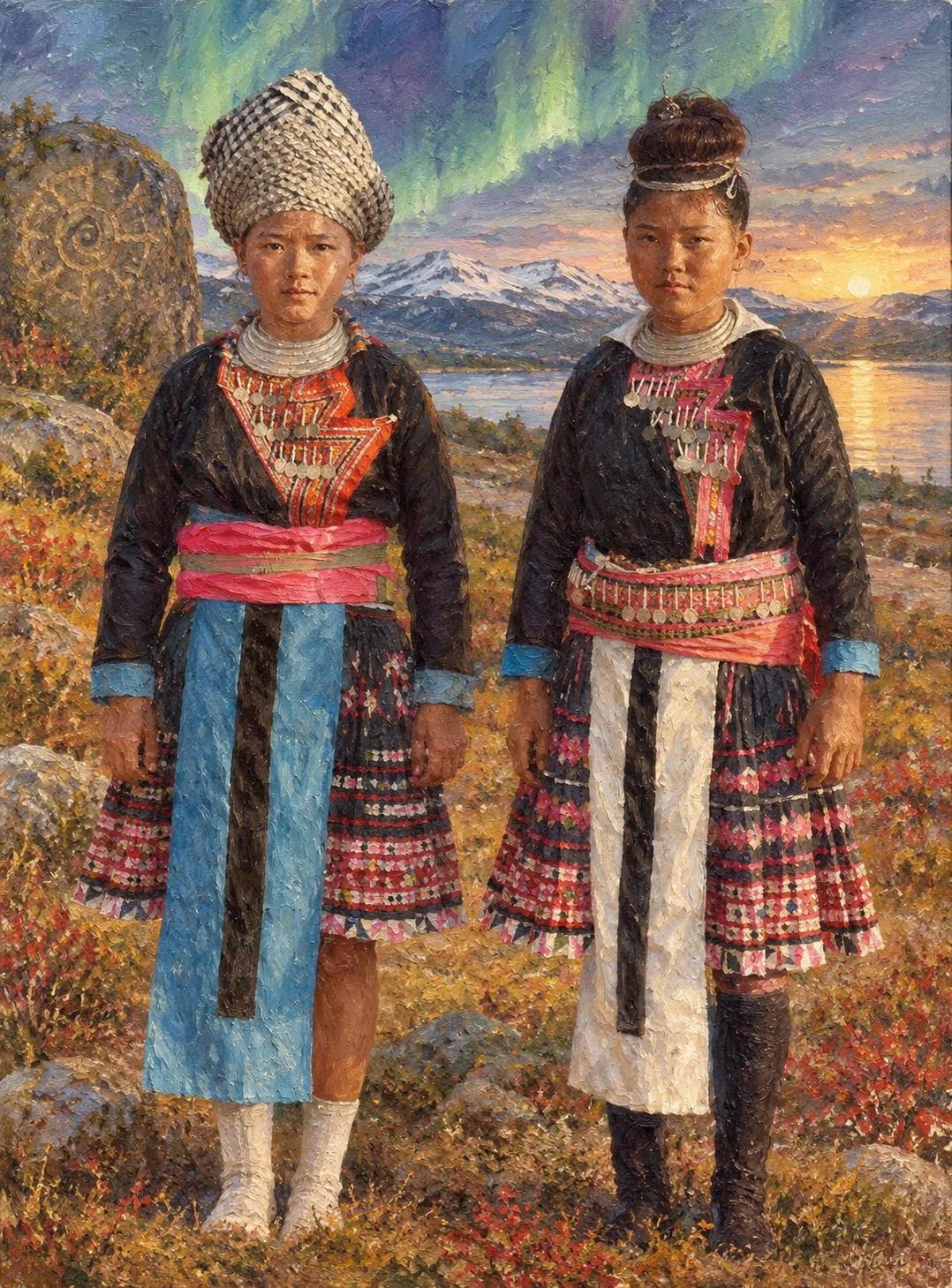
Hmong women are known throughout the world for paj ntaub, a term meaning “flower cloth”. These are embroidery and appliqué works of breathtaking precision: geometric patterns of spirals, snails, crosses and stars, rendered in vivid colours against dark fabric.
The patterns are not merely decorative. Many have names and meanings connected to nature, family and protection. The spiral, or “snail shell”, can represent family unity and the journey of life. Clothes made for New Year celebrations or funerals carry the story of the person who created them.
In more recent times, Hmong women have also developed embroidered story cloths, depicting entire life histories, myths and village life through images. Researchers have described them as a visual language, a way of preserving and passing on knowledge without words.
Today, Hmong textiles can be seen in markets in Luang Prabang, Vientiane and Vang Vieng in Laos. Behind every piece lie hours, days and sometimes months of work, as well as knowledge passed down from mother to daughter over generations.
New Year in the Mountains
If you want to experience Hmong culture at its most joyful, you should attend the Hmong New Year, Noj Peb Caug. It is usually celebrated in November and December, after the harvest has been completed. It is a time for gratitude, reunions and renewal.
Families make offerings to their ancestors and household spirits, giving thanks for the year's harvest. Shamans perform rituals to cleanse the house and call the souls home before the new year begins. Then the celebrations start. Young women and men dressed in colourful costumes decorated with silver ornaments line up in long rows and toss a ball, pov pob, back and forth. It is an ancient game, and many love stories have begun this way. There is singing, food, silver jewellery sparkling in the sunlight, and laughter echoing between the mountains.
In Laos, the Hmong New Year is one of the major cultural events, attracting large numbers of people, including members of other ethnic groups. It is a clear expression of the country's cultural diversity and of a tradition that continues to stand strong.
A Tradition in Motion
The American researcher Dwight Conquergood wrote in the 1980s about how Hmong shamanism and Western medicine could complement one another rather than compete. He observed how respect for traditional healers created trust and opened doors. The same understanding is shared today by many healthcare workers in the region. The shaman and the doctor can work side by side. One takes care of the body, the other of the soul's place within the family and the world.
Journalist Anne Fadiman portrayed a Hmong family and their encounter with a Western hospital in her award-winning book The Spirit Catches You and You Fall Down (1997). The book is still included in the curriculum of many medical schools because it demonstrates something fundamental: understanding what illness means can be just as important as the treatment itself.
Today, Hmong traditions continue in many different ways. Some families maintain the old rituals, others combine them with Buddhism or Christianity, and many young Hmong people are discovering a renewed pride in their language, music and craftsmanship. The Hmong language has its own Latin-based alphabet, developed in the 1950s, and today it is used in songs, books, social media and videos. Young musicians combine the qeej with modern sounds. Textile artists incorporate traditional patterns into contemporary designs.
Back in the Village
Inside the house, the gong falls silent. The shaman steps down from the bench and removes the black cloth. Sweat runs down his face, and his breathing is heavy. In a quiet voice, he tells the family something: the soul has been found. It had wandered away near the stream where the child fell a week earlier. Now it is on its way home.
The mother ties a white thread around the child's wrist. The grandfather does the same and murmurs a blessing. Outside, the mist has lifted, and the sun shines on the mountainsides.
It is easy to think of Hmong shamanism as something exotic and distant. But if you stand in the middle of such a room, it is not the unfamiliar that strikes you. It is what feels recognisable: a family gathered around a sick child, a community supporting one another, and a belief that no one should be lost, neither in life nor in death.
Hmong shamans still ride their invisible horses through the mountains. They do so for the same reasons they always have: to hold together what belongs together, and to find the way home.