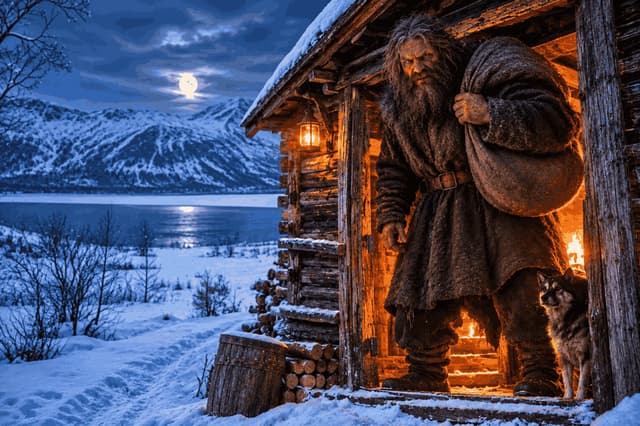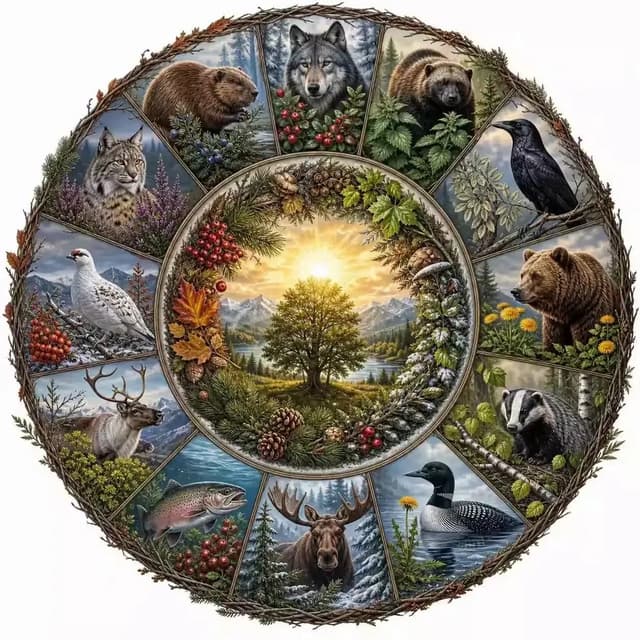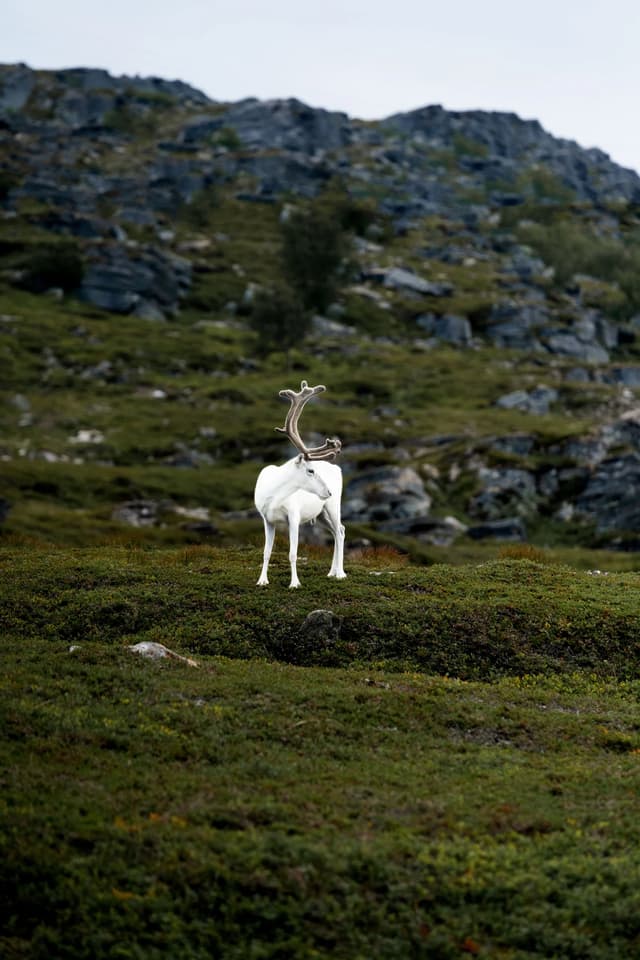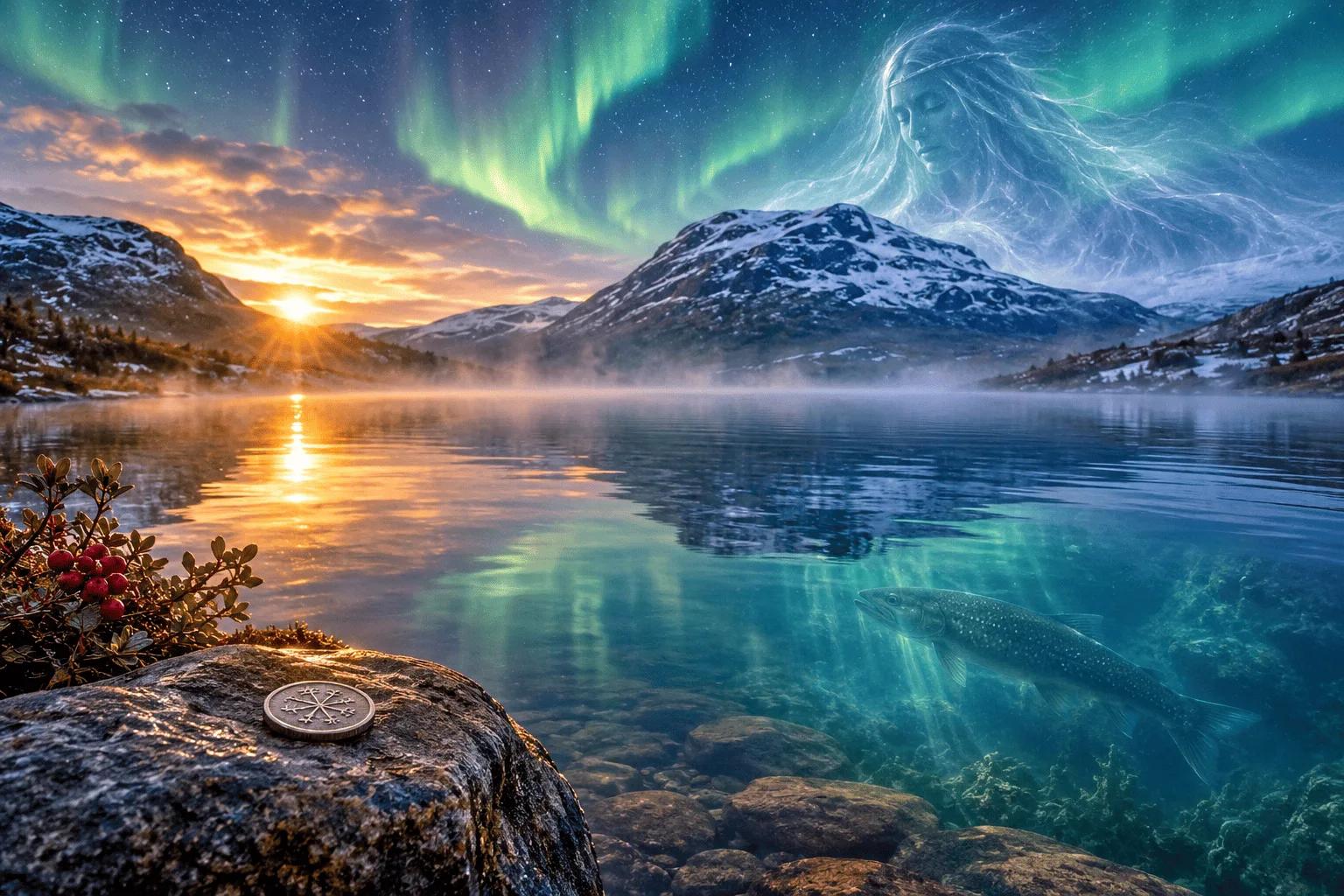
When I go fishing, I often offer coins, especially when setting out in a boat. I am also careful not to whistle, having been taught that this might arouse the wind. These are among the teachings I received from my teachers. They belong not only to stories about the past, but to the way I approach water today.
A coin and a withheld whistle may seem small things. Yet both invite a different understanding of the shore: not simply a convenient place from which to launch a boat, but a threshold where our behaviour matters.
This is also where a journey through Sámi water traditions should begin. Not with a single pantheon imposed upon the whole of Sápmi, but with relationships shaped by particular places and livelihoods, an approach emphasized by Phebe Fjellström in “Cultural- and Traditional-Ecological Perspectives in Saami Religion” (1987) (Fjellström). From Norway and Sweden through Finland to the Kola Peninsula in Russia, the waters do not all tell the same story.
The one who rules the fish
A net can be carefully repaired and a boat skilfully handled. Still, the fish may not come. The practical question, “Where have they gone?”, can open into another: “Who decides whether they will be given?”
Historical accounts examined by Fjellström name Giase olmai as a power ruling over water, while Jurij K. Kusmenko discusses Tjatsiolmai, the “Water Man,” as a deity associated with fishing, particularly in southern Sámi traditions (Fjellström, 1987; Kusmenko, 2009). These names should not lead us to imagine a northern Poseidon enthroned beneath every lake. They point instead towards locally recorded ways of understanding the powers with whom fishing brought people into contact.
Fjellström also discusses tjatse-halde, a water spirit to whom Sámi in the area of Finland reportedly offered silver coins in the hope of obtaining fish, beaver and pearls; other accounts connect wind powers with sea, water and weather (Fjellström, 1987). From a small boat, such connections need little explanation. Wind and water are not experienced as separate departments.
The historical mention of coins echoes my own practice, although resemblance alone cannot establish an identical meaning or an unbroken line of transmission. My account is narrower and more personal: I offer coins when fishing, and I remember my teachers’ warning about whistling. The archive and a living teaching can stand beside one another without either having to speak for every Sámi community.
The lake beneath the lake
Imagine a still lake reflecting a mountain. For a moment, the reflected slopes seem to descend into another country. It is only an image with which to approach the subject, but the possibility of another world beneath familiar water has a documented place in Sámi traditions.
In From Boulders to Fells: Sacred Places in the Sámi Ritual Landscape (2015), archaeologist Tiina Äikäs describes traditions, particularly from present-day Finland and Sweden, of sáiva lakes with a double bottom and access to a world inhabited by human- and animal-shaped beings who could protect people or assist hunting and fishing (Äikäs, p. 44). Depth becomes more than a measurement. What appears to be the bottom is not necessarily the end.
The sáiva complex could also be associated with mountains and fells, and not every sacred lake had a sieidi beside it, although some did (Äikäs, p. 44). Regional variation matters: sáivo and related terms should not become a rigid map of an identical otherworld everywhere.
At Äkässaivo in Finnish Sápmi, the lake and the rock formation Seitapahta form part of a documented sacred landscape (Äikäs, pp. 109–110 and site descriptions). A named lake brings us back from general symbolism to somewhere people could actually approach, remember and revisit.
On the Swedish side, Inga-Maria Mulk and Tim Bayliss-Smith examine rock images and water seeping from cliffs at Badjelánnda, suggesting that such features may have contributed to the place’s religious significance; their interpretation of boats as possible vehicles between worlds remains a scholarly proposal, not a recovered explanation from the images’ makers (Mulk and Bayliss-Smith, 2007). Water can open a question without supplying a final answer.
Water and the noaidi
For a discussion of noaidevuohta, these relationships lead beyond the visible shoreline. Francis Joy’s “Sami Shamanism, Fishing Magic and Drum Symbolism” explores water as a boundary and possible route in the noaidi’s dealings with otherworldly beings, interpreting fish and water-bird imagery in relation to livelihood and spiritual assistance (Joy). His reading of a surviving drum is an interpretation, not a universal key to every painted figure.
A diving bird offers a compelling image for the reader: a creature disappearing beneath the surface and returning from a depth the watching human cannot see. Yet the important relationship is not simply between a traveller and an entrance. As Louise Bäckman emphasizes in “The Noajdie and His Ecstasy,” the ritual specialist’s abilities depended upon helping powers from the other world (Bäckman).
This is not merely a story of individual power. It is also one of assistance and dependence. Nor did every act beside sacred water require a noaidi: Mulk and Bayliss-Smith distinguish household and community religious practices from the more occasional interventions of ritual specialists (Mulk and Bayliss-Smith, 2007).
Water that carries away
Water is not approached only for what it might give us. Sometimes the hope is that it will carry something away.
Alongside the teachings about fishing, I want to include two bathing practices: entering a brook that comes down from the mountains for healing, and bathing in the ocean beneath a full moon to release what is described as “heavy energy.” I bring these into the account as spiritual practices, not as medically established treatments or customs I can claim for every part of Sápmi.
Johan Turi offers a related, though distinct, account in An Account of the Sámi: deep, bubbling cold springs inhabited by powerful háldi spirits could bring healing to those who knew how to approach them, requiring one to “wash in it and make a little payment” (Turi, translated by Thomas A. DuBois, p. 115 in the linked text). The small offering brings us back to a familiar pattern: receiving something from water also involves giving.
Turi explicitly warns against drinking from these particular springs or using their water for anything other than healing, lest the háldi spirits become angry (Turi, p. 115). His passage concerns washing and an offering, not drinking brook water, and should not be treated as documentation of the separate full-moon bathing practice.
The brook, spring and ocean thus offer different ways into the article’s central question. We have asked what it means to receive from water; bathing also invites us to consider what it means to let go.
The stone that receives a share
Beside the water, a stone may become the focus of the relationship. Äikäs describes historical traditions in which particular sieidis could speak, move, become angry or give advice, making an offering something more than placing food before an inert object (Äikäs, pp. 88–89). The difference between approaching a stone as something and approaching it as someone changes the meaning of the gesture.
At Taatsi in Kittilä, archaeological excavations recovered pike, perch and trout bones, supporting accounts of the place as a fishing sieidi; radiocarbon dating of pike bones placed part of this activity in AD 1040–1220 (Äikäs, pp. 55–56). The bones cannot preserve the words spoken over them. They nevertheless give material depth to the history of offerings.
Sámi scholar Liv Østmo and sociologist John Law recount a story of a fisherman pouring fish oil over a stone, a boy throwing the stone into the lake, and subsequent misfortune revealing the power of the offended sieidi (Østmo and Law, “Mis/translation, Colonialism, and Environmental Conflict,” 2018, p. 353). Its question is unsettling: what happens when one person treats as disposable what another knows as a partner?
A fishing sieidi thus draws attention to both sides of the catch. There is what the human receives, and there is what the human gives. The lake is not approached only with an empty hand waiting to be filled.
A voice across the water
Can a lake be joiked? Østmo and Law describe making and singing a luohti for a lake among practices of caring for waters in northern Norway, alongside tending channels and the conditions in which fish live (Østmo and Law, pp. 354–355). Song appears here not as decoration, but within the relationship itself.
At Taatsinkirkko, accounts examined by Äikäs describe dripping water, resonant echoes and people singing sieidi prayers beneath the rock; she also records connections between joik and offerings, including traditions of sieidis themselves joiking and Taatsi answering with a bell-like sound (Äikäs, pp. 118–119). Falling water, a human voice, an answering resonance: the scene needs no invented melody to hold our attention.
An eastern example survives as an identifiable recording: Pavla Konkova’s “На Сейдозере,” “At Seydozero,” recorded in 1977 and released on Melodiya’s Sámi Songs in 1982 (Российские саами, recording documentation). Its title is also documented by the Murmansk regional scientific library, although the catalogue does not establish that this particular piece was a noaidi’s ritual invocation (Murmansk library catalogue, entry 72).
Song, however, was not always the appropriate approach. Äikäs also describes sacred places where silence was required and even squeaking oarlocks could be unwelcome (Äikäs, pp. 118–119). This is not evidence for the exact teaching I received about whistling. It does, however, bring us back to a shared question: what sounds should we carry onto the water, and which should we leave ashore?
The sacred waters of Kola
On the Russian side of Sápmi, the waters have their own recorded inhabitants. In their Russian-language account “Саамы. Духовная культура,” researchers V. A. Belyaeva-Sachuk and E. N. Danilova describe Akkruva, a human-fish being, and a spirit in walrus form as helpers associated with fishing (Belyaeva-Sachuk and Danilova, “Sámi Spiritual Culture”). These beings deserve more than being folded into a western catalogue of mermaids.
The same account describes sieidi as referring both to a revered place and its local spirit, with offerings including fish oil applied to stones (Belyaeva-Sachuk and Danilova). Once again, water, animal, stone and human meet through an action. The relationship is something done, not merely believed.
Near Lujávri, in the Lovozero region, lies Seydozero, also rendered Seidyavr, whose continuing sacred significance is described in this Russian scholarship (Belyaeva-Sachuk and Danilova). It belongs centrally in a journey through Sámi sacred waters, though its sacred character alone does not establish that every western account of double-bottomed sáivo lakes applies here unchanged.
Above the lake, the cliff figure Kuiva enters several kinds of narrative: Vadim Likhachev’s “Легенда о Куйве,” “The Legend of Kuiva” (2018), discusses both a master of the place and traditions of an evil attacker or sorcerer overcome and fixed in the landscape (Likhachev, 2018). A place can hold more than one memory of power.
These traditions should also be distinguished from modern claims about a lost Hyperborean civilisation, a separation emphasized by Alena Davydova and Sergei Shtyrkov in their research on Seydozero tourism (Davydova and Shtyrkov, 2025). The lake does not need somebody else’s vanished empire to make it extraordinary.
Another Kola narrative takes us to Bolshoy Vudyavr in the Khibiny Mountains, where Likhachev gathers accounts of a resident power called galles that disliked loud conversation and boating (Likhachev, “Сейд на Большом Вудъявре”). In Wilhelm Ramsay’s account, a gunshot fired despite Sámi warnings was followed by falling stones, understood by the Sámi companions as a warning from the spirit (Likhachev, quoting Ramsay). Whatever explanation a reader gives the falling rocks, the human failure is clear: the visitors had been told how to behave and had refused to listen.
When the water reaches back
Not every presence offers protection. Thomas A. DuBois’s research on early twentieth-century folklore from northern Norway preserves distinctions between spirits of drowned people and the rávga understood by one narrator as a physical creature (DuBois, 2023). Such distinctions caution against gathering every frightening being into one category of “water demon.”
In one account, a rávga enters a dwelling with wet kelp hanging from its head, warms its fingers and asks for coffee (DuBois). The domestic detail makes it more disturbing. The unknown does not remain outside; it sits down beside the fire.
Water beings also remain present in contemporary storytelling: a research report from a Sámi kindergarten setting in Tromsø describes children discussing čáhcerávga beside a partly frozen lake, connecting imagination with learning caution around dangerous water (Ødegaard and colleagues, 2023, pp. 15–17). A story can warn without being only a warning. It can also teach that familiarity with a place does not make us its masters.
What the lake gives
Østmo and Law describe jávredikšun, caring for lakes, through practices that include clearing channels, attending to fish populations, limiting the catch, making offerings and blessing the water (Østmo and Law, pp. 353–355). Practical knowledge and respect are not confined to separate worlds. The hands that tend the net can also perform a gesture of gratitude.
“Jávri addá dan maid addá”: “the lake gives what it gives,” runs an expression they record (Østmo and Law, p. 353). It does not explain every water spirit or every sacred shore. It does remind us that taking is not the only important human action.
For me, these questions return to the teachings with which I began: offering coins when fishing, and remembering not to whistle when the boat carries me onto the water. I offer them here as my own received teachings, not as rules for everyone. Alongside them, bathing brings the hope of healing and release into the story. A coin, a song, a carefully kept silence, a body entering the current: different gestures, each asking us to consider how we enter a place and what relationship remains when we leave.