Sami rock carvings, spread across Norway, Sweden, Finland and Russia, represent an important part of the Sami cultural heritage. These rock carvings, or petroglyphs, provide insight into early Sami history, cosmology and spiritual practices. The researcher Francis Joy has through his work contributed significantly to the understanding of the shamanic significance of these rock carvings, which are often connected to nature, wildlife and the spirit world.
Francis Joy
Francis Joy is from West Yorkshire in Great Britain, and has lived in Finland since 2004. Since that time he has studied and worked as a researcher in Sami religion at the University of Helsinki, where in 2007 he obtained a master's degree in the philosophy of religion with a focus on Sami shamanism and prehistoric rock art in Finland. In March 2018, Francis completed his doctorate at the University of Lapland, Faculty of Art and Design in Rovaniemi, Finland. His studies in Rovaniemi, which began in 2010, have mainly concerned Sami religion, cosmology and art from prehistory to the seventeenth century and onward into contemporary culture.
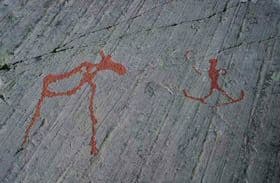
Rock Carvings in Context Rock carvings are prehistoric art, in which images and symbols are carved into stone. Sami rock carvings, which date back to the early Stone Age and Bronze Age, stand out for their unique motifs and symbolism. They are found mainly in areas such as Alta in Norway, Nämforsen in Sweden and on the Kola Peninsula in Russia. These rock carvings are often located near sources of water, which suggests their practical and spiritual significance.
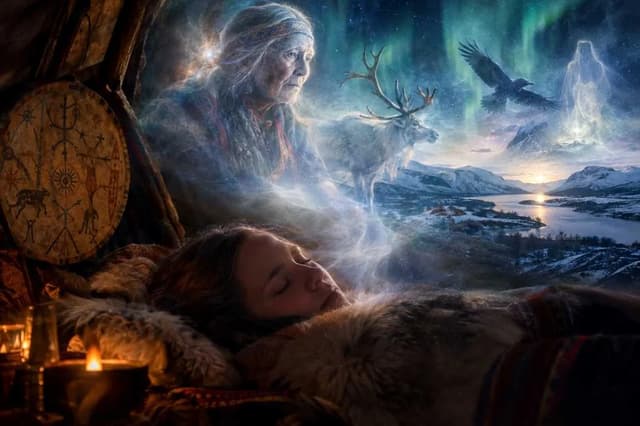
Shamanism and Rock Carvings Shamanism has been a central part of Sami spirituality for millennia. A shaman is a spiritual leader who communicates with the spirit world through trance and rituals. The rock carvings give visual expression to the shamans' cosmology, and show motifs such as animals, humans and mysterious figures that can be interpreted as spirits or deities.
Francis Joy has been a pioneer in highlighting the shamanic significance of these rock carvings. In his research he argues that many of the depicted scenes represent shamanic rituals, hunting magic and communication with animal spirits. For example, images of reindeer, a central animal in Sami culture, can be interpreted as a manifestation of the animal's spirit, which shamans could invoke to ensure a successful hunt.
Examples of Rock Carvings Alta, Norway: The rock carvings at Alta, a UNESCO World Heritage Site, contain over 6000 images spanning several thousand years. Many of these images show reindeer, elk, bear and fish, as well as human figures in various scenes that can be interpreted as hunting and rituals. Joy points out that these images probably represent shamanic practices and communication with the spirit world. This is the largest find of Sami petroglyphs.
Nämforsen, Sweden: This area contains the second-largest collection of rock carvings in Northern Europe. Motifs include boats, animals and humans engaged in various activities. Joy and other researchers have suggested that these rock carvings may represent shamanic journeys or hunting ceremonies, with a deep symbolism connected to the cycles of nature and the spirit world.
Kola Peninsula, Russia: The rock carvings here show complex scenes with animals, humans and abstract symbols. These images provide insight into Sami shamanic practice and worldview. Joy has highlighted how these rock carvings were probably part of ritual ceremonies to communicate with animal spirits and the forces of nature.
In Finland there are also a number of rock carvings from the Stone Age population that lived there at the time. This culture is a genetic relative of today's Sami. These rock carvings can be said to be the first written language, in which worldview, culture and language lie encoded in the images.
Interpretations and Significance Researchers have highlighted several interpretations of the Sami rock carvings:
Rituals and magic: Many rock carvings appear to be connected to hunting magic, where images of animals and hunting scenes were meant to ensure success in the hunt. Cosmology: The rock carvings reflect a deep connection between humans, animals and nature, a fundamental part of Sami shamanism. Spirit world: The abstract and often complex symbols may represent the spirit world and the shamans' communication with spirits and deities. Clear parallels can be found to the symbols on the Sami drum. Sami rock carvings in Norway, Sweden, Finland and Russia provide a unique insight into Sami culture and shamanic practice. Through the work of researchers, we have gained a better understanding of the spiritual and ritual significance of these rock carvings. They are not merely artistic expressions, but also important historical documents that illuminate the Sami people's deep connection to nature and their rich spiritual traditions.
Sources Joy, Francis. "The Significance of Sami Rock Art in the Context of Shamanism and Ancient Spiritual Practices." Joy, Francis. "Shamanistic Rituals and Petroglyphs: Understanding Sami Spirituality Through Rock Art." UNESCO World Heritage Centre. "Rock Art of Alta." Norrköpings stadsmuseum. "Nämforsen Helleristninger." Russian Academy of Sciences. "Petroglyphs of the Kola Peninsula." Joy, Francis. "Ritual Magic in Sami Rock Art." Joy, Francis. "Sami Cosmology and Rock Art." Joy, Francis. "Spiritual Communication in Sami Petroglyphs."