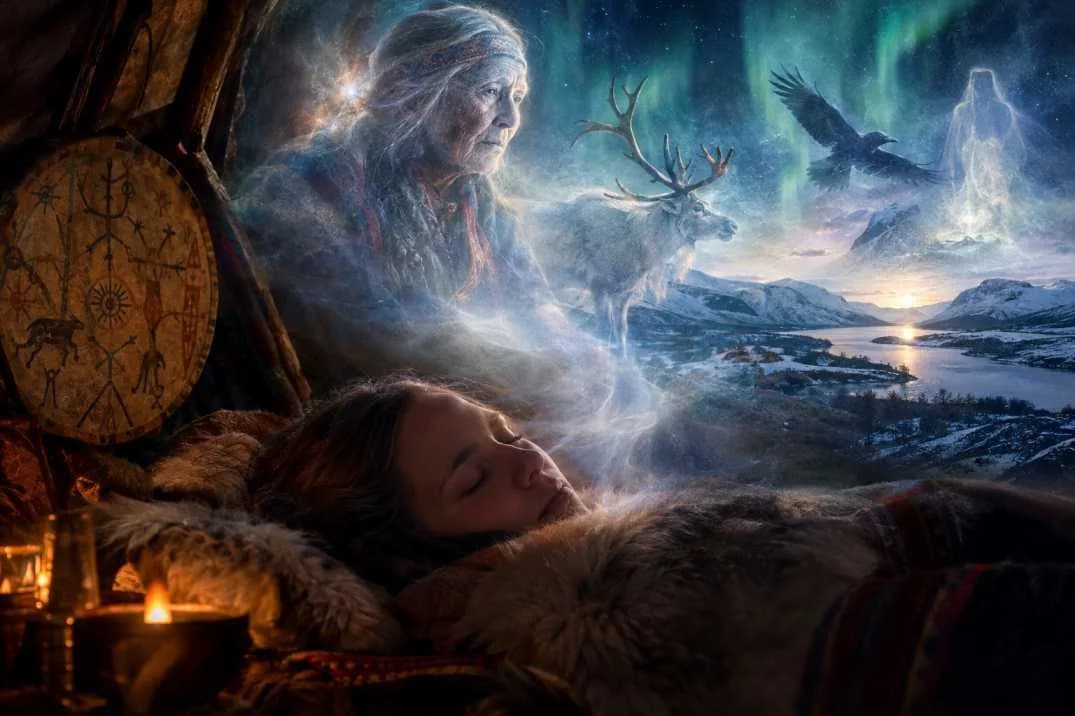
It is night, and the fabric of the lávvu shifts gently in the wind. The fire has burned down to glowing embers. The person sleeping lies still, yet something within her is on a journey. She walks beside a river she has never seen before, and on the bank stands an elderly woman wearing a Sámi gákti. The woman says nothing, but looks at her belly and smiles. In the morning, the young mother knows what her child will be called.
Stories like these do not belong only to old missionary accounts. I have heard them from people living today, around kitchen tables in Finnmark and in conversations after ceremonies. That is why I am writing this article. I write as a practitioner of noaidevuohta, with ancestral roots in Unjárga (Nesseby), and as part of a living practice. But I also write as someone seeking to communicate knowledge honestly, distinguishing what the sources actually say from my own interpretations. Whenever I interpret something from a shamanistic perspective, I make that clear.
A world without watertight boundaries
To understand why dreams have held, and continue to hold, such significance in Sámi tradition, we must begin with its understanding of reality. Sámi scholar Elina Helander-Renvall describes a worldview in which there is no sharp division between the physical and spiritual worlds, and in which humans, animals and spirits can all be regarded as “persons” in relationship with one another (Helander-Renvall, Polar Record, 2010). She writes about a “mythic discourse” between humans and non-humans, a conversation that takes place through dreams, rituals, stories, prayers and actions, helping people navigate everyday life (as discussed in Suomen Antropologi).
Notice that dreams come first in that list. In such a world, a dream is not merely the brain tidying itself up during the night. It is one of the channels through which the world speaks to us. Helander-Renvall also writes that certain beings in the landscape may first make themselves known when something disturbing happens, after unusual dreams or when strange sounds are heard (cited in Enchantment and Non-human Voices in the Sámi Yoik). A dream is therefore a place where our proximity to the unseen becomes perceptible.
In Sámi tradition, human beings are often understood as having several souls or aspects of the soul. The free soul is the most mobile; it can leave the body during sleep, illness and trance. I have written more about this in my article Sámi Concepts of the Soul. From a shamanistic perspective, this is the key: when we sleep, a part of us travels. A dream is not simply something that happens inside us, but something in which we participate out there, beyond ourselves.
When the dead ask for a name
The clearest example of the significance of dreams can be found in naming traditions. The Store norske leksikon encyclopedia describes how the dead in saivo, the world of the dead, could long to return to the world of the living and communicate this through dreams. Expectant mothers might dream of a particular relative who wished the child to be named after him or her (Store norske leksikon: “Saivo”). If several relatives wanted the same child to bear their names, the child could become ill, and there were female specialists who could perform a new baptism or naming rite (Store norske leksikon).
In the Southern Sámi tradition, such a name was called saajvenïmme, meaning “saivo name”, and the ritual was known as saajvelaavkoe, or “saivo baptism”. After the rite, the deceased person's nïmmeguelie, the “name fish”, accompanied the person who received the name (Eldar Heide, 2022). Studies of the history of religion also indicate that a child named after a deceased relative could receive that person's helping spirit (Saami Religion, edited by Ahlbäck, 1987).
What matters most to me, however, is that this tradition did not end with Christianisation. Norway's official report NOU 1995:6 states that choosing a name remained so important “up to our own times” that people consulted their female and male ancestors. Some children were named after deceased relatives who visited the expectant mother in a dream (NOU 1995:6). If a child became ill after being baptised in church, this could be interpreted as a sign that the ancestors were displeased. The church-given name might then be washed away at home, and the child given a Sámi name (NOU 1995:6).
This is documented in an official report from the 1990s, not merely in a travel account from the seventeenth century. Church baptism and dream-inspired naming existed side by side. Neither necessarily had to give way to the other.
The advice that came during the night
The noaidi, too, could receive knowledge through dreams. Historical material on Sámi religion mentions that helping spirits could offer guidance in dreams (Reuterskiöld, cited in Saami Religion, 1987). The missionary Henric Forbus appears to describe spirits being invoked through yoik, with the answer arriving in a dream (Saami Religion, 1987).
This suggests a practice in which waking and dreaming states are connected. The yoik opens the door, sleep carries the journey, and in the morning one brings back what has been received. At the same time, I must be honest about the limitations of the sources. Much of what we know about older Sámi religion was written down by priests and missionaries who wanted to eradicate it. Historian of religion Håkan Rydving has shown how carefully we must ask who wrote these accounts, for whom, and under what pressures. This does not make the sources worthless, but it means we must read them cautiously.
From a shamanistic perspective, however, I would say that what Forbus describes is familiar to many practitioners today. When I work with a drum or yoik in the evening, the answer often comes during the following night. It is as though the ritual action poses the question and the dream provides the answer. To me, this is not superstition but a method: a way of asking for guidance that requires patience and the ability to listen.
“The only thing we have changed is the uppermost tier of gods”
How can a tradition that was persecuted so severely still be alive? Social anthropologist Marit Myrvoll conducted eight months of fieldwork in the Lule Sámi community of Musken in Tysfjord, where Laestadianism shapes everyday life. One woman explained the development this way: “The only thing we have changed is the uppermost tier of gods” (discussion of Myrvoll's dissertation at samer.se).
Myrvoll shows how traditional Sámi understandings of death coexist with Christian belief in a Northern Norwegian rural community, and how certain experiences are interpreted as signs of proximity to the world of the dead (Myrvoll, Religion og livssyn). She describes, among other things, an incident in which a deceased relative appeared in a dream to someone who had been bereaved and said that she was cold (discussed in Samer och livets slut).
A dream like this calls for a response. Perhaps something warm needs to be placed in the coffin; perhaps something else must be done for the deceased. The dream is not merely an image. It creates an obligation.
Sociologist Astri Dankertsen has shown that stories about hauntings and unseen beings in Sámi areas are more than remnants of an old religion. They have helped people grow into a Sámi worldview, even in communities where the language and visible expressions of culture were suppressed for a long time (Dankertsen, 2022). I believe dream stories serve a similar purpose. When a grandmother tells the story of a dream she had before her grandchild was born, she is passing on more than an anecdote. She is passing on a way of seeing the world.
Dreams today
I encounter this regularly. People come to me with dreams they do not quite know what to do with. A deceased grandfather standing in a doorway. A reindeer looking straight at them. A mountain calling to them. Many grew up in families where such things were spoken of in hushed voices, or not discussed at all. The Norwegianisation policies taught many Sámi people that it was shameful to “believe in such things”. Yet the dreams have continued to come.
From a shamanistic perspective, I understand this as follows: the connections to our ancestors and the landscape were never entirely severed, even when the language used to describe them grew weaker. Dreams are perhaps the channel that has been hardest to prohibit. Drums can be burned and noaidi practitioners punished, but no one can forbid a person to dream. Perhaps this is why dreams have been among the safest carriers of continuity in Sámi spirituality.
When we at the Shamanistic Association of Norway hold naming ceremonies, it is often a dream that points the way. Parents tell us about dreams they experienced during pregnancy, and we take them seriously. This is not an attempt to recreate a lost past, but a continuation of something that never entirely ceased. At the same time, it is important to acknowledge that contemporary practice has been shaped by both inheritance and the present day. We do not live as people did in the seventeenth century, and we should not pretend that we do.
Listening without overinterpreting
Not every dream is a message. This is true both of the tradition and of my own practice. Some dreams concern everyday life, our anxieties and the things we carry with us. The skill lies in distinguishing dreams that are simply dreams from those that carry particular weight.
From a shamanistic perspective, significant dreams often feel more real than ordinary dreams, recur over time, or carry a clear wish or warning. Tradition also offers us an important corrective: dreams are not interpreted in isolation. They are interpreted together with others, with family, elders and, where appropriate, a noaidi. Meaning emerges through relationships, not in isolation. This accords with Helander-Renvall's description of the relationship between humans and non-humans as relational and dependent on context (Helander-Renvall, 2010).
The night as teacher
The Store norske leksikon states that, in Sámi tradition, death became final only when a person was forgotten. This tells us something about what dreams really are. They are places where those who came before us can be remembered and continue to accompany us. Every time a mother dreams of a name, every time someone takes a dream about a deceased relative seriously and acts upon it, a thread between generations remains alive.
When I go to bed at night, I still offer a small prayer that the night will teach me something. I do not always receive an answer. But I have learned that dreams are teachers who cannot be forced. They come when they choose, and they speak a language older than both the church and colonialism.
Dreams in Sámi belief do not belong only to the past. They are still being dreamed every night, in lávvus, detached houses and apartments throughout Sápmi.
Sources
- Dankertsen, Astri (2022). “It's More Like It Doesn't Even Exist”: Stories of Hauntings as a Way of Resisting Colonial Elimination of Sámi Presence. PDF.
- Heide, Eldar (2022). Old Icelandic and Sami Ancestor Mountains: A Comparison. PDF.
- Helander-Renvall, Elina (2010). “Animism, Personhood and the Nature of Reality: Sami Perspectives.” Polar Record 46(1): 44–56. Cambridge Core.
- Ahlbäck, Tore (ed.) (1987). Saami Religion. Åbo: Donner Institute. Digital edition.
- Myrvoll, Marit (2010). “Bare gudsordet duger”: Om kontinuitet og brudd i samisk virkelighetsforståelse. PhD dissertation, University of Tromsø. Overview.
- Myrvoll, Marit (2011). “Døden er den andre verden.” Religion og livssyn 23(1): 32–37. PDF.
- NOU 1995:6. Plan for helse- og sosialtjenester til den samiske befolkning i Norge, Chapter 4. Regjeringen.no.
- Rydving, Håkan (1995). Tracing Sami Traditions: In Search of the Indigenous Religion among the Western Sami during the 17th and 18th Centuries. Oslo: Novus.
- Store norske leksikon. “Saivo.” snl.no.
- Samer och livets slut. Umeå University. DiVA.