On the bird, the fish, the reindeer bull and the bear – and why they are not simply “power animals”
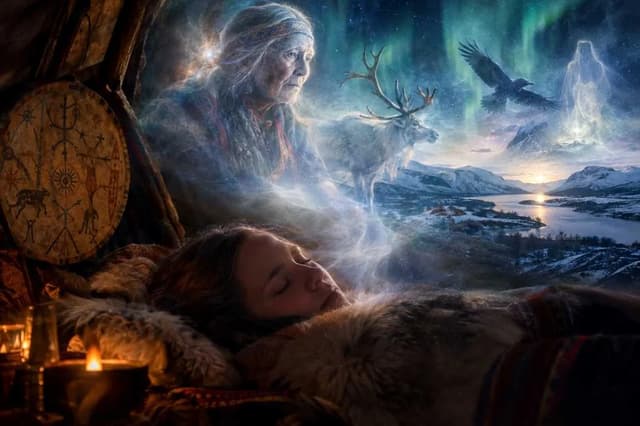
It is late in the evening, and the drumbeats have found their own pulse. The room is dark, but a landscape opens up behind my closed eyelids. I know who will arrive first. Not because I have decided it, but because the relationship has been there for a long time: a presence that stands beside me before the journey begins. In Norwegian, many of us say “my power animal”. But every time I use those words, I feel that they are too small, and that they come from somewhere else.
My teachers had a different word. They called it sueie. I learned the word from them orally, long before I encountered it again in old texts and academic research. That is why, in this article, I am not merely someone reading the sources. On this particular point, I am a source myself.
This article is about Sámi companion spirits – known in Northern Sámi as noaidegázzi (plural noaidegáccit), written as noide-gadze in older sources, and also called sueie. It explores how these spirits had specific tasks in particular parts of the cosmos: the bird, the fish and the serpent, the reindeer bull – and the bear, which may be closer to the very heart of the idea of a companion spirit than we have previously thought.
I write as a practitioner of noaidevuohta. I draw on three kinds of sources: the writings of missionaries and clergy from the seventeenth and eighteenth centuries, modern scholarship, and the oral tradition passed on to me. Where I offer an interpretation, I say so.
An essential qualification: power animals are a bridge, not a map
Let me make one thing clear from the outset: when I compare noaidegáccit with power animals, I do so only to make the subject more accessible. Power animals are a concept familiar to many readers, and the term can serve as a bridge into this material. But Sámi religion is a culture in its own right, with its own concepts, language, landscape and history. It is not a local variation of a universal “core shamanism”, and noaidegáccit are not power animals dressed in Sámi clothing.
The term power animal was popularised by the American anthropologist Michael Harner in his 1980 book The Way of the Shaman. The historian of religion Andrei Znamenski describes how Harner built his concept of “core shamanism” on the premise that a tradition, once “stripped of its cultural clothing”, reveals generic, cross-cultural practices. One of the central aims of Harner’s system is to find one’s own power animal, which is supposed to function as a kind of guardian angel. Znamenski also points out that what Harner calls power animals are known in ethnographic literature as guardian spirits, spiritual familiars, totem animals or helping spirits.
Archaeologist Tiina Äikäs and scholar of religion Trude Fonneland make the crucial point: although animals occupied a central place in Sámi worldviews, the term “power animal” is not found in the sources describing the old Sámi religions. They also show that the Sámi Shamanistic Association itself has stated that there is no direct equivalent to power animals in ancient Sámi worldviews, although beings with similar functions do exist. The most common names are “Noaidegàssi (Gadze) or Sueie”, and these beings may take either human or animal form.
There is a well-known history behind modern Sámi shamanism in this respect. Ailo Gaup, whom many regard as the founder of the Norwegian shamanic movement, developed his skills through training at Harner’s Foundation for Shamanic Studies in California. Fonneland shows that, until the late 1990s, shamanism in Norway differed little from the core shamanism developed by Harner. This makes it important for those of us who practise today to return to Sámi sources and allow them to correct imported models – not the other way around.
The practitioner’s interpretation: The concept of power animals is not “wrong”, but it is a translation term. It helps us explain that a relationship exists between a human being and a spiritual helper in animal form. But it tells us little about who the helper is, where it belongs, whom it belongs to, or what it is meant to do. This is precisely where the Sámi material offers a richer understanding.
Gázzi – the company, the group, the companion
The word itself tells us a great deal. Anthropologist Barbara Helen Miller, who has worked with Sámi healers in Porsanger, points out that the singular gázzi means “household, assembly of people” in Konrad Nielsen’s dictionary, while the plural form gáccit is understood to refer to spirits.
Isaac Olsen explained the word as early as around 1715. He described noaidegáccit as the noaidi’s “company, watchers, followers, attendants, teachers, and companions”, explaining that the word gadze in the Sámi language means something like a following, company, group, gathering or fellowship.
A noaidegázzi is therefore not primarily a symbol, but a companion – someone who goes with you.
Olsen’s manuscript Om Lappernes Vildfarelser og Overtro (“On the Errors and Superstitions of the Lapps”) is the oldest and most detailed source we have from Finnmark. It is based on what he himself saw and heard among the Sámi in eastern Finnmark between 1704 and 1715.
According to Olsen, the noaidegáccit are small human-like figures, “only half an ell tall”, dressed in Sámi clothing with “red and blue gáktis”. They offer to teach the chosen person the art of the noaidi. Among the things they provide are nourishment and sustenance, a long life, good fortune, protection against misfortune, and the ability to help the sick and the weak.
Louise Bäckman summarises Olsen’s list as follows: “how to prolong life, how to be a good healer, how to predict future events, how to transform oneself into an animal, and how to obtain practical advantages for oneself and one’s group”. The first things they teach him, Olsen writes, are joik and runes.
Notice the order of events: the spirits come to the human being. Bäckman interprets the sources as showing that the noaidi was chosen by supernatural beings, and that only those chosen by these beings and accepted by the community were qualified.
Olsen writes that the spirits preferably reveal themselves to people descended from a noaidi lineage, “for this is their inheritance and property”. Åke Hultkrantz interprets him as saying that, after a noaidi’s death, the noaidegáccit offered their services to a son or close relative.
Just Qvigstad, who published Olsen’s text in 1910, added information from Nesseby, the place from which my own family originates. According to this account, a noaidi could decide who would inherit his gaddse. After his death, the spirits appeared to the heir and troubled him until he agreed to take them into his service. According to tradition, helping spirits could also be inherited, sold or given as part of a marriage dowry.
Aage Solbakk describes noaidegáccit as beings who could be understood as deceased relatives or former noaidi who lived in Sáiva/Bassevárri, the Sámi “paradise”, and who were believed to offer help when the siida was in need.
Perhaps this is the greatest difference between the Sámi tradition and Harner’s power animals: in Sámi tradition, the companion spirit is connected to kinship, place and community.
The same applies in the south, where corresponding beings are called saajvh. Erik Norberg of Saemien Sijte describes, in material published by Västernorrlands Museum, how noaidi practitioners in particular during the 1720s believed they received help from former noaidi who lived as saajvh in mountains and hills. The mountains were called saajve-vaerie and were associated with predecessors and personal spiritual beings who could help their owner.
This is the heart of the matter for me. A power animal in Harner’s sense is mine. A noaidegázzi is more like ours – part of a network of ancestors, mountains and kinship into which I enter. When I call upon a helper, I am not simply calling upon an aspect of myself, but upon a relationship older than I am.
Sueie – the protector, the working companion and the bear’s guardian
I learned the word sueie from my teachers as part of the oral tradition in which I was trained. The word is also used today in Norwegian shamanic circles, as Äikäs and Fonneland demonstrate when they quote the Sámi Shamanistic Association referring to “Noaidegàssi (Gadze) or Sueie”.
But the word is not a modern invention. It has survived through the transmission of knowledge from teacher to student, and it has deep roots in the written sources.
The earliest written source is Nicolaus Lundius, a clergyman of Sámi descent who was particularly familiar with the Sámi regions of Lule and Pite. Linguist Olavi Korhonen shows that Lundius used the word sueie in the 1670s to refer to the Sámi “spirit of prophecy” – supernatural helping spirits in animal form or appearing as “little people”. They could reveal things happening far away, heal the sick and help the noaidi on journeys to Jábmiidáibmu, the realm of the dead.
Lundius adds that someone with a strong noaidevuođavuoigŋa was also a good “man of the forest” – in other words, a skilled hunter. In the English edition of Schefferus published in 1704, the Sámi are said to call these beings “Sveie”, meaning something like “companions in their labour” or “help-mates”.
Researchers have debated the precise meaning of the word for more than a century. Korhonen reviews the principal theories. K. B. Wiklund believed that sueie was a very ancient term for the shaman’s helper in animal form. Scholars of religion have more often connected sueie with the Southern Sámi saajve, plural saajvh, referring to helping spirits with a range of different functions (Bäckman 1975; Rydving 1993).
As early as 1909, Heikki Paasonen suggested that the word was identical to Northern Sámi suodji (“shelter, protection”) or suoivvan, a view supported by Åke Hultkrantz. Ivar Paulson connected Lundius’s sueie with the concept of the free soul.
Korhonen follows this linguistic line further. In his interpretation, suije, sueie and söiwe may all be connected to the common word suodji, which is suöjjie in Ume Sámi. The word exists across the Sámi language varieties, but it is impossible to determine whether it is inherited from an older Sámi language or an ancient loanword from Finnish suoja, meaning “shelter” or “protection”.
In Lexicon Lapponicum from 1780, Korhonen finds the form sjuoje, plural sjuojeh, explained as “protective spirits” and haldi. The Latin commentary describes them as lares and penates – household guardian spirits – as well as nature spirits.
The most surprising trail leads to the bear. Korhonen shows that the Lule Sámi word sjuodje has preserved its connection with the bear most clearly. In the writings of Anta Pirak, an author from Jokkmokk, sjuoje appears in connection with bear hunting, and the word is clearly associated with the bear’s supernatural qualities.
Pirak explains that one had to be careful about what one said as a bear hunt approached. Otherwise, “vuojn sjuoje biellje gullá goarssás hoallev” – the sjuoje ear might hear careless speech. After telling the story of a man who tried to kill a bear alone and was bitten in the hand, Pirak draws this lesson: “Sjuoje biellje le juohkka sajen stedas gullamin” – the sjuoje ear listens everywhere.
Korhonen concludes that, in Lule Sámi tradition, sjuodje is most closely associated with the bear’s guardian spirit – or, in the terminology of folk belief, the bear’s háldi.
This leads to Korhonen’s central hypothesis. In his English abstract, he writes that “sueie, or ‘a spirit of prophecy’ in a text from the 17th Century seems to have its origin in the belief in the guardian spirit of the bear. We know that the guardian spirits of animals are often transformed into the personal spirits of shamans”.
It is important to emphasise that this is Korhonen’s interpretation, and that he himself considers the words in need of further investigation. The etymology remains unresolved.
It was a powerful experience to discover that the word I had received from my teachers had such deep roots in the written sources, and that researchers from Paasonen and Hultkrantz to Korhonen had connected it with suodji, protection.
Oral tradition and written sources are two different kinds of evidence, and where they meet, they can strengthen one another.
For me, the word now brings together three meanings. Sueie is protection – something that shelters you. Sueie is a working companion, as Lundius’s explanation suggests. And sueie may originally have been the bear’s guardian – the listening ear in the forest.
This is my interpretation, based on a scholarly hypothesis, not an established fact. I will return to what it might mean for our understanding of the bear.
Each spirit has its own task
What most clearly distinguishes the Sámi material from modern power-animal practices is the division of functions. The companion spirits were not universal protectors. They were specialists.
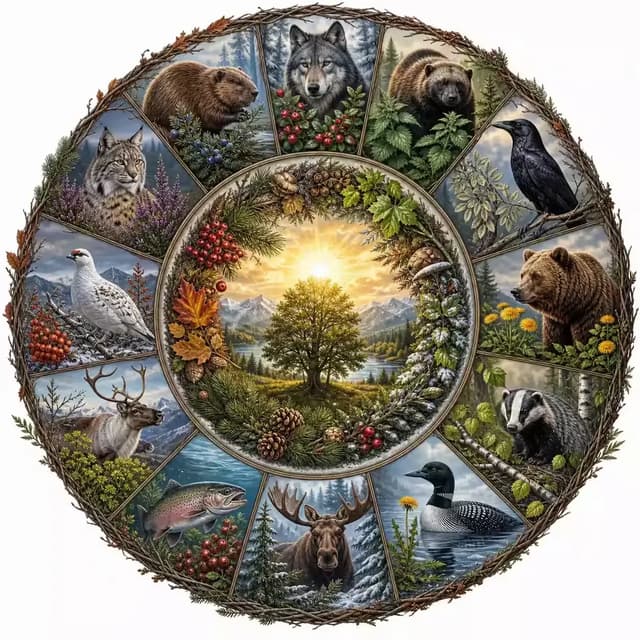
Solbakk lists the invisible helpers available to the noaidi: the bird – noaideloddi; the fish – noaideguolle; and the reindeer bull – noaidesarvvis. Further south, the corresponding names were saivoloddi, saivoguolli and sáivosarvvis. The serpent, gearpmaš, was another helper. Together, they were called noaiddesvuoigna, or noaidi spirits.
Britannica summarises the same tradition: when a noaidi wished to enter a trance, they called upon their guardian spirits from Sáiva – the Sáiva reindeer, the Sáiva fish and the Sáiva bird – for assistance.
Louise Bäckman’s 1975 dissertation Sájva remains a foundational work on the subject. She writes that the noaidi summoned animal forms from Sájva-ájmuo, the dwelling place of spirits: the bird to bring news, the fish to accompany the free soul to places in this world and other worlds, and the reindeer bull to fight as the noaidi’s alter ego against another noaidi in a struggle for power. If the reindeer bull was killed, its owner died as well.
Juha Pentikäinen describes the same animals – the supernatural wild reindeer, fish and bird – as essential to the shaman’s soul journey and as animals into which the shaman could transform.
Lundius also observed this variety. The helping spirits appeared “some like Fishes, some like Birds, others like a Serpent or Dragon, others in the Shape of a Pigmee, about a Yard high”.
Let us follow them one by one through the three worlds.
The bird – messenger between the levels
The bird is the most versatile of the helpers. In the nineteenth century, Lars Levi Laestadius wrote that Sáiva birds came in different sizes and forms, including swallows, sparrows, ptarmigans, eagles, swans, capercaillies and hawks.
They accompanied their masters while they performed joik, showed them the way when they travelled, provided hunting equipment when they went hunting, brought news from distant places and helped look after reindeer herds and other possessions. The noaidi could also travel long distances on the back of a bird.
But the bird also had a darker side. When a noaidi used birds to harm others, they were called vuornes-lodde. Håkan Rydving emphasises that this does not mean there were good birds and evil birds. Rather, the birds reflected the dual nature of the noaidi’s power, which missionary sources interpreted through a moral framework of good and evil.
Francis Joy and his co-authors point out that the accessories of the Sámi drum were kept in a pouch made from the skin of a diver. The diver can be understood as a symbol connecting the three worlds, because it can dive from the water’s surface into the depths and fly above the earth.
The practitioner’s interpretation: In my own understanding, which I have also described in my article on the three worlds in Sámi cosmology, the bird is the helper that provides ascent and orientation. It is most closely associated with the upper world, but the sources do not confine it to that realm. The bird is a messenger between levels – that is precisely its task.
The fish and the serpent – guides through the depths
The fish is the helper for the most dangerous journey: the journey downward. Bäckman’s description is precise – the fish was meant to accompany the free soul. While the bird carries messages, the fish acts as a guide.
This is no coincidence. In Sámi cosmology, Sáiva lies beneath sacred mountains and beneath lakes with a double bottom. Pentikäinen describes Sáiva as the Sámi otherworld beneath the earth or water.
Anyone travelling down through water needs a companion who can breathe there. This was precisely the task of Lundius’s sueie: to help the noaidi when travelling to Jábmiidáibmu.
The serpent, gearpmaš, occupies a similar position. Helpers associated with water appear in very old sources. Historia Norwegiae, from the late twelfth century, tells of a noaidi whose gandus – a dispatched power or spirit – took the form of a “sea animal” (specified as a whale in Tolley’s translation). It was killed when it encountered the gandus of a hostile noaidi while crossing a lake.
The practitioner’s interpretation: I understand the fish and the serpent as helpers of the lower world – both Jábmiidáibmu, the realm of the dead, and Sáiva, the luminous realm. When I work with soul retrieval, this is the kind of helper I need: not strength, but knowledge of the way. The fish knows where the currents flow.
The reindeer bull – the alter ego in Sáiva
The reindeer bull is the strongest helper, and the most dangerous to have. The Sámi Shamanistic Association’s overview states that the most powerful noaidi had reindeer bulls as helping spirits.
Bäckman describes the reindeer bull as the noaidi’s alter ego. It fought on the noaidi’s behalf against the reindeer bulls of other noaidi. If it was killed, its owner died too.
Here we encounter something absent from modern power-animal practices: a helper whose fate is bound to the human being’s own life. The reindeer bull is not merely an ally. In a sense, it is the noaidi themselves, existing in another world.
Bäckman also recounts that when a noaidi became exhausted during these battles, they were strengthened with water from the sacred mountains, sájva-cazie, which the women of the sacred mountains gave them to drink.
The fact that the reindeer occupies this role makes sense. Äikäs and Fonneland write that reindeer have been the most important sacrificial animals since the fifteenth century. The semi-domesticated reindeer is an exception to the modern tendency to regard domestication as a loss of power, precisely because of its deep roots in ritual symbolism.
I understand the reindeer bull primarily as a helper of Sáiva – the one that provides endurance and strength where power is greatest. Its role as alter ego reminds me that certain forms of spiritual work should not be approached lightly. The sources describe a practice involving genuine risks.
The bear – the source of the company?
And then there is the bear. It does not appear in the lists of the classic Sáiva animals. Yet it emerges everywhere we investigate this material: in hunting rituals, in graves, in the noaidi’s transformation into animal form – and, if Korhonen is right, in the very word sueie.
The most sacred animal
In the older sources, the bear is not primarily a helper. It is something greater.
Pentikäinen writes that the bear was spoken of with reverence, as a god and as a member of the human family. An unspoken agreement existed: the bear would refrain from killing human beings, its descendants, while humans would honour the bear and could kill it only within the limits established by myth and with the bear’s own permission.
In 1723, Randulf wrote that the Sámi regarded all animals as sacred, “but the bear they consider the holiest of all”.
Pehr Fjellström, who in 1755 produced the most important account of the living bear cult, explains that the Sámi called the bear passe vaisje, “sacred game”.
The noaidi was involved from the beginning. After the first snowfall, the bear was tracked and surrounded, often with the help of an oracle from the Sámi drum. Leaibeolbmái, the Alder Man, received an offering before the bear hunt to protect the hunters.
When the ritual was performed correctly, it ensured that the bear would be reborn in Sáiva, the otherworld beneath the earth or water. The souls of other sacrificial animals also went there, and deceased noaidi took up residence there.
Archaeology confirms how deeply rooted these beliefs were. Ragnhild Myrstad has investigated 29 bear graves along the coast of northern Norway, dating from around the third century to as late as the eighteenth century (Bjørnegraver i Nord-Norge). The bear’s bones were placed in the grave in strict anatomical order, because both humans and animals could receive new bodies in the otherworld as long as their skeletons remained intact.
Two interpretations of the bear’s name
According to Fjellström, when a bear had been killed, the leader of the hunt was to strike the goahti three times and say söive ålma for a male bear and söive neit for a female bear. What do these expressions mean?
The traditional interpretation goes back to Laestadius, who understood the expressions as “man of Sáiva” and “daughter of Sáiva”, indicating the bear’s sacred nature and origin in Sáiva. Pentikäinen gives the forms as saivo olmai and saivo neit, meaning “man/girl from Sáiva”.
Korhonen interprets them differently. He believes that Fjellström’s söiwe is probably a hypercorrection of the Ume Sámi suöjjie, which subsequently led scholars of religion astray.
Fjellström was an enthusiastic linguist who helped develop Ume Sámi as a written language. Korhonen suggests that Fjellström heard his informants say suöjjie, recognised a sound correspondence between Southern Sámi -jj- and Ume Sámi -jv-, and consequently constructed a form that became söiwe.
If Korhonen is right, söive ålma does not mean “man of Sáiva”, but something closer to “man of protection” – and the word is related to sueie.
Both interpretations connect the bear with the sacred. The first places it in Sáiva. The second makes it the bearer of protection – and therefore the key to understanding the word for the companion spirit.
The bear and the noaidi’s transformation
Could the bear itself be a companion spirit?
Olsen is explicit on this point. Among the things the noaidegáccit teach the noaidi is how to “run in the likeness and skin of wolves and bears, and cast wolf and bear skins upon others”.
Olsen presents this as harmful sorcery: the noaidi could send wolves and bears against other people’s livestock. We must remember, however, that this is the missionary’s perspective. Nevertheless, the connection between noaidegáccit and the form of the bear appears in the oldest detailed source from Finnmark.
Pentikäinen writes that, during trance, the shaman’s soul was imagined to transform into a bird, a fish, a wolf, a bear and other animals. In modern Sámi shamanism, the bear has also become an important helper.
Äikäs and Fonneland argue that the present-day significance of the reindeer and bear as power animals highlights their connections with earlier traditions.
For a long time, I saw the bear as a helper on several levels – the lord of the forest in the middle world, coming from Sáiva and returning there. I still see it that way.
But Korhonen’s work has given me a new perspective. If sueie originally referred to the bear’s guardian spirit, and if the guardian spirits of animals often become the personal spirits of shamans, as he suggests, then the bear is not simply one among the companion spirits. It may be the very source of the idea of a companion spirit.
Perhaps the company surrounding the noaidi developed from the protection surrounding the bear.
When the bear appears during a journey, I do not experience it as a helper I possess, but as a relative who has chosen to stand beside me.
This is my interpretation, based on a scholarly hypothesis and my own practice. The sources do not list the bear among the classic Sáiva animals. But they connect it with Sáiva, with the noaidi’s transformation into animal form and, perhaps, with the very word for protection.
Joik as the key
None of these helpers simply appeared during a ritual. They were called.
In Olsen’s account, joik is the first thing the noaidegáccit teach. Lundius explains that the spirit taught the chosen person a particular song, adding:
“Whenever a Laplander has occasion for his Familiar Spirit, he calls to him, and makes him come by only singing the Song, he taught him at their first Enterview.”
Laestadius wrote that the birds accompanied their masters when they performed joik.
What is most striking is that this is not merely history. Miller describes a man in Porsanger in the 2000s who visits his stone when he needs advice and “calls up” his deceased teacher by singing the teacher’s joik. Miller herself draws the parallel: the song is sung and the helper arrives – just as in Lundius’s account.
Miller also shows that the word gáccit remains part of everyday language. One informant says that gáccit are thoughts and ideas, that they are spiritual and “could be called helpers”. Another describes how the gáccit can hide a tool she needs. When they have taken it, there is no point searching for it; after a few days, it returns by itself.
For me, joik is the difference between thinking about a helper and being in a relationship with one. Each companion spirit has its own address, and the joik is that address.
This is also why I believe modern practice should place greater emphasis on sound, song and names rather than relying on visualisation alone. Oral tradition – the same path through which the word sueie reached me – is itself a kind of joik: something that remains alive because it is passed on.
When the companions do not obey
It is tempting to romanticise companion spirits. The sources do not.
Olsen writes that the noaidegáccit teach the noaidi everything they need to know, “both for evil and for good”. He goes further:
“If the noaidi merely thinks evil of a person he is angry with, the Noide-gadze immediately carries it out as he thinks, without being commanded, and the noaidi cannot control or govern them.”
He recounts the story of a noaidi who was angry with his daughter because she had married against his wishes. The noaidegáccit killed her, and the noaidi later regretted that he had not intended to kill her but could neither control nor command the spirits.
This is the missionary’s perspective, and we must read it critically. Olsen’s text is shaped by religious opposition, and his knowledge was used to compile lists of sacred offering sites that were subsequently destroyed.
Nevertheless, the account resonates with Rydving’s observations about the birds: spiritual power had a dual nature.
The same applies to the bear. Pirak shows that the sjuoje ear hears everything. The lesson in his stories is humility. People should not speak too much or boast too loudly, and hunters were not permitted to brag about themselves.
I read this as an ethical lesson rather than a warning about demons. Companion spirits amplify what is already within us, including thoughts we have not spoken aloud.
This is why noaidevuohta has always required maturity, responsibility and a community around the practitioner. A helper is not a tool for fulfilling personal wishes. Someone who walks with a sueie does not walk with a servant, but with a being that listens.
The wolf is overworked
In their study of Isogaisa, Äikäs and Fonneland quote a comment I once made as a gentle jab at power-animal culture:
“I need to talk to you about spirit animals. The wolf is overworked. And the squirrel – well, the squirrel is beginning to get a little lonely.”
They point out that the animals highlighted by Harner – bears, foxes, deer, porpoises and dragons – have considerable symbolic capital in Western culture.
There is an irony here that I did not recognise at the time: in Olsen’s account, the wolf and the bear are precisely the animals the noaidi learns to take the form of. The wolf has been working for a long time.
The joke nevertheless has a serious point. When we choose companion spirits according to what seems powerful or beautiful, we do the opposite of what the sources describe.
In the Sámi tradition, it is the spirit that chooses. The Sámi Shamanistic Association expresses this in a formulation quoted in English by Äikäs and Fonneland:
“The power animal will choose you and make its presence known to you, not the other way around.”
Walking with the companions today
When the drum falls silent after a journey and I return to the room, I give thanks to those who accompanied me.
Not my power animal, but my companions.
The bird that showed me the way. The one that travelled beneath the water. The one that provided strength where it was needed. And the bear, standing at the edge of everything and listening – perhaps the reason we have a word at all for the one who walks beside us.
I am happy to use the term power animal when explaining this to people unfamiliar with the tradition. It is a useful bridge.
But the bridge leads to another land, with its own names, its own mountains and its own ancestors. Sámi tradition is a culture in its own right, and it deserves to be understood on its own terms.
The companion spirits – noaidegáccit, sueie and the Sáiva animals – are not a local version of something universal. They belong to a living Sámi world that has survived persecution, the burning of ritual drums and the missionaries’ lists.
The word sueie came to me from my teachers, and now I pass it on. The least we can do is call the companion spirits by their own names.
Sources
Oral source
- Franck, Kyrre Gram. The word sueie, learned orally from the author’s own teachers in noaidevuohta.
Primary sources and older accounts
- Olsen, Isaac (c. 1715–1717/1910). “Om Lappernes Vildfarelser og Overtro”. In J. Qvigstad (ed.), Kildeskrifter til den lappiske mythologi II. Det Kgl. Norske Videnskabers Selskabs Skrifter, 1910, no. 4. Trondheim. Digitised by the National Library of Norway; quotations checked against this edition, pp. 232–234, 239–240 and 259 in the pagination of the collected volume. Biographical information on Olsen: Norsk biografisk leksikon.
- Schefferus, Johannes (1673/1704). The History of Lapland. London. Lundius’s account of helping spirits, the song and the word “Sveie” has been checked against the English edition of 1704.
- Lundius, Nicolaus (1905 [1670s]). Descriptio Lapponiæ. Quoted in Korhonen 2007.
- Randulf, Johan (1723/1903). Nærømanuskriptet. In J. Qvigstad (ed.), Kildeskrifter til den lappiske mythologi I. Quoted in Pentikäinen.
- Fjellström, Pehr (1755/1981). Kort berättelse om lapparnas björnafänge. Umeå. Quoted in Pentikäinen and Korhonen 2007.
- Lindahl, Erik and Johan Öhrling (1780). Lexicon Lapponicum. Stockholm. Quoted in Korhonen 2007.
- Laestadius, Lars Levi (2002 [1838–1845]). Fragments of Lappish Mythology. Edited by J. Pentikäinen. Quoted in Joy, Armstrand and Helander 2024 and in Pentikäinen.
- Pirak, Anta (1993 [1933/1937]). Jåhtte sáme viessom. Quoted in Korhonen 2007.
Research literature
- Bäckman, Louise (1975). Sájva. Föreställningar om hjälp- och skyddsväsen i heliga fjäll bland samerna. Stockholm: Almqvist & Wiksell. Discussed in Miller 2007 and Västernorrlands Museum.
- Äikäs, Tiina and Trude Fonneland (2021). “Animals in Saami Shamanism: Power Animals, Symbols of Art, and Offerings”. Religions 12: 256. Link.
- Fonneland, Trude (2017). “The Development of Sámi Shamanism”. In Contemporary Shamanisms in Norway. Oxford University Press. Link.
- Hultkrantz, Åke (1978). “Means and Ends in Lapp Shamanism”. In L. Bäckman and Å. Hultkrantz, Studies in Lapp Shamanism. Stockholm. Discussed in Miller 2007.
- Joy, Francis (2025). “Revisiting the Hossa-Värikallio Rock Painting: Towards a Theory of a Sámi Cosmological Landscape”. Nordicum-Mediterraneum. Link.
- Joy, Francis, Peter Armstrand and Elli-Maaret Helander (2024). “The Spiritual Significance of Birds in Sámi Tradition”. Journal of Ethnology and Folkloristics 18 (2): 49–74. Link.
- Korhonen, Olavi (2007). “Bivdi ja guovžabálvalanmeanut” [The Hunter and the Bear Ceremony]. Sámi dieđalaš áigečála 1–2/2007: 42–63. Link.
- Kraft, Siv Ellen, Trude Fonneland and James R. Lewis (eds.) (2015). “Introduction: Nordic Neoshamanisms”. Palgrave Macmillan.
- Miller, Barbara Helen (2007). Connecting and Correcting: A Case Study of Sami Healers in Porsanger. Leiden. Link.
- Myrstad, Ragnhild (1996). Bjørnegraver i Nord-Norge. Spor etter den samiske bjørnekulten. Master’s thesis, University of Tromsø.
- Pentikäinen, Juha. “The Bear Rituals among the Sámi”. Accademia University Press. Link.
- Rydving, Håkan (2010). Tracing Sami Traditions. In Search of the Indigenous Religion among the Western Sami during the 17th and 18th Centuries. Oslo: Novus.
- Solbakk, Aage (2018). What We Believe In. Noaidevuohta – An Introduction to the Religion of the Northern Sámi. Kárášjohka: ČálliidLágádus. Discussed in Joy 2025.
- Znamenski, Andrei A. (2007). “Toward the Ancient Future: Shamanism in the Modern West”. In The Beauty of the Primitive. Oxford University Press. Link.
Reference works and public information
- Encyclopaedia Britannica: “Saivo”.
- Samer.se: “Saajve – heliga fjäll och folk”.
- Norberg, Erik / Västernorrlands Museum: “Sydsamisk världsåskådning”.
- Johnsen, Stig Daniel (ed.) / Sámi Shamanistic Association (2019): “Samisk tro, om guder og gudinner”.
- Franck, Kyrre Gram (2026): “De tre verdener i samisk forståelse”. Sámi Shamanistic Association.
- Gemini.no (2017): “Kunnskap fra samisk historie bevart”.