The dictionary explains the threshold drily and technically: a crossbeam forming the base of a doorframe (Det Norske Akademis Ordbok). But the same dictionary also hints at something larger, when it defines threshold in its figurative sense as "a barrier or boundary that must be crossed before something can happen" (Ordbøkene.no). It is precisely this double meaning — the physical crossbeam and the invisible boundary — that makes the threshold one of the richest symbols in shamanistic and folkloric thinking around the world. The Wikipedia article on the doorsill states it quite plainly: in folk belief and mythology, the doorsill marks "the physical boundary between inside and outside" (Wikipedia).
Where the house ends and the world begins
In the Norse and Norwegian farmstead world, the threshold was never merely a construction detail. It was the edge of the protected space. Within the doorsill, the house's own laws applied — what in Old Norse times was called grið, a form of peace-grant or amnesty that made certain places and times inviolable (Wikipedia, "Grid i norrøn tid"). Breaking the peace of the house was among the ugliest acts one could commit, and the threshold was exactly where that peace began to apply. Step across it with hostile intent, and you stepped into something protected by more than mere walls.
Nor did the threshold guard only against living enemies. It was also the boundary against the dead. Norse literature is full of fear of revenants — the draug, whose name comes directly from the Old Norse draugr, originally a word for the ghost of anyone who had died (Wikipedia, "Draug"). An archaeological article in the journal Archaeological Dialogues, tellingly titled "Doors to the dead," shows that people in Viking Age Scandinavia built their own "doors to the dead": freestanding portals, ring-shaped enclosures, and thresholds to burial mounds, sometimes even burying their dead right in the doorway (Cambridge University Press). These ritualized doors were meant to do three things at once: forge a connection between the living and the dead, establish a controllable boundary between them, and create a between-space where liminality itself could unfold.
Archaeologists have found concrete traces of this beneath the floors themselves. At Ullandhaug, skeletal remains have been found — ship-shaped graves, a coffin, elk antlers mixed with human remains — precisely beneath the threshold of a Viking Age house, according to Ancient Origins' review of the research (Ancient Origins). Infants were sometimes placed in the hearth or in the postholes of the longhouse. Placing part of the dead beneath the threshold, or within the house itself when abandoning the farm for good, must have carried deep meaning for those who did it — perhaps a way of keeping ancestors close, perhaps a way of binding them to the place so they would not wander elsewhere.
There is even an account of a woman who was lifted above a doorframe to see into another world — an eyewitness description from a ship burial on the Volga River, where a slave woman is raised above a freestanding portal to speak with the dead chieftain, recounted in the same Ancient Origins article. Another, more obscure source describes a ritual gone wrong, where the mistress of the house asks to be lifted "over hinges and door-beams" to see whether she can save the sacrifice. The door, then, was never just a boundary one passed through — it was a tool for seeing into the unseen.
This fear that the dead might find their way back through the ordinary door gave rise to what researchers call the "corpse door" — a separate opening in the wall, used only to carry the dead body out, so that the ghost could not remember or find its way back through the threshold it had used in life (Reddit thread discussing the research, citing the same study). In Icelandic sagas, revenants were even summoned to a kind of "door-court," where they had to pass through a doorway to be formally banished from the world of the living.
The house-spirit beneath the doorsill — And the coin that pays him
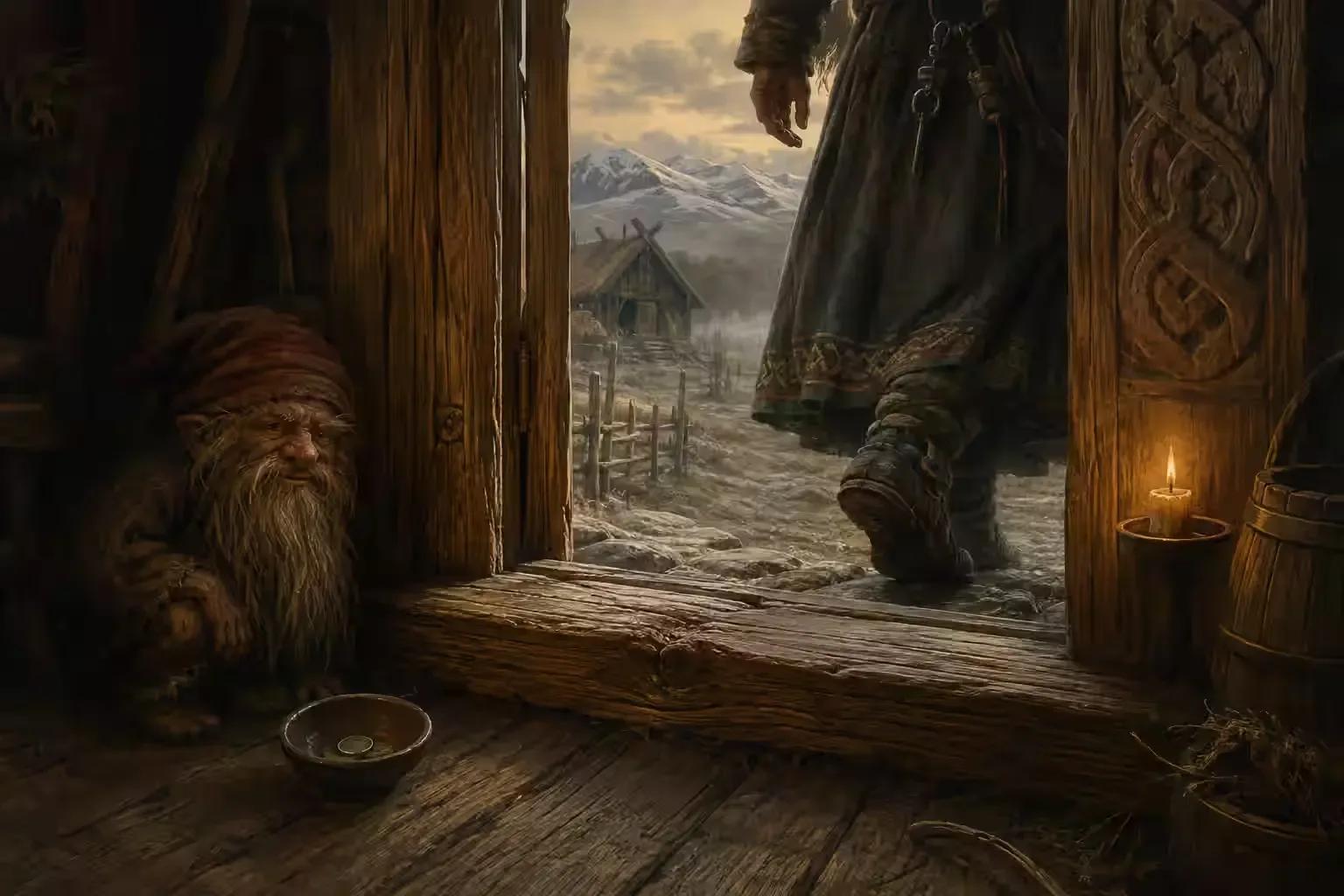
But the threshold was never only about the dead. It was also about the living — and about the figure who never truly died, but simply became more and more hidden: the farm-guardian. In Norwegian folk belief we know him by many names — nisse, tunkall, tuftekall, gardvord, haugbonde, godbonde — depending on which district you ask in (Nynorsk Wikipedia, "Nisse"; Nynorsk Wikipedia, "Gardvord"). The Norwegian-American newspaper The Norwegian American cites folklorist Svale Solheim, who argued that all these names emphasized one thing: that this house spirit was identical with the settled homestead itself. Solheim surmised that the farm-guardian was originally the ancestor who had cleared the farm out of the primeval forest, and that he was thought to lie buried beneath the yard-tree in the farmyard or beneath the hearth in the house itself (The Norwegian American). He was, in essence, the very same figure as the anonymous skeletons archaeologists find beneath threshold stones — except that in oral tradition he got to keep a name, a personality, and a seat at the table.
To keep him in good humor, people set out porridge for him — sour cream porridge with a dab of butter on top, a custom still recounted by many Norwegian museums today (Helgeland Museum; Norsk Folkemuseum). But the porridge was only the visible, edible portion of a much older pact. The custom people still recognize best today, even if few know why, is placing a coin beneath the doorstep. This practice recurs again and again across the sources, from Ukrainian and Russian news reports describing how a copper-colored coin is placed beneath the doormat while a formula is whispered three times (ukr.media), to similar customs described in Italian and Eastern European contexts, where the coin is said to work as a "magnet" for financial luck and to stop wealth from flowing back out of the house (buoninfo.com; rbc.ua). Even far to the east, in China, a related custom survives: coins are placed beneath the doorsill of new homes to draw wealth and keep evil forces out, with precise rules for how many coins and how they should be arranged (zixun.jia.com). It is tempting to think that the coin beneath the threshold, wherever in the world one finds it, is a payment — a small gift to the invisible guard who lets you pass safely every day, a continuation of the very same logic that once let ancestors lie beneath the floor to protect the house they themselves had built.
Just as deeply rooted in tradition is the custom of knocking on the door when leaving the house, asking the house spirit to watch over it in the owner's absence. This is a gesture of respect toward something unseen but known to be present — a reminder, a pact renewed each time one steps out. It is the same instinct that lay behind scattering salt across the threshold to keep unwanted energy out, a practice described in several sources on Slavic and Eastern European household magic, where salt was considered a powerful "carrier of bio-information" able to bear both good and evil messages (puritybox.techinfus.com).
Uksáhkká: The door goddess who watches over the smallest
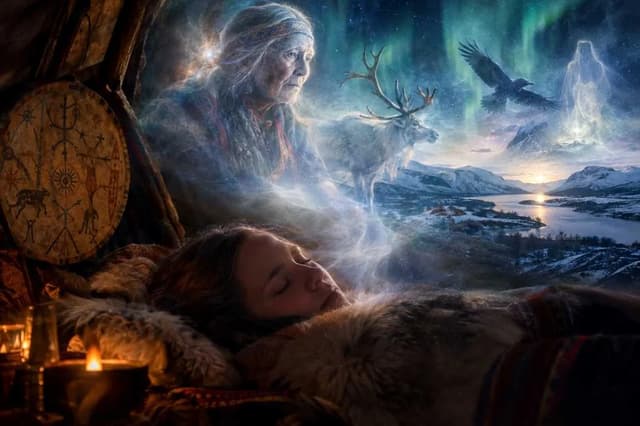
Moving northward, into the Sámi world, we find one of the clearest and most personified threshold guardians in all of northern folk belief: Uksáhkká, "the door woman." She was one of three daughters of the great mother goddess Máttaráhkká, alongside Sáráhkká and Juksáhkká, and her dwelling was quite precisely defined: she resided beneath or beside the very entrance to the goahti, the Sámi winter turf hut (Sjamanforbundet). Her name comes directly from uksa, the Sámi word for door.
Uksáhkká's role was no accident. She was the threshold's guardian in her own person: she controlled who went in and out, protected the innermost space from harmful influences, and ensured that the passage between inner and outer always happened correctly (iwell-guard.com). Every time someone entered or left the tent, she was acknowledged through a small ritual — in some places a brief knock on the threshold was enough, elsewhere specific words were spoken aloud. Those who carried in food or firewood thanked her particularly. And at the threshold itself, small votive offerings were laid down: scraps of fabric, bone fragments, pieces of plants — a quiet dialogue with the invisible guard who never rested.
Most important of all was Uksáhkká's role as guardian of children. She watched especially over the youngest in their first years of life, and above all during the critical period when they learned to walk and, for the first time, had to dare cross the edge between inside and outside on their own (Sjamanforbundet). It is a beautiful, almost heart-wrenching detail: the threshold as the place where a child learns to move between safety and the world, watched over by a goddess whose entire being was tied to that very movement.
Behind Uksáhkká stood the noaidi, the Sámi shaman, who through trance and the sacred drum could undertake soul journeys to other worlds — to the realm of the dead, Jábmiid áibmu, to the paradise Sáivu, or to any place on earth that was needed (Norwegian Wikipedia, "Noaidi"; religioner.no). The noaidi was, in a sense, a professional threshold-walker, doing for the whole community what Uksáhkká did for the individual home: moving safely across a boundary between worlds that ordinary people could not cross.
The Haltijas: The invisible owners of kven and forest Finnish land
Turning to the Kven and Forest Finnish heritage, both rooted in Finno-Ugric thought, we encounter a related but distinct tradition. Sjamanforbundet's own article on Kven and Forest Finnish shamanism points to several central elements: use of the sacred drum (kannus) to achieve trance, sacred sacrificial stones (sieidi) in nature, belief in nature spirits and ancestral spirits, and protective magical symbols carved into valuable buildings (Sjamanforbundet). Norway's Directorate for Cultural Heritage, in its own coverage of a preserved Forest Finnish barn, confirms the same point: Forest Finnish magical practice was rooted in the shamanistic worldview shared by Finno-Ugric cultures, and the symbols were carved into barns, storehouses, and stables to protect them (NTB Kommunikasjon / Riksantikvaren).
In Finnish and Balto-Finnic folk belief we find the concept of haltija — an invisible, place-bound guardian spirit that "owns" and protects a specific place, object, animal, or person, somewhat like a genius loci (occult-world.com). Every place could have its own haltija: kotihaltija for the home, metsänhaltija for the forest, vedenhaltija for the water, saunatonttu for the sauna. Canadian writer Samantha Garner, writing on Finnish and Filipino folklore, puts it aptly when she calls the haltija "a protector/guardian spirit living in a liminal space: nature, homes — even within ourselves" (samanthagarner.ca). The threshold, occupying its place between the safe and the unknown, was a natural site for such spirits to dwell — exactly the same logic underlying both the Norwegian nisse and the Sámi Uksáhkká.
A world-spanning boundary
What makes the threshold so fascinating is how similar ideas emerge again and again in cultures that never had direct contact with one another. Among Slavic peoples we find domovoy, an old, bearded house spirit who lives behind the stove or precisely beneath the threshold, protecting the family that houses him (divinityatlas.com). Another source on Slavic household folklore describes how a snake living beneath the threshold or hearth could be understood as the very soul of a founding ancestor, a protector of livestock and prosperity — killing it was considered a catastrophe for the entire household (wildwitchherbs.com).
Among Turkic and Mongolian peoples we find something similar, though stricter and more strictly codified. A Turkish scholarly article on door and threshold belief from antiquity to the present explains that the threshold spirit, eşik iyesi, was believed to dwell exactly there, and that any stranger who sat or stepped on the threshold was considered to have committed an insult (dergipark.org.tr). In the Mongolian yurt landscape this remains living practice rather than mere history: stepping on the yurt's threshold, the bosgo, is regarded as stepping on the neck of the head of the household, since the threshold is symbolically the "neck" of the home's spirit, and one must always step carefully over it, right foot first (travel.joroo.co; notesofnomads.com). Medieval travelers to the Mongol Empire reported that anyone who stepped on the threshold of the Khan's palace could be executed (mongolia-trips.com). The World History Encyclopedia confirms that among the many taboos Mongols observed to avoid offending spirits and gods was precisely the prohibition against stepping on a yurt's threshold (worldhistory.org).
Further north and east, among Siberian peoples, the tent or yurt itself was a ritual landscape in miniature. A study in Current Anthropology describes how Indigenous peoples across North Asia and North America shared a common ritual tradition — the "dark tent" — which researchers believe spread over 10,000 kilometers around the pole, from Western Siberia to Labrador, grounded in an animistic worldview (The University of Chicago Press Journals). Among the Evenki, the shaman's tent and prayer ground were built so that a small river, dug from the entrance to the back wall, would symbolize a flood connecting the upper, middle, and lower worlds — a physical threshold stretching through the entire ritual space (Foundation for Shamanic Studies).
The threshold as liminal pace
All of this — the coin beneath Norwegian doorsills, Uksáhkká's votive offerings, the yurt's forbidden crossbeam, the Siberian shamans' river-threshold — represents local expressions of something the French folklorist Arnold van Gennep named in 1909: liminality, from the Latin limen, which simply means threshold. Van Gennep described all rites of passage as consisting of three phases: separation from the previous state, an intermediate threshold phase, and finally reincorporation into a new state (Wikipedia, "Liminality"). He used, according to a review of his work at Encyclopedia.com, the very image of a house divided into rooms and corridors to explain the transition: moving from one group to another is, in this metaphor, exactly like passing from one room to another — one must pass through a door (Encyclopedia.com).
Van Gennep himself put it strikingly concretely, as quoted in a scholarly article on the symbolism of liminality: "The door is the boundary between the foreign and domestic worlds in the case of an ordinary dwelling, between the profane and sacred worlds in the case of a temple. Therefore to cross the threshold is to unite oneself with a new world. It is thus an important act in marriage, adoption, ordination and funeral ceremonies" (scispace.com). The anthropologist Victor Turner later developed the concept further, describing those in the threshold state as "betwixt and between" — neither here nor there, without fixed status, without fixed attributes, often symbolically likened to death, to the unborn, to invisibility, to darkness (monoskop.org, Turner's "The Ritual Process").
It is therefore no coincidence that the bride, in many countries, is still carried over the doorsill into the new, shared home (no.wikipedia.org) — a living remnant of an ancient understanding that precisely this one step is dangerous enough that it should not be taken on one's own feet. Nor is it a coincidence that Norwegian folk belief warned pregnant women against stepping over a threshold that had recently been struck or cut into, for fear the unborn child would be marked for life — a superstition already recorded in the nineteenth century in the collection "Overtro og Sagn i Lister og Mandals Amt" (no.wikisource.org). The threshold was, in other words, always most dangerous and most powerful precisely in those moments when something was about to change for good: birth, marriage, death, departure, homecoming.
The step we still take
There is something deeply human in this attentiveness to boundaries. We seem to need, everywhere on earth and throughout our entire history, a place to mark that something is now happening — that we are moving from one room, one state, one life, into another. The threshold became that place because it already existed, physically, in every single home: a line one had to cross to enter or leave at all. It required no new sanctuary to be built, no distant temple gate to travel to. The sanctuary already stood there, beneath one's feet, every day.
When someone today, without quite knowing why, still tucks a coin beneath the doormat, or feels a flicker of unease at hopping over a doorsill instead of stepping across it normally, this is not superstition in the sense of empty nonsense. It is an echo of something that was once an entire cosmology — where the house was a small world with its own boundaries, its own guardians, and its own quiet pact between those who lived there and the unseen presence that lived there with them. People knocked on the door when they left, asking the house spirit to keep watch. They placed a coin beneath the threshold, as payment for safety. And every time someone stepped out or in, they crossed, whether they knew it or not, one of the oldest sacred lines human beings have ever drawn.