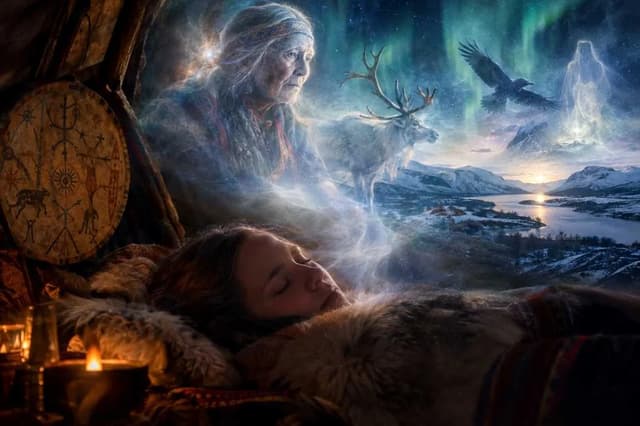
Last time I wrote about those who share my tent. Uksáhkká by the door. Sáráhkká by the árran. Juksáhkká and Boaššoáhkká back there, in the boaššu, where the drum sleeps when it is not in use. They are household spirits. One could call them that, even if the word feels too tame.
But a lávvu is not everything. Step out through the same door Uksáhkká guards, and you are not stepping into emptiness. You are stepping out among others. Just a little farther away. Still the same neighbourhood, only another district of it.
I will keep to those who walk upon the earth here. Not the sky gods, not Radien up there in his passive calm. He is interesting enough for another day, but he does not touch anything. I want to write about those with earth under their feet, or under the earth entirely, or in the forest where I myself walk. Those who actually touch the ground.
She who makes the mountains green
Rana Niejta. I begin with her because she proves something I believe: that even if you are born of the highest, it does not mean you stay up there and sleep.
She is called Radien-attje’s daughter in some of the old records, says Wikipedia on Rana Niejta – but I care less about who her father is and more about what she actually does. Her name means “the green one”, or if you stretch it a little, “daughter of the earth”. And that is precisely what she is. Not one who rules the earth from somewhere far away. One who comes down and makes it green with her own hands, every year, without exception.
The old sources, traced back to texts from the 1700s, say she made the mountainsides facing south green again after winter, so that the reindeer – hungry, thin, worn out by the cold – would find food, Norwegian Wikipedia on Rana Niejta explains. In some versions there is a sister beside her, Sala Niejta, who has the power simply to command the snow away. But Rana Niejta does something else, something I find more beautiful: she comes after the snow has gone, and she makes things grow. Not destruction of winter. Restoration of summer.
I think of her every time I go out in May and see the first green colour rising up through brown, dead grass from the year before. It is no coincidence that old Sámi girls were given the name Rana. It was a common name, the sources say, because to bear that name was to carry with you a promise that something always grows back.
He in the forest who does not like women there
Leaibolmmai. The alder-man. Hunting belonged to him, and the bear most of all.
He lives in the alder trees, the old sources say, and leaibi means both alder and – this is what catches me – the word is closely related to blood. The red sap from alder bark is the colour of blood, and that is no accident. When the hunters came home with bear, the women stood waiting for them, chewed alder bark into a reddish-brown juice, and spat it on the men through a brass ring, britannica.com on Leib-olmai and several other sources tell about the bear ceremony. The ring dampened the bear’s power, väki, before it came too close. The sap tied the men to Leaibolmmai himself, the hunting god, through something that resembled blood without being it.
I will be honest: I do not like everything about this spirit. The sources say he despised women, that hunting weapons were taboo for them, that the entire preparation for the hunt took place without women present. That is one side of the old belief I do not pretend did not exist. I practise noaidevuohta today with my own perspective, and I do not need to inherit everything unchanged. But I understand why the division existed – hunting was a world with its own logic, deadly and precise, and they separated it from birth and home for reasons that had to do with power, not contempt alone. That is how I see it now.
He appears as a bear himself, the tradition says. And the bear feast was not a feast in the usual sense. The women had to look at the men through the brass ring for several days after the hunt, not directly. The bear’s bones were gathered with care and buried in the correct order – no broken bones, because the bear was to be able to rise again in saivo, the other world, with its body whole, Earth Stories Collection on the bear legend tells. That is a thought I carry with me: that respect for what you kill is about ensuring it gets to live on elsewhere, in another way. It is not sentimental. It is a contract.
The spirit who lives exactly where you stand
Then there is háldi. And this is perhaps what I think about most when I walk, because háldi is not one figure. Háldi is the principle that every place has a guardian.
Every mountain its háldi. Every lake its háldi. Every forest its own, not borrowed from the neighbouring valley, the sources on Sámi nature belief say (see Ancient Sámi religion, Wikipedia). The word itself means something like “the one who holds”, “the one who owns”. Not owner as in property. Owner as in responsibility.
I have noticed something when I come to a new place to pitch a lávvu: an old custom, which some still follow, is to notice whether there is peace there. If you cannot sleep, if there is a restlessness you cannot put your finger on, it means the place already has someone. The háldi are supposed to live on the earth itself, not under it, Nordlige folk on hálddit says – they have their farms and their life, invisible to our eyes, parallel to ours. If you treat them well, they help. If you treat them badly, they punish. Quite simple logic, really. The same logic that applies between humans who share a landscape.
He in the water, and the small ones by the spring
I fish a lot. I always have. And there is a reason why čáhcealmmái, the water-man, sits somewhere in the back of my mind every time I set out a line.
He ruled over fishing and hunting in sea, river and lake, and people gave him reindeer blood at Christmas time, sometimes in small birch-bark boats hung up in trees, with boiled reindeer calf, butter and cheese placed inside, Beneath Northern Lights on old Christmas traditions tells about the old Yule traditions. He is not a god one prays to much. He is one one stays on good terms with, because the fish does not come by itself, and because he is the one you owe when the net is full.
Beneath him, some of the sources say, is kul – a poisonous, music-loving fish-spirit who controls the catch in the small scale, a kind of steward under the water-man’s supervision.
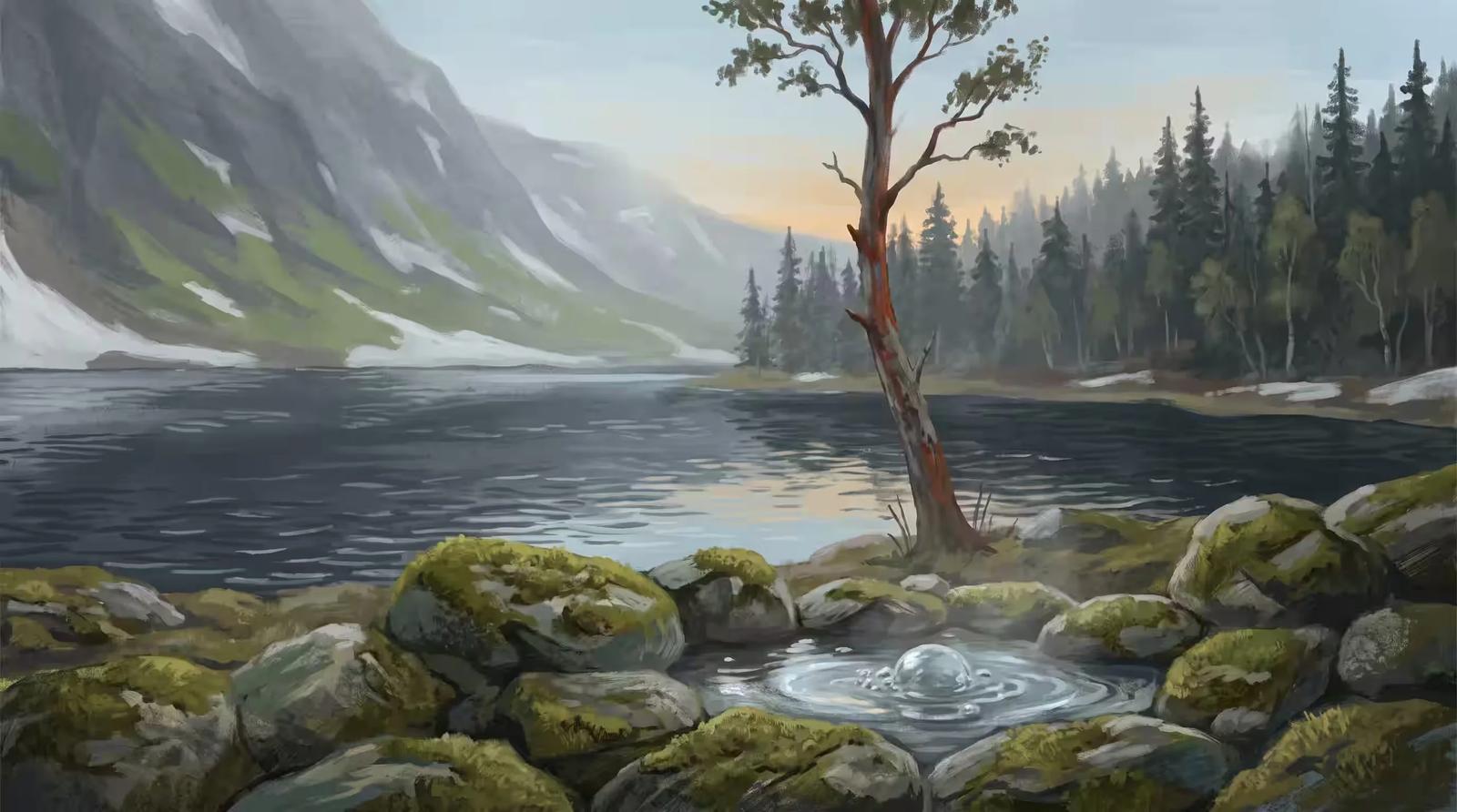
But it is the small ones by the springs that make the strongest impression on me. Čahkalakkat. Naked, small creatures who live exactly where a spring bubbles up from the earth. In their heads lies healing power. In their bellies lie silver coins. One could trick them, kill them, and take both, the old recipes collected by Beneath Northern Lights on Sámi gods and entities say.
I have thought a lot about this one. It is not like the others – no grandeur in it, no dignity one owes respect out of fear. Just a small, vulnerable creature by a spring, filled with something valuable, and a story that tells people it is acceptable to take it with cunning and killing. I do not think I like what it says about us. But I include it, because it is not my task to prettify what was uncomfortable even then.
Those beneath the ground
And then, deeper than háldi, deeper than the roots: gufihtar.
Elsewhere they are called ulda. Westward that is the name most used, and it comes from the Norwegian hulder, Saamelaisensyklopedia on gufihtar tells. Eastward, and in Northern Sámi generally, it is gufihtar – which actually comes from an old Scandinavian expression for “good wight”, a good being from below the earth.
Everything about them is inverted. When it is midnight with us, it is bright day with them. When it is summer here, it is winter down there. I find that thought beautiful in a way I cannot quite explain – that there is a whole other day going on parallel to ours, just one step beneath the ground we stand on.
They have their own reindeer herds, white or coal-black, with magical power in them. If you throw a knife or an iron object over their herd, the animals become yours, several of the old records say, among them collected in Inari Sámi Folklore. They have silver and gold in abundance, and all the treasures people have buried through generations still lie in their care, Beneath Northern Lights on Ulda says – they are called árahávddit, grave treasures, and only rightful descendants can retrieve them. If others take them, they become almost out of their minds with anxiety.
There is a rule I have heard since I was little, and I have never seen anyone break it as a joke: never eat anything with them, should you be taken in. Not a bite. If you do, you stay there. In the end you become one of them yourself.
Children are not safe from them either. They can take a child and lay their own in its place, without the parents always noticing until long afterwards. That is an old anxiety, this one, older than any of us, and I believe it deals with something real even if I do not believe it is meant literally anymore: that something unseen can change who you are, slowly, without you seeing it yourself.
The big scary one
I cannot write about what lives a little farther out without including stállu. Not because I love him. Because children for generations have been silenced by him, and because he still means something where I live.
Stállu is big. Stronger than us. But stupid, the tradition consistently says – stupid enough that a child with a little wit can trick him every time, Norwegian Wikipedia on Stallo tells. He walks in dark clothes with gold buttons, a sack on his back, Skolerom on Stallo tells, and he comes especially during the romjul, when it is cold and dark around the clock farther north. One had to be quiet. One had to clear the woodpiles from outside the tent, and set out a bucket of water with a ladle by the door – if he got a drink, he moved on. If he did not, he became dangerously thirsty, and the worst he could do was to suck the blood from people’s heads.
One could hear him before one saw him. A fluted tone in the wind, sharp enough to damage hearing if one did not take care.
I do not think stállu will disappear from my stories any time soon, even though I know he is the little fright more than the great wisdom. Some figures do not need to be exalted to belong.
Why I do not stop going out
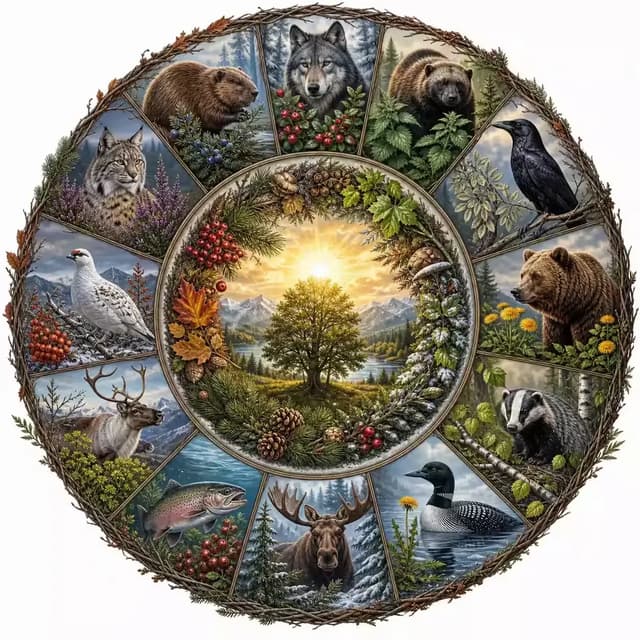
I could continue. Storjunkaren in the mountain, the sieidi out in the landscape that already got their place last time I wrote. But my point here is not to list everything that exists. My point is something else: that my belief does not stop at the house wall. It continues out, through the forest, up the mountainside where Rana Niejta walks and makes things green, out into the water where čáhcealmmái decides whether the net becomes heavy or light, down under the earth where gufihtar live in their inverted day.
I do not pour water by a doorstep and think I am done with the religious for the day. I go out, and I am still inside something. Just another room of the same house.
Sources used in the research: Wikipedia (Norwegian and English) on Rana Niejta, Leaibolmmai, Tjaetsieålmaj and Ancient Sámi religion; Britannica on Leib-olmai; Earth Stories Collection on the bear legend; Saamelaisensyklopedia on gufihtar; Inari Sámi Folklore (dokumen.pub); Beneath Northern Lights on Ulda, on čáhcealmmái and old Christmas traditions, and on Sámi gods/goddesses/mythical beings; Nordlige folk on hálddit; Norwegian Wikipedia and Skolerom on Stallo.