The Magic of Meadowsweet – The Goddess’s Herb from Bronze Age Graves to the Dance Floor
The summer heat lies over Jutland sometime around 1370 years before our era. A young woman has recently died, no more than sixteen or seventeen years old, dressed in a short, trailing wool skirt, with a birch-bark bucket at her side. The woman being buried at Egtved is not an ordinary person – she was probably a priestess or a prominent figure in her community, and she is being prepared for the journey to a place none of us has ever been. In her bucket, the mourners place some of the finest things they know: honey from linden trees, wheat grains, bog myrtle, cranberries – and an abundance of small, creamy-white flowers from the plant we today call meadowsweet.
Thirteen hundred years later, archaeologists dig her up again. Pollen analysis of the contents of the bucket tells a story: not of random nectar carried there by bees, but of flowers deliberately picked and placed there. Meadowsweet, with its sweet scent of almonds and honey, has followed human beings into death, into worship, into love, and into what we today call magic. And it still does.
This is the story of a herb perhaps less famous than bog myrtle and juniper, but which for thousands of years has carried some of the strongest associations known to folklore: love, divination, peace, and joy.
Queen of the Meadow
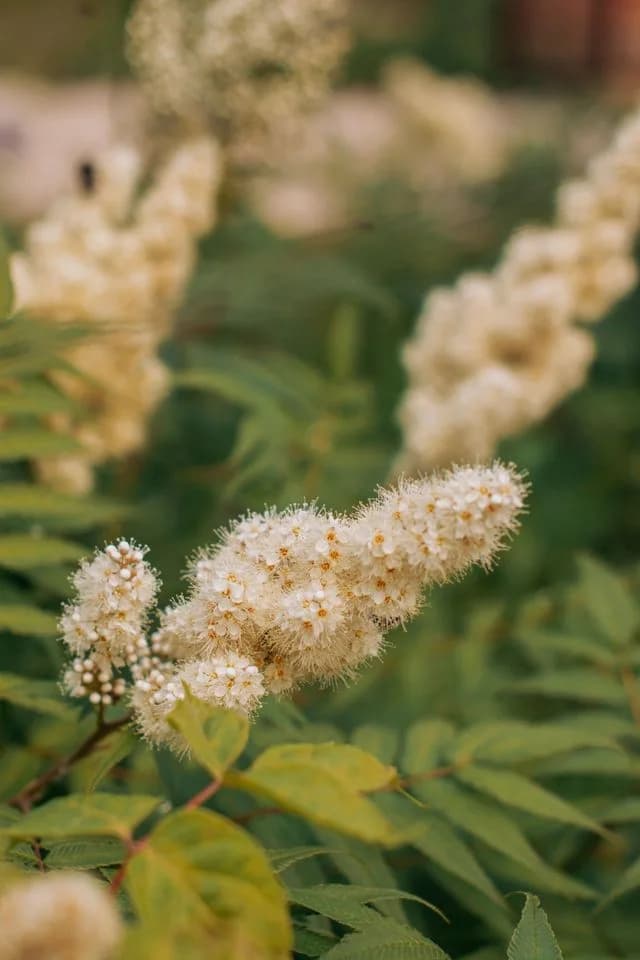
Let us first establish what kind of plant we are talking about. Meadowsweet – Filipendula ulmaria – is a perennial herb in the rose family that thrives in damp places: ditches, riverbanks, hay meadows, and the edges of marshes. From June to August, it raises dense, creamy-white flower clusters like luminous foam above the grass, and its scent announces itself long before you see the plant: warm and sweet, with a hint of almonds.
The English name, meadowsweet, makes fools of anyone who lazily interprets it as “the sweet plant of the meadow.” The name does not mean “sweet as a meadow” – it means the herb that makes mead sweet. From the sixteenth century onward, the name is documented as referring precisely to a plant used to sweeten and flavour mead, beer, and wine. And this use is much older than the name itself. Meadowsweet contains natural sweetening compounds and has an astringent, preservative effect that traditional brewing knowledge knew how to exploit. Without refrigeration or purified yeast cultures, herbs such as meadowsweet could make the difference between a drink that kept – and one that turned into vinegar.
But if meadowsweet was an everyday brewing herb, it was never only that. A plant that flavoured one of humanity’s oldest intoxicating drinks – mead, traces of which go back to the third millennium BCE – inevitably finds itself at the very heart of the sacred. Mead was drunk by chieftains in the great halls, offered to the gods, used in oath-taking and funerals. And meadowsweet was part of the journey all the way.
The Flowers That Followed the Dead
Archaeology gives us some of the most moving evidence of meadowsweet’s ritual significance. In a long series of Bronze Age graves, from Denmark to Scotland, pollen analysis of grave goods has revealed precisely this plant. At Egtved in Zealand, archaeologists found the young woman’s bucket containing the remains of a fermented drink – mead, fruit wine, or a “grog” made from a combination of these – in which meadowsweet had been deliberately added. From Nandrup on Mors, from Bregninge on Zealand, from the cist burial at Ashgrove in Fife, Scotland, and from the female burial at North Mains in Perthshire comes the same message: meadowsweet followed people into the grave.
This is where the ancient use touches upon something we today might call shamanic practice. Researchers such as D. Moe and K. Oeggl have shown that the quantities of meadowsweet pollen in these graves far exceed what bees themselves could have carried into the honey – in some finds accounting for more than seventeen percent of all pollen. This is not coincidence, but intention. The funerary drink was a drink of transition, a drink intended to carry the dead – or the mourners – into another state and another way of seeing. When a young priestess is buried with an intoxicating drink flavoured with fragrant flowers, we are very close to what ethnographers describe as ritual ecstasy.
There are traces from the Viking Age as well. In coprolites from the trading settlement of Birka on Lake Mälaren, researcher Sofia Karlsson has identified meadowsweet pollen in quantities suggesting that the inhabitants drank mead flavoured with this very plant. And it is worth remembering that mead in Norse culture was no ordinary intoxicating drink – it was the drink of the gods, served in Valhalla, while seiðr and ecstasy belonged to Freyja, the goddess who, according to tradition, taught seiðr to humankind.
Freyja’s Herb and the Beehives
Here we arrive at the heart of the Norse tradition, where meadowsweet and the goddess Freyja become intertwined. Freyja – goddess of love and fertility, and powerful daughter of the Vanir – is the very link between mead, love, and magic. Among modern practitioners of Norse tradition and shamanic practice, meadowsweet is still regarded as sacred to the Norse goddesses and is used in rituals for love and fertility – a practice that the Norwegian Sjamanistisk Forbund describes as a living part of the revival of Norse herbal magic. That this particular herb is associated with Frigg – and with Freyja, whom many scholars believe may originally have been one and the same goddess – is no coincidence: this is a goddess plant.
And the goddesses, as we remember, were not least friends of the bees. In Norwegian tradition, it was customary to rub the inside of beehives – in earlier times made of straw – with meadowsweet flowers. This was said to make it easier for the bees to enter the hives, and someone who rubbed meadowsweet onto their hands and clothes could handle the bees without being stung as easily. The bees, which carry the honey that becomes mead, belong to Freyja; and meadowsweet, which sweetens the mead, is in a sense the very point of contact between goddess and human beings. This custom survived into modern times in eastern and western Norway. Anyone who knows this sees a July hay meadow with different eyes: every creamy-white flower is a little greeting from the goddess.
Meadowsweet’s magical power can be used for love, divination, and to create peace and happiness. Use it in love magic, or place it in vases around the house to encourage domestic harmony, good fortune, happiness, and prosperity. This is the tradition that has been passed down into our own time – and every link in it has roots deep in history.
The Herb of Love
Meadowsweet’s strongest and most enduring association is with love – perhaps because its fragrance resembles honey and almonds, perhaps because it blooms in midsummer, in the very season of falling in love. In England, the plant was therefore given the evocative name Courtship and Marriage. The sweet, intoxicating scent of the flowers was said to symbolise the intoxication of courtship, while the sharper, more medicinal scent of the leaves represented the more sober reality of marriage. An entire stage of life in a single plant.
The bridal bouquet was meadowsweet’s domain; the English name bridewort is itself practically an instruction manual. But the herb was also for those who needed help finding the right person. Meadowsweet appears repeatedly in love potions and formulas throughout Europe, and in classical herbal magic literature we find the claim that love magic performed with meadowsweet on Walpurgis Night – the night when witches fly to the Blocksberg and protection is weakest – will bring the practitioner a romantic partner. In Norway and the Nordic countries we find the same traces: meadowsweet in or beneath the pillow to dream of the person one was destined to marry, meadowsweet in the brew to win the one you love.
There is also a darker undertone to love magic, one we recognise from Welsh mythology. When the magician Gwydion and King Math set out to create a wife for the hero Lleu Llaw Gyffes, they fashioned the woman Blodeuwedd – “flower face” – from the flowers of nine different plants, and meadowsweet was among them. But Blodeuwedd was no obedient creature: she chose for herself, betrayed her husband, and was punished by being transformed into an owl, the bird of night. Meadowsweet therefore carries not only the sweetness of infatuation, but also the independent will of women and the consequences of choice. Anyone who works with this herb in the traditional sense knows that it is not tame.
Divination and the Floating Flowers
Love and divination have traditionally belonged together – anyone who wishes to love also wants to know what the future holds. And meadowsweet had its own answer to this. One form of divination has been handed down in simple and picturesque imagery: if something had been stolen, pick meadowsweet at the summer solstice and place a sprig on water. If it sinks, the thief is a man. If it floats, the thief is a woman. Thus, the uncertain could be made clear, with a flower and a bowl of water.
Likewise, it was said that meadowsweet gathered at midsummer – on the brightest night of the year, when all boundaries between worlds are blurred – could provide knowledge of things otherwise hidden. Whoever carried it could hope for good fortune, happiness, and prosperity. We recognise the motif from Norwegian folklore: gathered on the right night, the plant acquires powers it does not otherwise possess.
The Strewing Herb That Created Peace
While love magic was the specialised use, strewing herbs belonged to everyday life – and here we perhaps find the most vivid of all meadowsweet traditions. Before wooden floors became common and linoleum had its day, people scattered herbs across their floors. The herb was cut, spread out, and trampled underfoot, and with every step its fragrance was released. Meadowsweet was among the most beloved strewing herbs: it smells not only sweet, but was also considered antiseptic (due to its natural salicylic acid content) and helped keep vermin and unpleasant odours away. In England, no less a person than Queen Elizabeth I is said to have preferred meadowsweet above all other strewing herbs – “for the smell of it makes the heart merry,” as the herbalist John Gerard put it.
But it is the Swedish tradition that captures the imagination most vividly. In olden times, meadowsweet was scattered across dance floors, where it released its delicate aroma as it was crushed underfoot. Imagine a dance in a barn on a warm summer evening: sweat, music, and dancing, and beneath your feet a fragrant carpet of meadowsweet releasing its sweet aroma with every step. Aroma, medicine, and magic in one and the same act – for scattering meadowsweet on the floor was also an invitation to peace and happiness, just as the tradition is described today: place meadowsweet in vases around the house, or scatter it on the floor, to promote domestic harmony.
The Herb That Heals – and the Dark Mirror
Between magic and medicine, the boundaries are fluid, and meadowsweet was as natural a part of healing as it was of spells. A medieval remedy for a blocked nose was to hold wool soaked in meadowsweet juice against the nose. The plant’s flowers contain salicylic acid – the same substance that was extracted from meadowsweet in 1838 and which, half a century later, formed the basis of aspirin. We might therefore call meadowsweet the ancestor of the modern painkiller tablet. In folk medicine it was used for fever, headaches, colds, stomach complaints, and rheumatism; tea made from the flowers was said to relieve headaches, and during the Black Death it was among the herbs used in “Four Thieves Vinegar,” the mixture believed to protect against plague and infection.
But, as with all powerful plants, there is a shadow. In Welsh folklore, meadowsweet was in certain contexts considered unlucky: anyone who slept in a room where meadowsweet was kept – or in a meadow full of meadowsweet – was said inevitably to die. Perhaps its pale-white flowers made people associate it with the colour of death; perhaps it was because this particular plant was associated with graves and funerary drinks. Meadowsweet is the goddess’s plant, and the goddesses of the Norse and Celtic worlds ruled over both love and death. The plant that brings peace and happiness also knows where peace ends.
The Druids’ Sacred Herb
In the Celtic world, meadowsweet held a position few plants could match. According to the classical herbal literature, meadowsweet, water mint, and vervain were the three herbs most sacred to the Druids. It is not difficult to understand why: a plant that sweetens the sacred drink, eases pain, smells of summer and eternity, and grows wild precisely where water and land meet – in ditches, along rivers, and in the damp meadows that formed part of the Celts’ sacred landscape. Bronze Age finds in Wales, England, and Scotland show that this honour has roots stretching back thousands of years.
In modern Celtic-inspired practice, meadowsweet is still used in rites of passage – at weddings, puberty, death, and new beginnings – precisely because it carries the story of Blodeuwedd, of something that is created, chooses, and is transformed. At Lughnasadh, the harvest festival at the beginning of August, meadowsweet was woven into wreaths intended to unite the wearer with the Great Goddess.
A Living Tradition
So what remains for us, walking through hay meadows in July with the scent of almonds and honey in our noses? The tradition of meadowsweet is striking because it seems to have grown stronger, rather than weaker, in our own time. Shamanic communities in the Nordic countries actively highlight it as an herb of love and fertility, sacred to the goddesses; modern practitioners of herbal magic place it on the altar for peace and happiness; and in everyday life, anyone can follow one of the oldest pieces of advice of all: put a vase of meadowsweet on the kitchen table and notice what happens to the atmosphere in the house.
Perhaps this is the deepest magic of meadowsweet: that it works. Not through supernatural intervention, but through the oldest channel of all – scent. A scent that, thirty-eight hundred years ago, was placed in a young woman’s funerary bucket, that was trampled across Swedish dance floors, that drifted through Queen Elizabeth’s chambers, and that this summer stands in a vase on your kitchen table, slowly filling the room with domestic peace.
That is a long tradition to be part of. All you need to do is pick the flowers.
Sources
- NIBIO – Meadowsweet – Strewing herbs on festive days, beehive traditions in eastern and western Norway, medicinal use
- Sjamanistisk Forbund – Magical Use of Herbs in Norse Tradition – Meadowsweet Sacred to the Norse Goddesses, Rituals for Love and Fertility
- Sjamanistisk Forbund (English edition) – same tradition in English
- Brewing Classical Styles – Meadowsweet in Archaeology – archaeological finds: Egtved, Bregninge, Nandrup, Ashgrove, North Mains, Kinloch Bay, Birka; Moe & Oeggl (2014)
- The Druid's Well – Filipendula ulmaria – the Druids’ three sacred herbs (after Grieve 1931), Blodeuwedd, love magic on Walpurgis Night, divination at the solstice (after Cunningham and Beyerl)
- Pagans of the North – Meadowsweet: The Bittersweet Queen of the Meadow – “Courtship and Marriage,” Bridewort, strewing herbs and Elizabeth I, Welsh death symbolism, Four Thieves Vinegar, Lughnasadh
- St Mary at Finchley – Celtic Wisdom No. 19: Meadowsweet – Gerard’s quotation about the scent making the heart merry, Elizabeth I’s strewing herbs
- Wikipedia – Filipendula ulmaria – name history: the herb that sweetened mead
- Wikipedia – Strewing herb – the history of strewing herbs