Meandash, the White Reindeer and the Bright Dead in Sámi Tradition
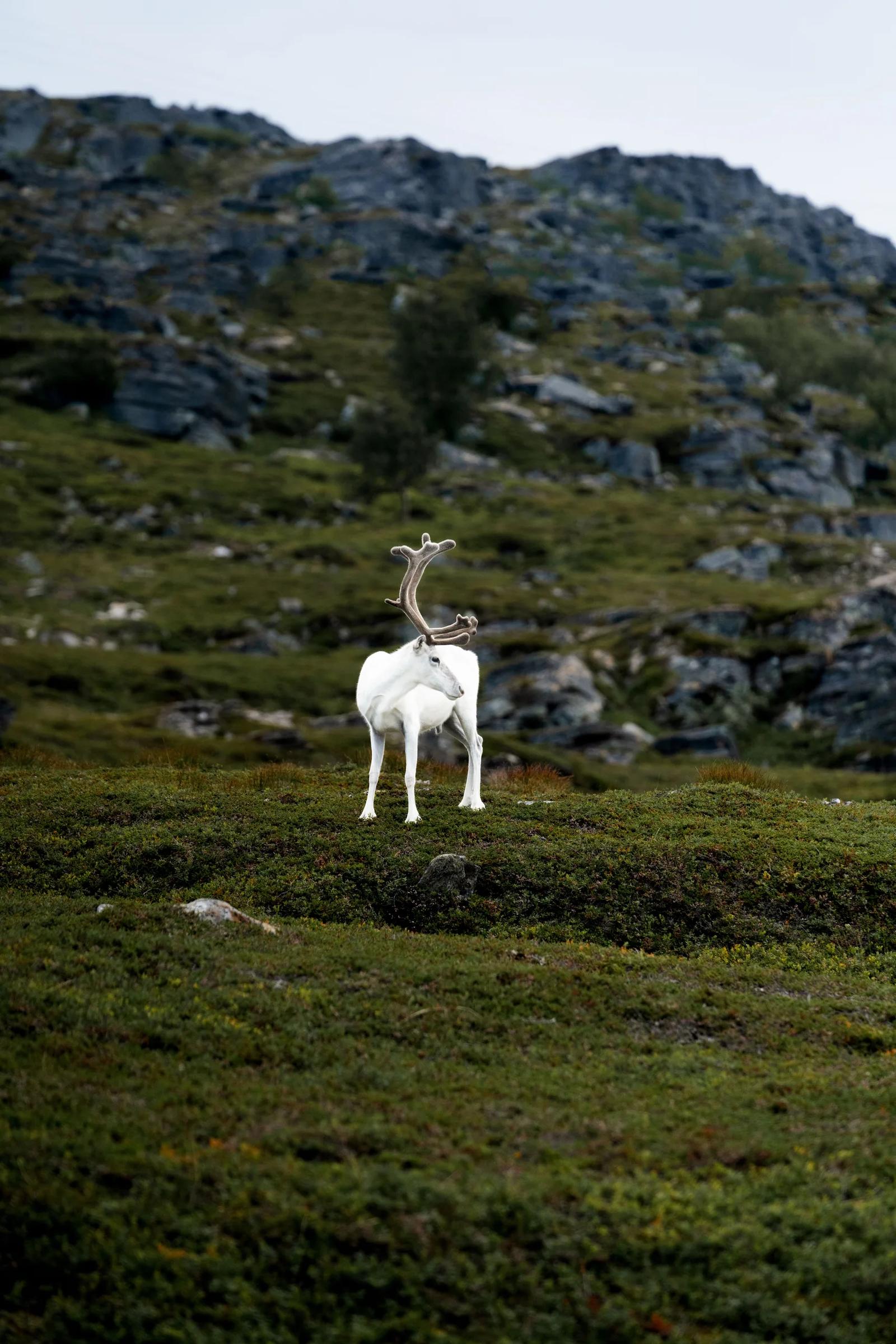
Late in autumn the herd moves through the birch scrub, a river of brown and grey backs flowing over the first snow. Then one animal catches the eye. It is white, so white that at a distance it seems less like a reindeer than a gap in the landscape. Herders have met that sight for centuries with a mixture of joy and unease. A white reindeer can mean luck. In older Sámi storytelling it could also mean that the animal was not quite yours, that it belonged to someone living alongside you, beneath the ground or inside the mountain.
This article follows those animals: the reindeer that are more than reindeer. It moves from the mythical wild reindeer Meandash on the Kola Peninsula to the white animals in the herds of the underground people, and ends with the noaidi, the one who could travel between worlds. Along the way it asks a simple question with a complicated answer: why white?
The sources are scattered across three centuries and many Sámi regions, written down by missionaries, priests, folklorists and Sámi narrators. Where I draw connections between them, I say so. Those connections are my interpretation, not a reconstruction of a single unified mythology.
The ordinary reindeer as a sacred animal
To understand the magical reindeer we have to begin with the ordinary one. It was food, clothing, thread, tools and transport. It was also a religious being. The historian of religion Håkan Rydving, in his study of religious change among the Lule Sámi, The End of Drum-Time, shows how the reindeer belonged to a web of obligations between people and powers. Animals were offered, bones had to be handled correctly, and luck in herding and hunting depended on people keeping their side of the bargain.
Archaeology tells the same story: at many sieidi sites, reindeer bone and antler dominate the finds.
The seventeenth- and eighteenth-century writers, among them Samuel Rheen, Johannes Schefferus and the circle around the missionary Thomas von Westen, describe sacrifices directed by the noaidi. They are hostile witnesses who often misunderstood what they saw, but they agree on one detail: colour mattered. Animals offered to Beaivi, the sun, were to be female and, if possible, white. If no white animal was available, a white thread could be sewn through its ear. As the scholar Anna Westman has shown in her reading of these early accounts, the white thread made the animal white in the eyes of the powers. Animals offered to the realm of the dead, Jábmeáibmu, and to the dangerous powers below, were by contrast often black.
This gives us the oldest documented colour code we have. White belongs to the sun, the upper world, warmth and life. Black belongs to the heavy realm below. Any interpretation of the white reindeer has to start here.
Meandash, the reindeer who was a man
Far to the east, among the Sámi of the Kola Peninsula, people told of Meandash, also called Mient'ash or Mändash. He is both reindeer and man, and he is one of the best documented single figures in Sámi mythology. The Estonian folklorist Enn Ernits has examined nearly thirty tales about him, and the Russian ethnographer Vladimir Charnoluskij devoted a whole book to the legend of the reindeer-man.
The variants differ, but the core is recognisable. A woman marries a wild reindeer, or a reindeer in human form, and gives birth to Meandash, who grows up between two natures. In several versions he gives people the bow, or teaches them how reindeer may be hunted: which animals may be taken, how the kill must be treated, what must never be done. When people break the rules, the wild reindeer withdraw. Ernits draws attention to episodes in which a river of blood separates the land of the living from the land of the dead, and to Meandash's repeated crossing of such borders.
One detail in Charnoluskij's material is crucial for this article. The reindeer ancestor is described as white as snow, with golden antlers. Here, and only here in the sources I have found, whiteness and ancestry meet directly. Meandash is not simply a white animal. He is a white forefather.
My interpretation is that Meandash is less a reindeer god than a living contract. He explains why the hunt is possible, because the reindeer allow it, and why it can end, because people forget their debt. That makes him a natural counterpart to the noaidi. The noaidi negotiated with the powers on behalf of the people. Meandash negotiates on behalf of the reindeer.
The dead are the ancestors
To go further we need to understand what the dead were in Sámi tradition. They did not disappear. The missionaries found few ideas more offensive than the Sámi conviction that the living and the departed were two halves of one family. The dead could help and harm, they could long for their living relatives and make them ill, and they could return in the name given to a newborn child.
But the dead did not all live in the same place. The early sources and later research distinguish between Jábmeáibmu, the ordinary realm of the dead below the earth, and sáivo, a brighter otherworld associated with sacred mountains and lakes with double bottoms. The historian of religion Louise Bäckman interpreted sáivo as the place where dead noaidis lived, while ordinary people went to Jábmeáibmu. The Norwegian scholar Eldar Heide has argued that the sáivo beings, often treated as a separate category of spirits, are hard to understand as anything other than ancestors. The sáivo people are described in Sámi narratives as bright and beautiful, and they appear as helpers who work with the noaidi.
Here I connect the threads myself. If white belongs to the sun and the upper world, and black to the heavy realm of the dead, then whiteness does not stand against the ancestors as such. It stands with a particular kind of ancestor: the bright dead of sáivo, the helpers, the old noaidis, the snow-white forefather of the Kola tales. The colour does not divide the dead from the living. It divides the bright dead from the heavy ones.
The ptarmigan that comes close
There is another white creature in this landscape, and it comes much closer to people than any wild reindeer. The ptarmigan, rievssat, turns white in winter, and it lives near human dwellings. The Sámi scholar Krister Stoor has shown how birds in Sámi tradition act as messengers of death and of important moments in human life, and how the ptarmigan itself is tied to the turning seasons: the days grow longer because of the bird's steps, not the other way round.
Among the legends collected in Northern Norway around 1900 by the philologist Just Qvigstad and the Sámi folklorist Isak Saba, recently made available in English by Barbara Sjoholm, there is a short tale told by Efraim Pedersen with a telling title: Ptarmigan Are Messengers from the Dead. Since the dead are the ancestors, the ptarmigan here carries word from the family on the other side.
The noaidi's own birds point the same way. Lars Levi Laestadius, writing in the 1830s and 1840s, described the sáivo birds that served the noaidi as being of many sizes, among them grouse-like birds, and of many colours, some speckled white and black, some with white wings. In recent work on birds in Sámi tradition, Francis Joy, Peter Armstrand and Elli-Maaret Helander also note that the willow grouse was one of the yard birds that followed the Sámi along the reindeer migration routes.
Again I interpret. The sources do not say that the ptarmigan is an ancestor because it is white. They say that it brings messages from the dead, that birds served the noaidi from sáivo, and that white belonged to the bright side of the cosmos. Putting these together, a white ptarmigan near the goahti in winter can be read as a visit from the bright dead. That reading is mine, but it rests on firm ground.
The white reindeer of the underground
Return now to the white animal in the herd. In northern and western Sámi tradition the underground people, called ulddat, gufihtar or háldi depending on region and context, live lives that mirror human life beneath the earth or inside the mountains. They have dwellings, livestock and reindeer. Laestadius describes the ulda beings as beautiful, dangerous and easily offended, and Qvigstad's collections contain many stories of encounters with their herds.
Their animals are often unusually fine, unusually bright, sometimes white. A herder who finds one among his own must decide what to do. In some tales, throwing iron over the animal makes it his, because iron breaks the hold of the other world. In others, taking it brings misfortune. Sometimes the white reindeer simply vanishes, leaving no tracks.
In Norwegian vernacular such animals were sometimes called trollrein, troll reindeer. The word needs care, since the Norwegian troll is not the Sámi ulddat. Still, it shows that the idea of reindeer belonging to a hidden people was strong enough to be understood on both sides of the language border.
Whether the underground people are themselves a form of the dead is a question the sources answer differently from region to region. In the south the boundary between sáivo beings, underground people and ancestors is notably blurred. I will not erase the distinction, but I note that the bright, beautiful underground herds and the bright sáivo dead share more than their colour.
The noaidi and the reindeer bull
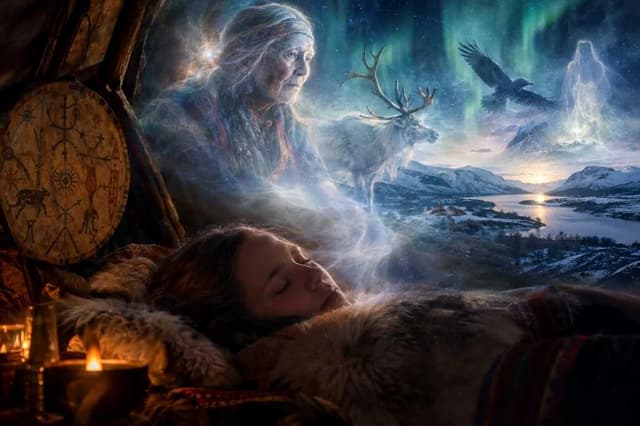
This is where the threads meet in noaidevuohta. The noaidi did not travel alone. The early sources describe helping animals from sáivo: a bird, a fish or serpent, and a reindeer bull. Among them the bull held a special place. It carried the noaidi on his journeys and fought on his behalf.
One of the most striking motifs in the tradition is the duel between two noaidis in the shape of reindeer bulls. They clash antlers in the other world, and the outcome there decides health, luck or life here. Whoever's bull breaks loses.
On the drums catalogued by Ernst Manker, reindeer appear again and again, read by researchers as offerings, helping spirits or parts of a cosmic map. In the trial of the noaidi Anders Poulsen in Vadsø in 1692, studied closely by the historian Rune Blix Hagen, a practitioner explains the figures on his own drum before a Danish-Norwegian court. His testimony is filtered through a hostile process, but it remains one of the most important windows into how a noaidi understood his tools.
The sources do not say that the noaidi's helping bull was white, and I do not claim it. But the structure is the same in each case. A reindeer appears that is borrowed from another reality, from sáivo, from the ulddat, from the ancestors, and whoever meets it must know the rules of that reality.
What the rules protected
The stories themselves are practical. Meandash forbids waste. The underground people punish those who disturb them. The sacrificial rules demand that bones be returned whole so the animal can rise again. Much of the noaidi's work is about restoring a balance that someone has broken.
Taken together, and this is my reading, the magical reindeer and the white birds form a kind of moral ecology bound up with kinship. The animals people live from are not simply property. They have their own owners, their own kin and their own world, and some of that world is inhabited by people's own ancestors. A white reindeer in the herd, or a white ptarmigan by the door, reminds us that luck is borrowed, and that the lenders are often family.
In Sámi tradition the reindeer is not only the animal people follow across the tundra. It is also the animal that leads them to the boundary between worlds, where the bright dead keep their own herds.