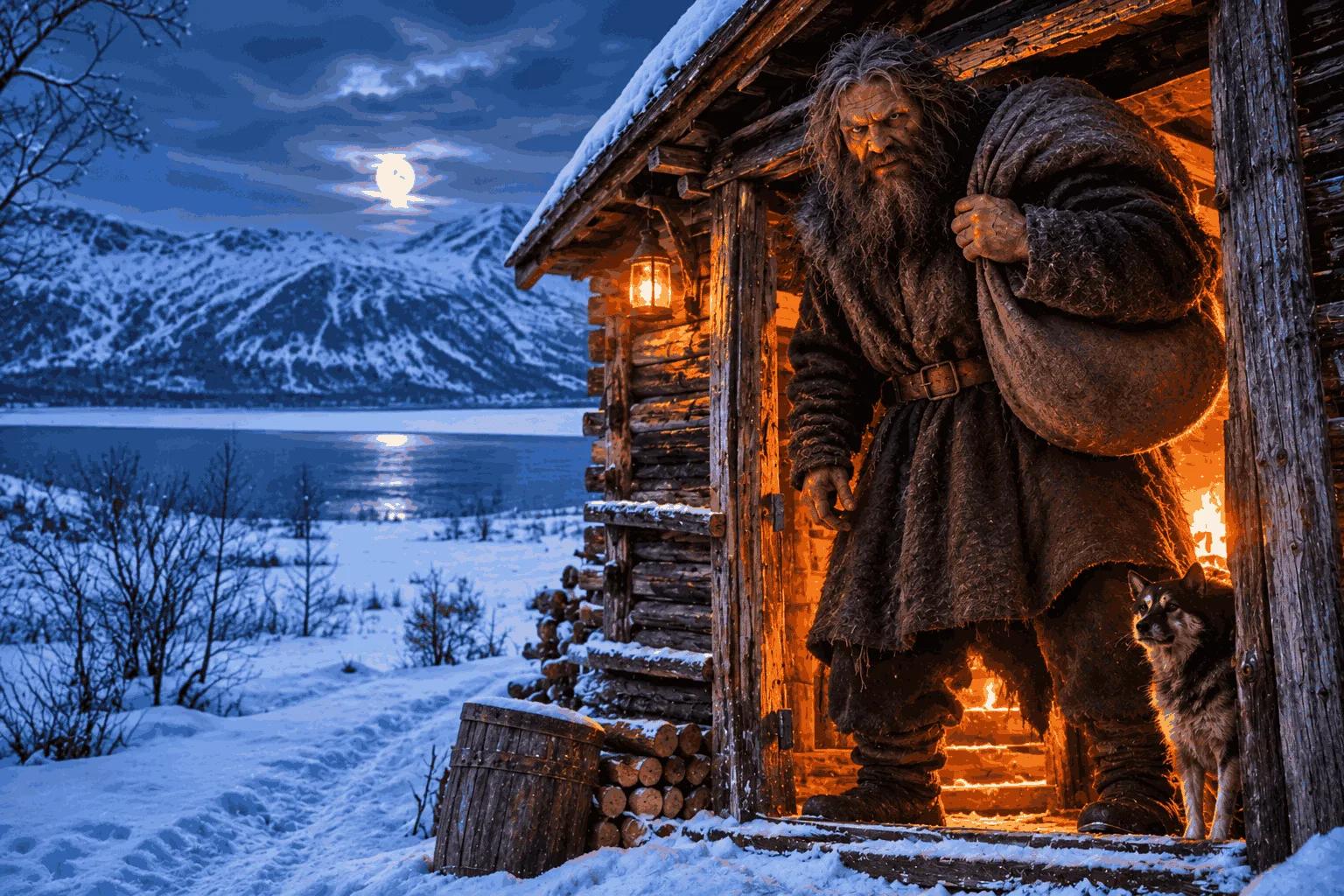
Imagine a winter evening. Inside, the fire has settled into a low, breathing glow; outside, a sound interrupts the dark. Let us begin with that imagined moment, rather than with a monster’s portrait, because a portrait might make the stranger too easy to recognise. In Sámi storytelling, stallo can be a huge, murderous adversary, a wealthy household head, or a being associated with a noaidi’s dangerous powers; the Centre for Northern Peoples introduces him through precisely this unsettling range of appearances (Centre for Northern Peoples, “Stallo / Stállu”).
Who, then, has approached the fire? A troll under another name? A memory of a violent outsider? Or something more troubling: a figure who knows the community’s ways well enough to turn them against it? These are useful questions, but none should be allowed to answer the others in advance.
A monster with a household
The familiar outline seems straightforward: stallo is large, strong, dangerous, and frequently hungry for human flesh, yet also susceptible to deception, a combination recognised in Sweden’s national inventory of living cultural traditions (“The tradition of Stállu”). Here, surely, is the old promise of the ogre story: what strength threatens to destroy, intelligence may yet save. The reader can breathe a little more easily once the giant’s foolishness becomes apparent.
But the details complicate that reassurance. In the traditions summarised by the Centre for Northern Peoples, stallo may wear dark clothes, carry a sack, keep a dog, possess gold and silver, and sound a piercing whistle; his wealth, moreover, does not necessarily bring lasting good fortune to those who obtain it (Centre for Northern Peoples). These are not merely anatomical features. They suggest possessions, habits, relationships, and consequences, the beginnings of a social world rather than a zoological description.
Literary scholar Ruth Seierstad Stokke makes the resemblance more uncomfortable: in many oral narratives, stallo appears human, only bigger and stronger, while some stories give him a wife and children living in a dwelling recognisable within Sámi life (Stokke, “Natureculture in a Stallo tale,” 2020). The horror, on this reading, is not simply that something inhuman waits outside. It is that another household may resemble one’s own while following a radically predatory understanding of what other people are for.
That resemblance matters. A monster wholly unlike us offers one kind of fear; a monster who understands hospitality, marriage, property, and family offers another. To see how close stallo can come, we should follow a storyteller who brings him directly to the marriage feast.
Johan Turi leads us to the lake
In Johan Turi’s Muitalus sámiid birra, first published in 1910 and available in Thomas A. DuBois’s English translation as An Account of the Sámi, a stallo living beside a lake has a wife, a son, and a daughter, and the family catches fish and reindeer (Turi, An Account of the Sámi, “An Account of the Stállu who Lived on the Shore of Stálojávri Lake”). The setting is not an abstract kingdom at the end of the world. Turi’s account attaches the family to named waters, mountains, and remembered features of the land (Turi, An Account of the Sámi).
DuBois’s geographical index places Stálojávri and its neighbouring mountains in Sweden, while the translator’s introduction locates the making of Turi’s manuscript near the great lake Torneträsk, in the northern Swedish landscape from which his account emerged (Turi, translated by DuBois, introduction and list of placenames). We should not confuse the place where a book took shape with the precise location of every event it recounts. For this tale, the safest route is to follow its own local landmarks rather than attach an unsupported modern map pin.
At the lake’s outlet, Turi identifies Stáloguoika, the “Stállu rapids,” and describes a fishing pool and enormous stones associated with the being’s boat trench; nearby Goartovárri is his dangerous stronghold, while the ulddat dwell on a slope opposite Čoalmmi sound (Turi, An Account of the Sámi). That arrangement gives the story a strikingly practical geography. There are places to avoid, places to seek help, and a route whose direction will become a matter of life and death.
The landscape is not merely being illustrated by the tale; the tale explains how to understand the landscape. Yet its explanations are not automatically linguistic history: DuBois’s note, drawing on Mikael Svonni, identifies Turi’s accounts of several placenames as folk etymologies, suggesting, for example, that Vátnimajávri originally meant “beaver lake,” rather than the “straining lake” explained in the narrative (Turi, An Account of the Sámi, note 28). The distinction need not diminish the story. It lets us recognise two different kinds of knowledge sharing the same shore.
A hungry Sámi traveller accepts food at the stallo’s dwelling and becomes entangled in a disastrous bargain: his daughter is promised to the stallo’s son, although the father does not want the marriage and fears refusing it (Turi, An Account of the Sámi). Hospitality has become a trap. The meal does not restore the guest’s independence; instead, it draws his family into the host’s power.
Help comes from an old woman among the ulddat, whom the father knows, and her advice enables the wedding party to approach by the side of a mountain that the stallo has dreamed would bring danger, while falsely telling him they came by the other side (Turi, An Account of the Sámi). Already, the apparent fool has become more complicated. He possesses foreknowledge, but others can interpret and manipulate the circumstances in which that knowledge becomes useful.
At the feast, the daughter helps tip boiling fat over her intended husband; later, the men lure the elder stallo into a concealed opening in the lake ice, while the women disable his wife’s dangerous iron pipe by heating its mouthpiece in the embers (Turi, An Account of the Sámi). The victory belongs neither to a solitary strongman nor to an effortless miracle. Read as a narrative of resistance, it distributes intelligence across a community: advice, concealment, timing, and coordinated action accomplish what a direct contest might not.
Even then, the ending refuses complete comfort: Turi relates the sinking of the stallo’s body in the lake and connects the aftermath with poor fishing and a cursed landscape (Turi, An Account of the Sámi). The enemy has been defeated, but the place has not become innocent. One might say that the story leaves something beneath the ice.
Why “a Sámi troll” is not quite enough
Calling stallo a troll is understandable, provided the comparison is treated as an invitation rather than a definition: Stokke connects the ending of one modern stallo retelling with the international tale group conventionally called “Tales of the Stupid Ogre,” which includes stories built around the defeat of overwhelming strength through cunning (Stokke, 2020). The family resemblance is real. A listener familiar with Scandinavian ogre stories will recognise the pleasure of watching the physically weaker party seize control.
Yet the word “troll” is itself less stable than a souvenir-shop figure suggests. Reviewing John Lindow’s Trolls: An Unnatural History, folklorist William Hansen explains that Scandinavian traditions encompass trolls who are large or small, solitary or social, and variously described; Lindow’s broad point is that they stand outside the human community, not that they share a fixed body or uniform behaviour (Hansen, Journal of Folklore Research Reviews, 2015). Before distinguishing two creatures, then, we must resist inventing a tidy species called “the troll.”
Against the spectacular trolls of Asbjørnsen and Moe, with their exaggerated noses and multiple heads, stallo’s dark clothing, household, wealth, and recognisably human arrangements can seem disturbingly concrete, although this is a contrast between prominent portrayals, not a rule covering every narrative (Hansen on Lindow; Centre for Northern Peoples). The difference is one of emphasis. Stallo need not look like a landscape brought to life; he may look like someone with whom a person could make a very bad agreement.
Sunlight offers another useful caution: turning to stone or bursting in the sun is a recurrent troll motif in Lindow’s survey, whereas the stallo materials discussed here place their decisive weight on deception, combat, dangerous implements, and the management of supernatural power (Hansen on Lindow; Turi, An Account of the Sámi). It would therefore be misleading to equip every stallo with a troll’s supposed weaknesses. A comparative motif is not a universal law.
Nor should we claim that trolls are merely physical while stallo is uniquely magical: shape-changing and proficiency in magic also belong to the broad history of troll representations (Hansen on Lindow). The more useful distinction is cultural and narrative. To translate stallo simply as “troll” may help an unfamiliar reader through the doorway, but it should not be allowed to furnish the entire house.
When stallo knows the noaidi’s arts
At the centre of Turi’s lake narrative lies a crucial detail: both stallo and his wife are described as a diehtti or noaidi, and the wife’s iron pipe can draw out another person’s power and, if necessary, the heagga, or life-spirit (Turi, An Account of the Sámi). Here the connection is explicit, not a resemblance imposed by a modern interpreter. Stallo’s family possesses knowledge and capacities associated with noaidi practice.
To understand the significance, however, we need to approach the noaidi without carrying the monster along as our definition. In his study of early twentieth-century Sámi accounts of the dead, Thomas A. DuBois describes noaiddit as ritual and healing specialists involved in dealings with spirits, divination, the maintenance of luck, and healing (DuBois, “The Usually Invisible, Occasionally Visible, Spirits of the Dead in Early Twentieth-Century Sámi Folklore,” 2023). The category therefore concerns expertise and relationships, not simply benevolence or malevolence.
The term noaidevuohta requires equal care: religious-studies scholars Bengt-Ove Andreassen and Torjer A. Olsen explain it approximately as “what is related to the noaidi,” while warning that it cannot automatically encompass religious practices in which the noaidi has no part (Andreassen and Olsen, “‘Sami Religion’ in Sámi Curricula,” 2020). It is more precise than using “shamanism” as an atmospheric label for everything mysterious in Sámi tradition. It is also narrower than “Sámi religion” understood in its fullest possible sense.
Within that distinction, Turi’s story becomes especially revealing: the wife’s attack can be resisted by someone able to counter such magic, so the danger unfolds within a field of contested expertise rather than through physical strength alone (Turi, An Account of the Sámi). My reading is that stallo here embodies not the absence of knowledge but its predatory use. The pipe offers a brutally economical image: another person’s vitality becomes something to consume.
This interpretation should not be mistaken for proof that stallo originated as a corrupted noaidi, or that every stallo tale conceals a ritual teaching. The evidence supports a more limited, and more interesting, conclusion: some stories explicitly bring stallo into the sphere of noaidi powers, without making that association the explanation for every appearance (Turi, An Account of the Sámi; Centre for Northern Peoples). A tradition can sustain several possibilities without resolving them into one biography.
When a noaidi sends stallo
There is a second connection, distinct from stallo’s own expertise: the Centre for Northern Peoples records a form of stallo created and sent out by a noaidi to kill an enemy (Centre for Northern Peoples). Now the direction of the relationship changes. Instead of meeting an adversary who possesses dangerous knowledge, we encounter a hostile being whose appearance is itself the consequence of someone else’s intervention.
The folkloristic record also preserves this association under a remarkably direct heading: the contents of Sámi Folktales from the Near and Far Worlds identify Johan Aikio’s narrative “To Make a Stállu with Noaidi Skills,” within a section devoted to noaidis and their abilities (Qvigstad and Saba, translated by Barbara Sjoholm, University of Minnesota Press; Project MUSE contents). The title establishes that such a narrative was collected; by itself, it does not justify reconstructing the procedure or treating it as a standard ritual. That distinction keeps curiosity from outrunning the evidence.
Placed beside Turi’s lake household, this sent stallo makes a revealing contrast: one acts as a possessor of noaidi capacities, while the other functions as an instrument of hostile action (Turi, An Account of the Sámi; Centre for Northern Peoples). As an interpretive image, the second form makes distant enmity almost tangible. Someone’s intention has acquired an approaching body.
But danger is not a licence to describe noaidevuohta as inherently sinister. DuBois shows that Turi’s accounts include both practitioners associated with surrendering their souls and an Ipmilis noaidi, a “noaidi of God,” whose powers were understood as deriving from God (DuBois, 2023). These distinctions belong to a historically changing world in which Christian and inherited Sámi understandings could interact. The moral question is not settled by the presence of extraordinary power alone.
The stranger in armour, and the scholar’s temptation
Stallo’s wealth and violence invite a historical explanation, and nineteenth-century interpreters supplied one: as archaeologist Marte Spangen recounts, Lars Levi Læstadius and Jens Andreas Friis associated him with Vikings, thieves, or other threatening outsiders, while iron clothing could be read as a memory of armour (Spangen, “Sámi Myths and Medieval Heritage,” 2020). It is an attractive argument. A story’s terror appears to resolve into an encounter that could once have happened.
Spangen nevertheless warns against assuming too much historical literalness, noting the variability of the traditions and the lack of grounds for identifying stallo consistently with a Norse population (Spangen, 2020). This is not a demand to remove history from folklore. It is a demand to distinguish a possible historical resonance from an established origin.
Even the remains called stallo house grounds cannot simply settle the matter: Spangen discusses their interpretation as Sámi sites and rejects an automatic chain of reasoning from the name “stallo” to Norse inhabitants or tax collectors (Spangen, 2020). A name tells us that a place has been interpreted. It does not necessarily identify the people who first built there.
These remains have a definite geographical distribution: Spangen places them principally in the high mountains along the present Norway–Sweden border, with roughly 470 recorded house grounds between the sixty-fourth and sixty-ninth parallels (Spangen, 2020). Here, unlike the floating geography of a generic fairy-tale kingdom, the question can be pursued on mountain slopes and in archaeological surveys. But the turf foundations and the stories attached to them must still be allowed to give different kinds of evidence.
Stokke, drawing on folklorist JoAnn Conrad’s work, likewise cautions against reducing stallo to foreign evil opposed to Sámi goodness, since numerous narratives place him within a recognisably Sámi setting (Stokke, 2020). We can retain the possibility that experiences of coercion helped certain stories speak powerfully to their audiences without turning every ogre into an ethnically labelled invader. The more difficult possibility is that predation can emerge close to home.
Eastward to Kola, where the stranger may wear a bear’s shape
If we now turn to the Russian side of Sápmi, the evidence changes both language and texture: Olga A. Bodrova of the Kola Science Centre discusses Stallo under forms including Tala and Talyy, appearing in Kola Sámi materials sometimes as a threatening outsider and sometimes as a bear (Bodrova, “‘Sami Fairy Tales’ (1980 Edition),” 2023, pp. 24–25). We have not merely found another spelling to insert into a list. We have reached a regional strand in which the figure’s apparent identity becomes still less secure.
Bodrova describes the bear-shaped Tal as a meeting point of ideas about an ancestral bear, the hostile outsider Stallo, and motifs shared with Russian tales (Bodrova, 2023, p. 25). These are scholarly interpretations of layered material, not proof that all those elements had one origin. Indeed, Kola offers a strong reason to resist making the western giant the template against which every eastern story must be measured.
Let us enter one such story through the ethnographer Lyudmila Khomich, whose chapter on Sámi legends and tales reproduces an account of children sledging in moonlight despite their mothers’ warnings: Tala waits below the slope with a sealskin sack fastened with bone clasps, and the children slide straight into it (Khomich, Saamy, “Legends and Tales”). The trap belongs to a material world of snow, animal skin, and domestic tools. Its terror is measured not in a giant’s height but in the sudden click of a closed fastening.
While Tala is away, the smallest boy cuts open the sack, the children replace themselves with stones, and the girls sew it shut; the boy stays behind to answer when their captor returns (Khomich, “Legends and Tales”). Again, survival depends on cooperation rather than a stronger champion. A knife, a needle, and enough nerve become more useful than an ogre’s muscle.
A Russian-language version published on the Russian Sámi website, “Tala the Bear and the Great Sorcerer,” carries the episode further: the boy tricks Tala and his wife into believing he can restore their apparently transformed child, claims descent from a family of sorcerers, and frightens Tala into carrying him home (“Тала-медведь и великий колдун,” Saamskie skazki). This offers a revealing counterpoint to Turi’s account. There, stallo’s household possesses dangerous expertise; here, a child wins by staging the appearance of it.
The distinction is essential: the boy’s boasts and tricks do not establish that a noaidi ritual was performed, and the accessible version names no precise lake, settlement, narrator, or recording place for this particular tale (“Tala the Bear and the Great Sorcerer”). Its landscape can therefore be situated within the Kola material at a regional level, not honestly assigned to a specific shore. To invent a village for atmosphere would make the article more picturesque and less trustworthy.
The wider collection history is better documented: Bodrova traces Georgy Kert’s expeditions through Murmansk, the Lovozero district, Yona, Kovdor, Yokanga, and Tuloma, and explains how texts recorded in Akkala, Ter, and Kildin Sámi varieties entered the 1980 collection assembled by Yevgeniya Patsiya under Kert’s editorship (Bodrova, 2023, pp. 20–22). These are places of collection, not interchangeable settings for every story. They nevertheless restore a human geography to the archive: particular speakers, particular journeys, and particular acts of translation.
Russian-language scholarship also supplies an eastern parallel to the western historical interpretations: in her 2014 study, Bodrova recounts Dmitry Ostrovsky’s nineteenth-century reading of Stallo as an oppressive Russian or Norwegian tribute collector, while stressing the figure’s supernatural dimensions (Bodrova, “Folk Tales and Legends of the Kola Sámi in Papers of Russian Researchers of the Nineteenth and Twentieth Centuries,” 2014). Set beside Spangen’s warning, this is especially instructive. Different scholars could recognise different historical enemies in the same threatening outline without thereby proving who first stood behind it.
Finally, Bodrova cautions that many Kola narratives reached print through translation into Russian and subsequent literary editing, although some recorded linguistic materials preserve a much closer relationship to their Sámi-language performances (Bodrova, 2023, pp. 22, 25). We must listen for both the storyteller and the editor. A Russian-language source may preserve Sámi tradition, but it is not automatically a transparent window onto an untouched past.
Christmas footsteps and travelling stories
At Christmas, the threat becomes domestic in another way: traditions summarised by the Centre for Northern Peoples warn against children making noise, require tidiness, and prescribe water for the visiting stallo, whose arrival can otherwise have terrible consequences (Centre for Northern Peoples). Here the narrative can be read as bringing everyday conduct under the pressure of an unseen visitor. A bucket, a cleared space, a quieter household: ordinary arrangements become matters of extraordinary importance.
The Christmas figure also opens a route back toward Scandinavian comparisons. In an article published in Arv in 2019, folklorist Eldar Heide investigates links between Juovlastállu, the Yule stallo, and traditions of the Wild Hunt, including the southern Norwegian Stålesferda (Heide, “The Wild Host and the Etymology of Sami Stállu and Norwegian Ståle(sferda)”). The comparison suggests a different way to imagine cultural boundaries. Stories may cross them, acquire new companions, and become locally meaningful without remaining identical.
Heide also challenges the familiar steel-based explanation of the name, proposing instead a connection with a word for a crowded mass or host; importantly, he presents this as an etymological argument, not as an uncontested solution (Heide, 2019). We should leave room for that uncertainty. Neither an iron coat nor a promising resemblance between names can explain every layer of a living narrative tradition.
What remains beyond the firelight
Our sources themselves ask to be read with care: Andreassen and Olsen emphasise regional diversity and the limits of knowledge about earlier Sámi religions, while DuBois shows how fragmentary collected accounts can become misleading when detached from their wider contexts (Andreassen and Olsen, 2020; DuBois, 2023). “Sámi mythology” is a useful doorway, but not the name of a single, unchanging handbook. The storyteller, the collector, the translator, and the later scholar do not all speak from the same place.
Nor has stallo remained confined to old collections: Stokke’s examination of Sissel Horndal’s picturebook Sølvmånen shows a traditional adversary reappearing amid contemporary technology, family relationships, and an intricate living landscape (Stokke, 2020). That continuing adaptability is worth keeping in view. A figure need not remain unchanged to remain recognisable.
The strongest answer to our opening questions is therefore a qualified one: stallo overlaps with the Scandinavian troll and the wider ogre tradition, yet has distinctive roles within Sámi storytelling, including explicit associations with noaidi powers and with hostile beings a noaidi could send (Hansen on Lindow; Turi, An Account of the Sámi; Centre for Northern Peoples). The connection to noaidevuohta is real, but it is not a master key. It opens particular doors, not every door.
Return, finally, to the imagined fire. Perhaps the sound outside was nothing. What lingers from these stories is a question rather than a portrait: when great strength comes near, how will one recognise its intentions? And if the visitor knows the same roads, customs, and powerful arts as those within, where, exactly, does the boundary between the familiar and the monstrous begin?