Throughout history the shaman has played a central role in many indigenous societies across the world, where they act as spiritual leaders, healers and intermediaries between the human world and the spirit world. Although shamanism varies considerably from culture to culture, there are many common features in how the role of the shaman is carried out and understood. This article explores the function of the shaman in Sami, Norse, African and other shamanic traditions, with a focus on both similarities and differences. As we cover many cultures, the article will to some extent generalise the different cultures.
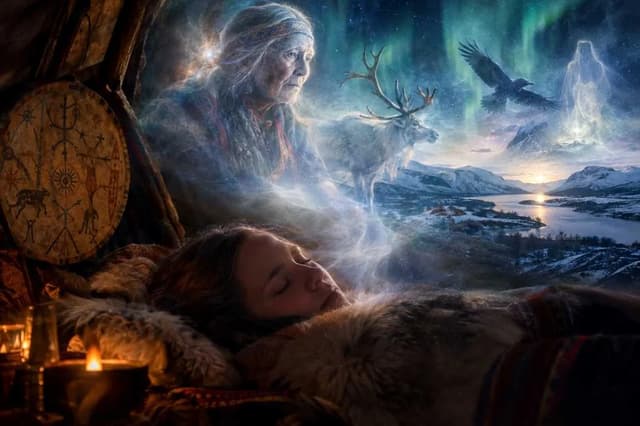
The role of the shaman in Sami tradition In Sami culture the shaman, known as the noaidi, has had an important role as a spiritual leader and guide. The noaidi acted as an intermediary between the human world and the spirit world, which consisted of nature spirits, ancestors and divine beings. Through the use of the drum, known as the rune drum, the noaidi could make contact with these spirits. The drum was used to enter a trance, and the noaidi could then travel to other worlds in order to find answers to questions, heal illnesses or avert dangers.
In Sami cosmology the world was divided into different spheres, which include the human world, the underworld and the upper world. The noaidi could move between these spheres and had a unique understanding of how they affected one another. In addition to performing healing ceremonies, the noaidi also played an important role in social and political decisions and was often a central figure in the community.
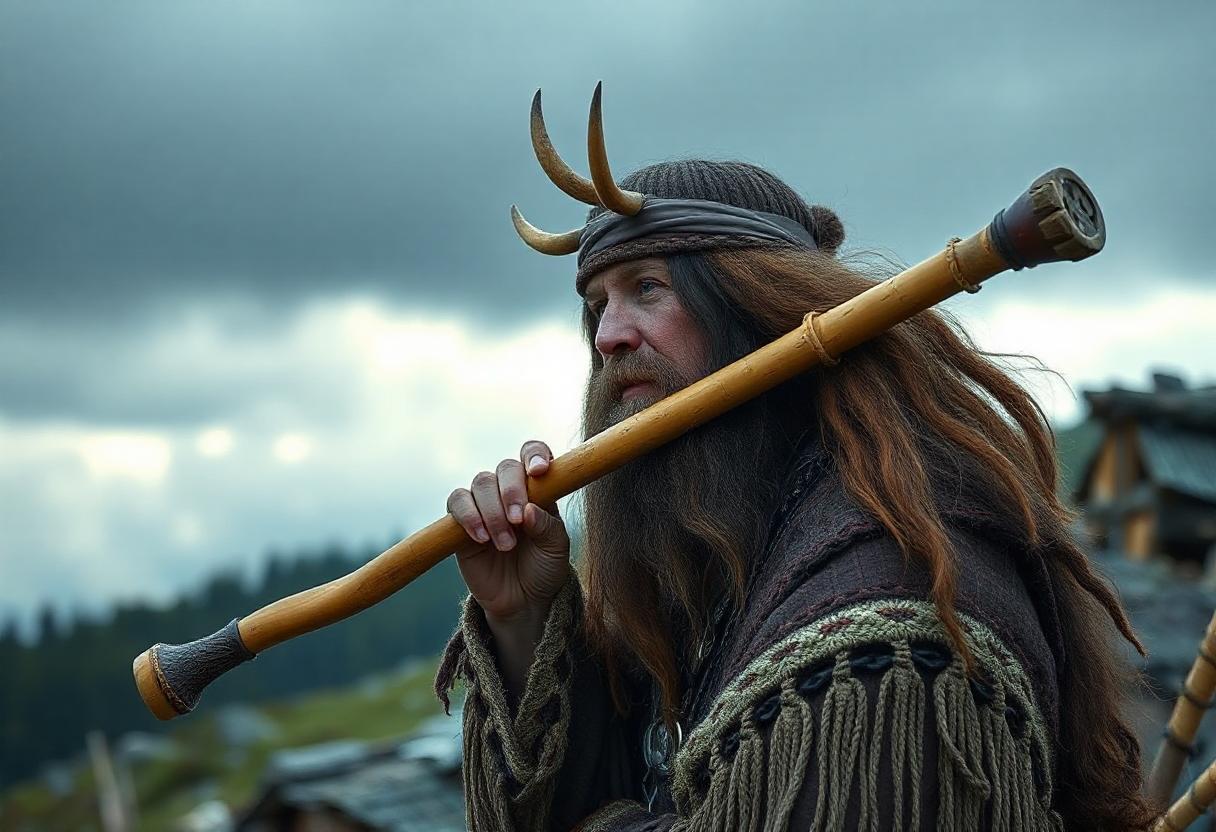
The role of the shaman in Norse tradition In Norse tradition, particularly known from the Viking Age, shamanic figures were known as völvas or seidmen. The völvas, who were often women, were seers and spiritual leaders who could look into the future and communicate with spirits through rituals known as seidr. This often involved entering a trance with the help of song, drumming or the use of staffs, and then travelling to other worlds in order to receive visions or advice from the spirits.
The völva acted as an advisor to chieftains and kings, and her prophecies were seen as very important for understanding what was to come, especially in times of war or when making major decisions. The practice of seidr could also be used to influence events or other people through magical means, and völvas were often feared and respected for their powers.
Although there are many similarities between Sami and Norse shamanism, such as the use of trance and communication with the spirit world, there are also some differences. In Norse tradition seidr was often associated with both feminine power and magic, while in Sami tradition the role of the noaidi was more gender-neutral, with a focus on the well-being of the community and contact with nature.
The role of the shaman in African tradition African shamanism, often referred to as healing, witchcraft or medical shamanism, has deep roots in many African cultures, where the shaman plays an important role as a healer and spiritual leader. Shamans in Africa, often called sangoma in southern Africa or babalawo in West African traditions such as Ifá, act as intermediaries between the physical world and the spirit world, where they seek guidance from ancestors and spirits in order to heal illnesses, avert evil, and protect the community. It is important to mention that Africa is an entire continent and that there are great differences between the cultures. Only a few are mentioned here.
In many African shamanic traditions the use of ritual objects and natural medicine is central. This includes the use of herbs, animal parts, and other natural materials that are charged with spiritual power. An important part of the African shaman's role is to communicate with the spirits of the ancestors, who play a central role in many African cosmologies. The ancestors are seen as protectors and guides for the living, and the shaman acts as a channel for their wisdom and power.
A distinctive ritual object in African shamanism is the mask. Masks are often used in rituals and ceremonies to represent the spirits or the ancestors, and by wearing the mask it is believed that the shaman can manifest the spiritual power of the being the mask represents. This gives the shaman the ability to perform healings, avert evil spirits, or ensure fertility and prosperity for the community.
The role of the shaman in Siberian tradition Shamanism in Siberia is one of the oldest and best-documented shamanic traditions. Here the shaman acts as a healer, spiritual leader and protector of the tribe. Siberian shamans often use drums and song to enter a trance and communicate with the spirits. They perform healing rituals, foretell the future and lead ceremonies that protect the tribe against evil spirits and natural disasters. A distinctive feature of Siberian shamanism is the extensive use of spirit journeys, in which the shaman is physically experienced to leave their body in order to travel to the spirit world. Here too there are cultural differences from people to people.
Similarities and differences
Communication with the spirit world: In all of these traditions the shaman acts as an intermediary between human beings and the spirit world, whatever form this spirit world takes. Trance and spirit journeys: The use of trance, often induced through drumming, song or the use of sacred plants, is a common method for achieving contact with the spirit world. Healing: Shamans often act as healers, both physically and spiritually, and their practice often involves a deep understanding of how spiritual forces affect people's health and well-being.
Gender roles: In some traditions, such as the Norse, shamanic roles such as seidr are often linked to women, while in others, such as Sami culture, both men and women can be shamans. Ceremonial practice: While Siberian and Sami shamanism place great emphasis on individual spirit journeys and healing, African traditions often have a strong focus on collective healing and protection, in which the entire community can take part in ceremonies. Ritual objects: African traditions often use masks and other artistic representations of spirits and ancestors, while in Sami and Siberian shamanism the drum is a more prominent ritual object.
Gaski, Harald. Noaidi: The Sami Shaman. Sami Culture, 1993. Hultkrantz, Åke. Shamanic Healing and Ritual Drama: Health and Medicine in Native North American Religious Traditions. Crossroad Publishing, 1992. Price, Neil S. The Viking Way: Religion and War in Late Iron Age Scandinavia. Oxbow Books, 2002. Hammond-Tooke, David. Rituals and Medicines: Indigenous Healing in South Africa. Ohio University Press, 1989. Bascom, William. Ifa Divination: Communication Between Gods and Men in West Africa. Indiana University Press, 1969. Vitebsky, Piers. *The Shaman: Voyages of the Soul, Trance, Ecstasy and Healing from Siberia to the