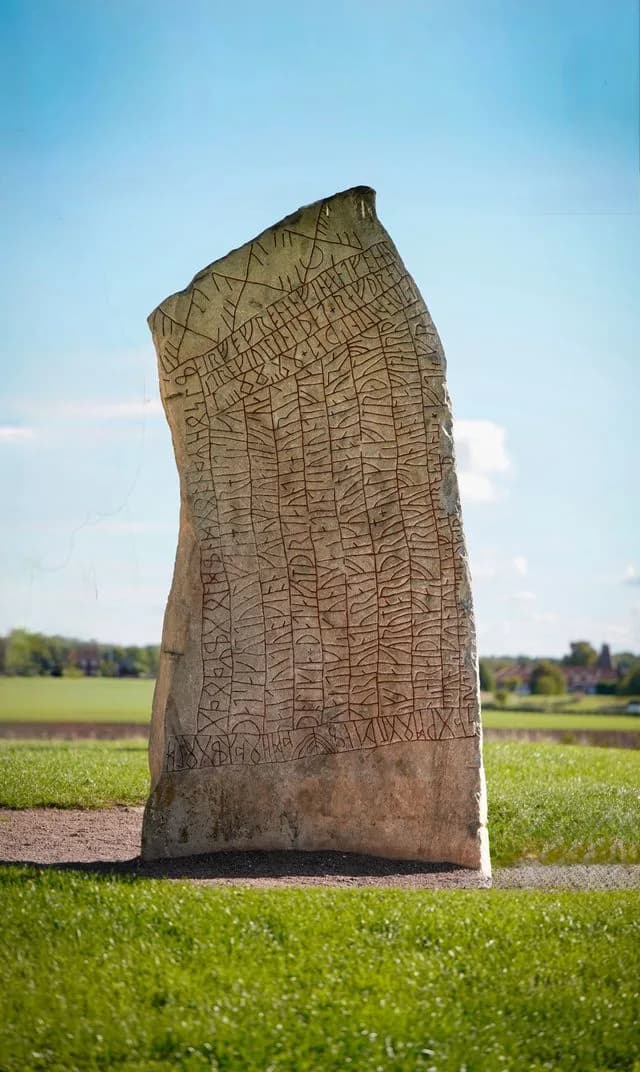
It begins with a stone.
It stands in the landscape, weathered and silent, while people come and go. Its surface bears traces of a time when words were carved with a sharp knife or chisel, not onto paper, but into wood, bone, metal, and stone. To us, runes may appear to be an alphabet. To the people who used them, they could be a memory, a message, a prayer, a warning – and perhaps also an action.
But this is where we must begin with an important qualification: We do not always know what a runic inscription “did.” We can read the signs, translate words, and compare formulations. We can place objects in time and space. But when we say that a text was a curse, a healing formula, or a prophecy, we move from what can be securely documented into the realm of interpretation.
This is precisely the tension that makes runes so fascinating.
Harley Nicole Botham’s thesis Interpreting Old Norse Magic: A Thematic Analysis of Seiðr, According to Runic Inscriptions examines magical themes in runic inscriptions from Denmark, Norway, and Sweden, dating from approximately AD 500 to 1500. The study focuses particularly on four themes: curses, healing, prophecy, and protection. At the same time, it emphasizes that the source material is difficult, incomplete, and open to multiple readings.
This article builds on Botham’s work, but clearly distinguishes between three levels:
Historical documentation: what can be read, dated, or connected to a specific object.
Scholarly interpretation: proposals based on language, comparisons, and historical context.
Speculation: more uncertain ideas about what people may have believed, felt, or attempted to achieve.
It is not a weakness that we have to mark this distinction. On the contrary, it is a prerequisite for telling the story of the past well without turning guesses into facts.
What was seiðr?
The word seiðr is often used as a collective term for Norse magic, but the concept is difficult to translate unambiguously. In modern popular culture, seiðr is often presented as a particular form of “witchcraft” or shamanism. Historically, the picture is more complex.
Seiðr could be associated with divination, influence, protection, illness, healing, love, warfare, and forces of nature. It is therefore problematic to portray seiðr as a single fixed type of ritual with one particular set of equipment, one specific group of practitioners, or one defined function.
Neil Price has described magic as an “extension of the mind and its abilities,” and this perspective is useful because it shifts attention away from modern ideas of magic as trickery. Instead, magic can be understood as people’s attempts to influence or understand a reality in which gods, ancestors, fate, illness, and invisible forces formed part of the same worldview.
The distinction between religion, magic, and medicine is also difficult to apply to Norse material. A prayer to a deity, a runic formula, an herbal medical treatment, and a ritual action may have been parts of the same practice. This does not mean that Norse people lacked categories or were “primitive.” It means that their categories do not necessarily correspond to ours.
Here, however, we should remain cautious. When we say that “Norse people believed” something specific, we can easily generalize. Scandinavia was not a religiously or culturally homogeneous region. Local traditions, social differences, gender, time, and contact with other cultures influenced how rituals and beliefs were understood. Botham therefore emphasizes that seiðr should be treated as a fluid and diverse concept, rather than as a closed system.
What is historically certain, then, is not that everyone in the Nordic world had the same idea of seiðr. What is certain is that words, objects, and texts show that ideas about magical influence formed part of the cultural landscape.
The stones that were meant to protect the dead
On the Glavendrup Stone in Denmark, we are told that Ragnhild raised a stone in memory of Alli the Pale. He is described as an honorable man and as a priest at a sacred site. Alli’s sons and his wife are also associated with the memorial, and the runemaster Sóti is named as the person who carved the inscription.
The text then contains an invocation to Thor to consecrate the runes. On the final side of the stone there is a threat against anyone who damages or moves the monument. Such a person is to become a ræta, a word that has been translated in different ways, including as sorcerer, outcast, or scoundrel.
Here we can clearly distinguish between text and interpretation.
Historical documentation: The stone exists. It can be dated to the Viking Age, around AD 900. The inscription contains a memorial text, an invocation of Thor, and a threatening formulation directed at anyone who damages the stone.
Scholarly interpretation: The formulation can be understood as a curse intended to protect the monument. It can also be interpreted as a social warning, intended to frighten people away from committing an act that violated the memory of the dead.
More uncertain speculation: That the text was actually perceived as a supernatural force that would strike the person responsible cannot be directly proven. It is reasonable to assume that the inscription was intended to have a deterrent effect, but we do not know whether it was understood as a literal magical act, a religious formula, a legal threat, or all of these at once.
Similar formulations occur on several runestones.
The Björketorp Stone in Sweden, dated to approximately AD 500–700, is one of the oldest objects in Botham’s selection. It contains a text describing runes as possessing power and threatening anyone who breaks the monument with evil and death. Part of the inscription can be read as uþarba spa, which has been interpreted as “I prophesy destruction” or “prophecy of destruction.”
Similar formulations occur on the Skern Stone and the Glemminge Stone. The person who destroys the memorial is to be called, or become, a magician. On the Sønder Vinge Stone, the text is damaged, making the interpretation even more uncertain. Some scholars have proposed sexual and shame-related meanings in the curse, connected to the concept of ergi, but this is an area where translation and cultural reconstruction can easily go too far.
It is documented that the words have negative connotations. What is not documented is exactly how a person called a ræta would have been treated in practice, or whether the term always had the same meaning. The claim that such a designation could automatically lead to outlawry or the death penalty is therefore an interpretation – not a historical fact that can be established from the inscription alone.
Nevertheless, the stones show us something important: They connect memory, social order, and ritual language. A memorial inscription was not merely a private greeting. It placed a person within the family, society, and landscape. The curse marked the fact that the memory was not to be disturbed.
When illness grows wings
A staff from Hemdrup in Denmark contains both runic text and figures. The text is short and difficult to interpret. One possible translation can be rendered approximately as: “The flying one never overcame you, Ása.”
What is “the flying one”?
This is where interpretation begins. Some scholars have suggested that it may be a spirit of illness or a fever demon. Other translations give the text a more general meaning, for example that “the flying one” did not defeat Ása in battle. The figures on the staff have also been interpreted in several ways, including as a magical practitioner accompanied by helping beings.
Historical documentation: There is a staff with runes and figures, dated approximately to AD 900–1050. The text mentions Ása and a “flying” being, or something that can be interpreted in that direction.
Scholarly interpretation: The staff may have been connected to healing or protection against illness. This is supported by the possibility that the text can be read as a victory over a threatening force, and by the fact that this type of object has been associated with magical practices in scholarship.
Speculation: That the figure actually depicts a particular shaman, or that the flying figure is a fever demon, is not certain. It may be a plausible hypothesis, but not an established identification.
This distinction is important because modern narratives often turn the most colorful interpretation into the truth. “A völva heals Ása from a flying disease demon” is a vivid story, but the source does not state this with certainty. It gives us a text, an object, and a space for interpretation.
On the Bryggen wharf in Bergen, another inscription has been found, dated to approximately AD 1185: “Health to you and good thoughts. May Thor receive you, may Odin possess you.” The formulation can be understood as a greeting or blessing. It may also resemble a short galdr, that is, a ritually or magically charged song or formula.
But here too we must be cautious. We cannot know whether the text was sung, whispered, or simply written. Nor can we know whether it was used as medical protection, a religious greeting, or a personal wish for well-being. The fact that it mentions Thor and Odin shows that these deities form part of the conceptual world of the text. It does not by itself prove that the inscription was a seiðr formula.
The Ribe staff and the meeting of traditions
The Ribe staff from Denmark is dated to approximately AD 1300, that is, after the Christianization of Denmark. It contains a prayer to the earth, the sky, the sun, Mary, and God. The writer asks for “healing hands” and a “healing tongue” to heal the trembling person. The body is mentioned in detail: the back, chest, limbs, eyes, ears, and everything that can be afflicted by something harmful.
This is one of the most concrete healing texts in the material.
Here it is historically documentable that the text combines Christian elements with older language and ideas. But it is more difficult to say what this means for the person who used the staff. We cannot simply conclude that the person was “really” pagan, or that Christianity was merely a superficial layer.
It is better to say that the text demonstrates religious blending or continuity in practice. A Christian prayer could incorporate older ideas about the earth, sun, numbers, illness, and effective words. Conversion did not necessarily mean that all earlier ritual forms disappeared at the same time.
The expression “nine needs” or “nine necessities” has acquired considerable importance in scholarship. The number nine is known from several Norse texts and mythological contexts. But the connection between this particular expression and a specific magical method is uncertain. Some scholars have understood “the nine needs” as destructive forces. Others have interpreted them as something that drives illness away.
Here it is academically responsible to say that the expression is enigmatic, but that it occurs in several magical or healing-related contexts. There is, however, no basis for describing the nine needs as a fixed, well-known “spell” with one specific meaning.
The term “healing hands” must also be interpreted cautiously. It may express a concrete belief that a healer possessed power through touch. It may also be a poetic way of describing medical or religious competence. We cannot know whether the staff was used for laying on hands, carried as an amulet, or formed part of a more extensive process.
Prophecy, memory, and riddles
The Rök Stone in Sweden is perhaps the runic inscription that most clearly demonstrates how difficult it is to distinguish between history, literature, and speculation.
The stone was erected around AD 800–900 in memory of a deceased man named Vámóðr. It contains stories about war booty, kings, heroes, the god Thor, and a series of enigmatic passages. It uses several runic systems and has a complex layout.
Historical documentation: The Rök Stone exists, can be dated, and contains a long, partially encrypted text with a memorial formula, narratives, and mythical or historical references.
Scholarly interpretation: The text may have been intended for a local community familiar with the stories. The repetition of a formulation that can be translated as “I tell a tale of the people” or “I tell the young men” may have connected the stone to oral tradition and collective memory.
More uncertain speculation: That the Rök Stone is a direct prophecy of Ragnarök, or that it was erected as a reaction to the climatic catastrophe following AD 536, are interesting hypotheses, but not proven facts. The same applies to the idea that the entire stone is primarily about preparing society for an approaching global catastrophe.
It is possible that climatic crises and memories of famine and death influenced the cultural background of the text. Such connections can make an interpretation historically meaningful. But it is a considerable leap from “society experienced climatic catastrophes” to “the runemaster created the stone to prophesy Ragnarök.”
The Rök Stone should therefore be described as a text that can be read in the light of prophecy, memories of catastrophe, and mythic time – not as an unambiguous prophecy.
The Malt Stone in Denmark is even more uncertain. It contains a fuþark sequence, repeated sequences of signs, and formulations that can be translated as “joy runes” and “runes for eternal friendship.” Scholars have suggested that the text may be a memorial inscription, a curse, a riddle, or a ritual formula.
When a text contains unusual patterns, it is tempting to interpret them as evidence of deliberate magical coding. But there are other possibilities as well: linguistic change, local writing traditions, errors, an incomplete text, or a mixture of different conventions.
It is not certain that every unusual runic form is deliberately cryptic. And it is not certain that every repetition is a magical formula.
Protection and love
At the Bryggen wharf in Bergen, a staff referred to as a bótrúnar staff was found. It contains formulations about helpful and protective runes, protection against elves, trolls, and jötnar, but also threats against a woman who does not return the writer’s love.
The text can be rendered approximately as: “I carve helpful runes. I carve protective runes.” This is followed by a formulation that appears to wish the woman unrest, sleeplessness, and pain.
Here it is reasonable to speak of a magical or curse-like text, because the inscription itself refers to “helping runes” and “protective runes,” while at the same time expressing a desire to influence another person.
But here too there is uncertainty. We do not know whether the text was meant seriously, whether it was a private complaint, part of a love ritual, a joke, or an attempt to frighten someone. Nor can we be certain that the writer actually believed the woman would be affected by supernatural harm.
What we can say is that the text uses language that turns emotions and will into a potential force. It attempts to formulate a relationship – perhaps a desire for love, perhaps a reaction to rejection – as though words could change the situation.
This is a good example of how runes can be more than information. They can be utterances that seek to do something. But “seeking to do something” is not the same as “having a supernatural effect.”
Fear and respect
The runes reveal a society in which magical ideas could be both respected and condemned. It is documented that some inscriptions refer to magical practices or people in negative terms. It is also documented that other texts ask for help, health, and protection from gods or through runes.
It is therefore reasonable to describe seiðr as a contested field. But we should avoid portraying society as though everyone held the same view.
Botham emphasizes the relationship between seiðr and ergi, particularly ideas about unmanliness and social shame associated with male practitioners of magic. This is based on a broader scholarly discussion about gender, sexuality, honor, and magic in the Norse period. Nevertheless, this too must be nuanced. The term ergi occurs in particular legal and literary contexts, and it cannot simply be used as a complete description of all male seiðr practitioners or of the entire Norse society’s attitude toward them.
Likewise, we should be cautious when writing that vǫlur or female practitioners of seiðr possessed “great power.” The sources show that women could be associated with prophecy, rituals, and magic, and archaeological finds of staffs in women’s graves are relevant. But the objects do not always tell us exactly who used them or what they were used for. A staff may have been a ritual tool, a symbol of status, or an object with several functions.
Here, the phrase “may have been” is often more historically precise than “was.”
What can we actually know?
The runic inscriptions give us a rare closeness to the past. They are original traces left by people who lived in a time when a great deal of communication was oral. They can contain names, family relationships, memories, laws, religion, curses, and wishes for healing.
But they are not windows providing us with a complete view of the past. They are individual traces.
A memorial inscription tells us that someone wanted to preserve a name. It does not tell us how everyone in the area thought about the deceased. A healing formula shows that someone wrote or used such language. It does not prove that everyone shared the same medical or religious beliefs. A curse shows that a threat was formulated. It does not prove that the threat was actually feared or had an effect.
That is why we must use words such as “may,” “probably,” “possibly,” “one possible interpretation,” and “scholars disagree.” Such formulations do not make history less exciting. They make it more credible.
In a way, the study of runes resembles listening to a song in which several verses have been lost. We can hear the rhythm, some of the words, and perhaps the outline of the story. But we must not fill the gaps with our own voice without saying that it is we who are singing.
When the runes still speak
Runes were not automatically magical. They could be used for everyday messages, names, and memorial texts. But in particular contexts they could acquire a ritual or magical function – especially when the text itself expresses a curse, healing, protection, divine invocation, or another form of influence.
The historical material gives us grounds to say that people in Scandinavia used runes in texts that could have religious and magical overtones. It also gives us grounds to investigate how memory, illness, danger, love, and fate were expressed.
But it does not give us permission to turn every hypothesis into fact.
It is documented that the Glavendrup Stone invokes Thor. It is reasonable to interpret the threat against anyone who damages the stone as protective. It is more uncertain whether the curse was understood literally, legally, or symbolically.
It is documented that the Ribe staff asks for healing and uses both Christian and older religious expressions. It is reasonable to view the text as an example of mixed traditions. It is more uncertain how the staff was actually used in practice.
It is documented that the Rök Stone contains riddles, memories, and mythical references. It is reasonable to connect it with cultural memory. It is more speculative to claim that it unambiguously prophesies Ragnarök.
It is documented that the Bryggen staff refers to protection and expresses hostility toward a woman. It is reasonable to call the text curse-like or magically charged. It is not possible to know with certainty whether it was intended as a serious ritual, a threat, or a personal expression.
This is how seiðr becomes a historical reality at a particular level: not because we can prove that curses worked, or that illnesses were driven from the body, but because people wrote, carved, and used language that assumed that words, signs, and rituals could have significance in encounters with invisible forces.
The runes do not merely tell us what people in the past did.
They also show us what they tried to protect, what they feared, what they hoped for – and how much we still do not know.
Academic sources
Main source
Botham, Harley Nicole. Interpreting Old Norse Magic: A Thematic Analysis of Seiðr, According to Runic Inscriptions. MLitt thesis in Viking Studies, University of the Highlands and Islands, July 30, 2024.
Botham’s thesis is the main basis for this article. It contains analyses of runic inscriptions, transliterations, translations, research history, and a thematic examination of curses, healing, prophecy, and protection.
Secondary literature
Barnes, Michael P. Runes: A Handbook. Woodbridge: Boydell Press, 2012.
Brink, Stefan. Works on pre-Christian Norse religion, forn siðr, cult practices, social structures, and Nordic cultural history, including publications from 2007, 2008, 2020, and 2021.
Dillmann, François-Xavier. Works on magic, seiðr, and magicians in Norse sources, particularly publications from 2006.
Düwel, Klaus, and Robert Nedoma. Works on runology, runic inscriptions, religion, and magic, including publications from 2023.
Gardeła, Leszek. Works on staffs, graves, ritual objects, and magical practices in Viking Age Scandinavia, including publications from 2008 and 2016.
Gustavson, Helmer. Works on runic inscriptions, materiality, healing, and magical objects, including publications from 2010.
Jesch, Judith, and Christina Lee. Work on the Ribe inscription and medieval healing formulas, published in 2019.
Kieckhefer, Richard. Works on magic, sexuality, and ideas of social and religious deviance in the Middle Ages, including publications from 1991.
Larrington, Carolyne. The Poetic Edda. Oxford: Oxford University Press, 1996. Later revised editions have also been used in scholarship.
MacLeod, Mindy, and Bernard Mees. Runic Amulets and Magic Objects. Woodbridge: Boydell Press, 2006.
McKinnell, John, Rudolf Simek, and Klaus Düwel. Runes, Magic and Religion: A Sourcebook. Vienna: Fassbaender, 2004.
Mitchell, Stephen A. Witchcraft and Magic in the Nordic Middle Ages. Philadelphia: University of Pennsylvania Press, 2011.
Moltke, Erik. Runes and Their Origin: Denmark and Elsewhere. Copenhagen: Nationalmuseet, 1985.
Nielsen, Karl Martin. Works on magical runic inscriptions, formulas, and thematic patterns, including publications from 1985.
Price, Neil. The Viking Way: Magic and Mind in Late Iron Age Scandinavia. Uppsala: Department of Archaeology and Ancient History, 2002.
Price, Neil. Works on seiðr, Norse magic, religion, shamanism, and cultural continuity, including publications from 2008.
Raudvere, Catharina. Works on seiðr, magic, rituals, fate, and Norse culture, including publications from 2001, 2003, and 2009.
Schulte, Michael. Works on the language of runic inscriptions, orality, formulas, and ritual function, including publications from 2006 and 2008.
Simek, Rudolf. Dictionary of Northern Mythology. Cambridge: D. S. Brewer, 1993.
Sørensen, Preben Meulengracht. Works on honor, sexuality, ergi, and society’s attitudes toward magic in the Norse period, including publications from 1983.
Strömbäck, Dag. Works on seiðr, shamanism, and prophecy in the Norse tradition, first published in 1935 and later issued in revised editions.
Tolley, Clive. Works on shamanism, seiðr, and magical practices in medieval Nordic sources, including publications from 2009.
Williams, Henrik. Works on runology, transliteration, understanding runes, and methodological challenges in interpreting runic inscriptions, including publications from 2008 and 2010.
Primary sources
The following runic inscriptions and objects are discussed in the article:
Björketorp Stone, DR 360.
Glavendrup Stone, DR 209.
Sønder Vinge Stone 2, DR 83.
Skern Stone, DR 81.
Glemminge Stone, DR 338.
Rök Stone, Ög 136.
Malt Stone, DR NOR1988;5.
Hemdrup staff, DR EM85;350.
Ribe healing staff, DR EM85;493.
Bryggen inscription 145, N B380.
Bryggen bótrúnar staff, N B257.
Kvinneby plate, Öl SAS1989;43.
Lund leather sheath, DR EM85;475A.