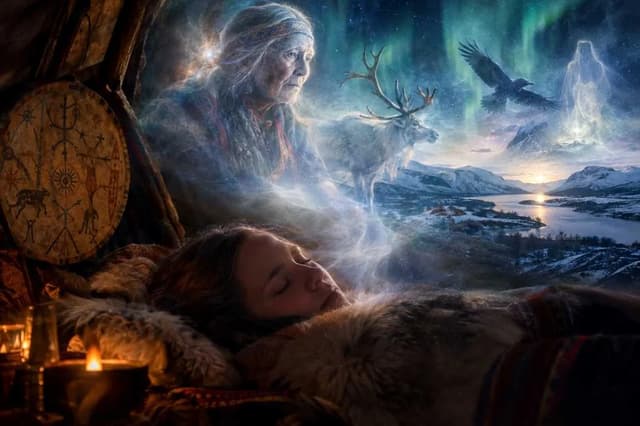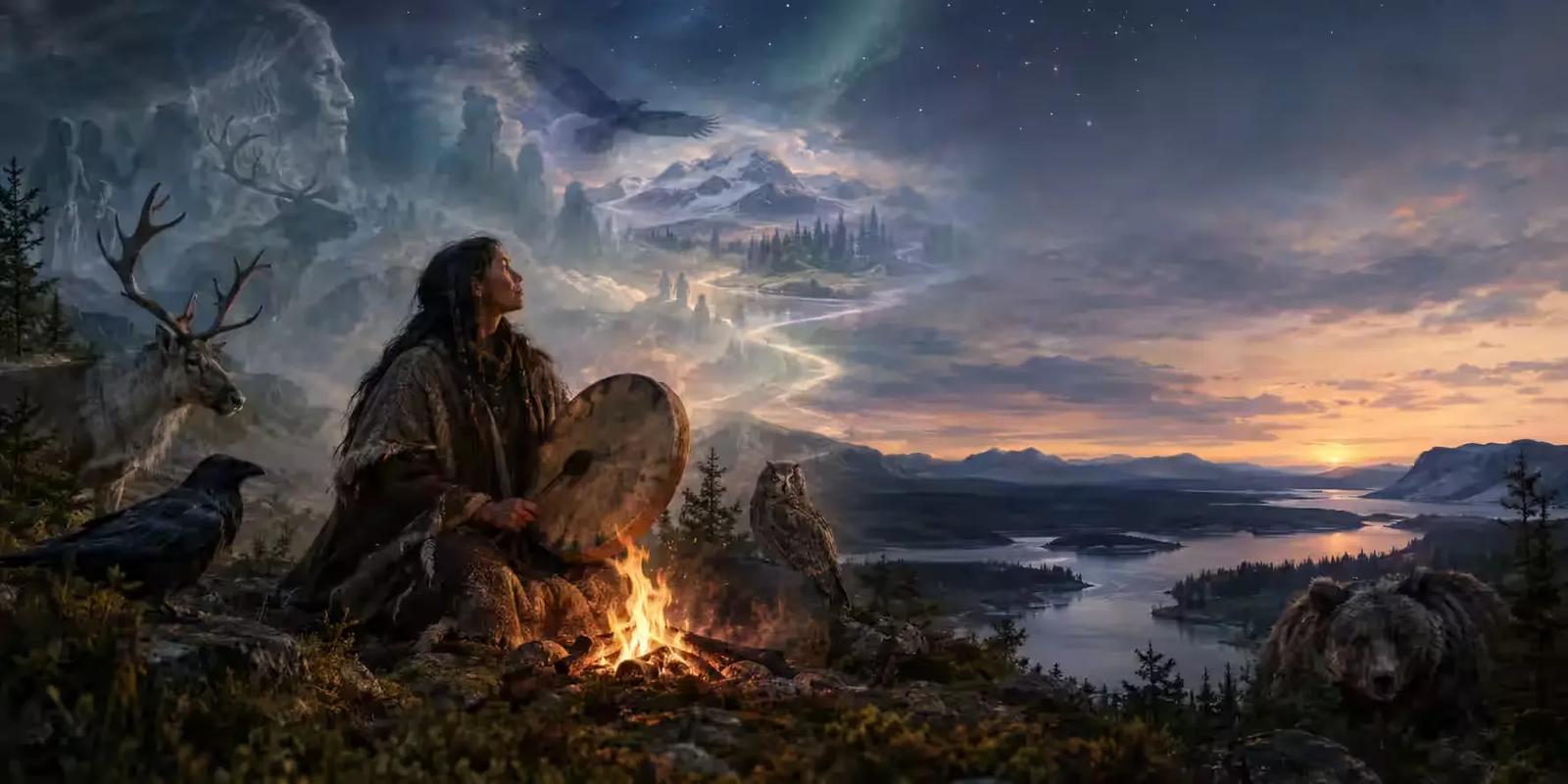
The question is important. When we use the word shamanism, we must do so with both openness and caution. We must be able to see the striking similarities between traditions that have arisen far from each other – without pretending that they all express one and the same religion. We must be able to approach experiences of the spirit world, healing, and altered consciousness – without reducing them to either superstition or romantic fantasies. Shamanism exists in this field of tension: between body and spirit, individual and community, nature and culture, illness and healing, life and death.
A meeting that changed perspective
In an article published by Human Relations Area Files at Yale University, anthropologist Jeffrey Vadala recounts his meetings with religious specialists in Mexico and Haiti. He originally set out with an academic gaze, shaped by scholarly literature and many discussions about whether shamanism was a useful concept. In his research, he had encountered the claim that shamans must be understood either as remnants of a distant, archaic past or as representatives of an original, shared religious system.
But the meetings with the people themselves made an impression in another way.
Vadala describes how he encountered individuals who were healers, seers, ritual leaders, and guides in sacred landscapes. They belonged to different cultures and lived in societies with different historical experiences. Yet he found clear parallels in their worldviews and practices. It was not that everyone did the same things or used the same words. But many of them worked with similar questions: What happens when a person loses connection to themselves, to their community, or to the living world? How can illness be understood? Where are the boundaries between dream and waking state, between visible and invisible reality? And how can a person draw help from forces that lie beyond ordinary everyday consciousness?
It was this experience that led Vadala to begin seeing shamanism less as a specific religion and more as a religious form that can arise in different societies when certain needs and conditions are present. The concept could then be used as a model for comparing certain roles and practices – but not as a claim that all traditions share the same origin.
This is an important distinction. When we speak of shamanism, we are therefore not necessarily speaking of one historical religion. We are speaking rather of a pattern that can be recognised in many different cultural contexts.
A word from Siberia
The word shaman originates in North Asia. It is usually associated with Tungusic languages, particularly Evenki, and was used for religious specialists in Siberia. Later, European scholars adopted the word as a designation for people with similar functions in other parts of the world.
This development brought both insight and problems. On the one hand, the word made it possible to compare religious roles across cultures. Scholars could examine similarities between healers, seers, and ritual leaders in Siberia, the Americas, Africa, Asia, and other regions.
On the other hand, the use of the word could lead to local traditions being treated as variations of something they themselves had never called shamanism. A society may have its own names for its religious specialists, its own ideas about spirits and illness, and highly distinctive rituals. When outsiders nevertheless place all these people in the same category, important differences can disappear.
This has led to extensive scholarly debates. Some researchers argue that the word should primarily be used for religious specialists in the Siberian regions where the concept originated. Others maintain that it can be used more broadly, as long as this is done with clear caveats.
The American anthropologist Michael Winkelman has attempted to define shamanism through a comparison of many societies. In his work, he examined a large number of variables related to rituals, initiation, altered states of consciousness, spiritual relationships, healing, and religious power. On this basis, he described a distinctive complex of practices that occur among religious specialists in many small-scale societies.
This does not mean that all these societies share one common doctrine. It means rather that certain functions and ideas appear to recur again and again.
The journey between worlds
One of the most well-known characteristics of shamanic traditions is the idea of a journey between worlds. In many traditions, reality is understood as composed of multiple levels. There is a visible world, the one we move through with our bodies. Beneath or within this may exist other realms connected to animals, ancestors, the dead, helpers, and natural forces. Above us may be heavenly or divine spheres.
The shaman's task is not necessarily to flee from the world, but to move between its levels in order to gather knowledge, help, or power. The journey may take place in dreams, trance, vision, or another form of altered state of consciousness.
In stories, the journey is often described as a voyage in which the soul or spirit leaves the body. The shaman may then encounter spiritual beings, receive guidance, retrieve a power that has been lost, or attempt to find the cause of an illness.
This language may seem foreign to a modern person. At the same time, the very experience of moving into another reality is not unknown. People know dreams that feel more real than waking life, intense nature encounters, religious visions, deep meditation, and experiences in which time seems to disappear.
Shamanic traditions give such experiences a cultural language. They place them within a cosmology and connect them to specific rituals, stories, and responsibilities.
The drum, song, dance, and rhythm can function as tools for gathering attention. The monotone sound can help the practitioner step out of the ordinary patterns of everyday consciousness. In many traditions, fasting, sleep deprivation, isolation, intense physical exertion, or the use of plants have also been part of the path into altered states of consciousness.
But it is important to emphasise that no single method is necessary for all shamanic traditions. Vadala describes, for example, how the people he studied used different means. Some used ritual drinks, while another avoided all intoxicants and worked through dreams. Thus, it is not the use of hallucinogenic substances alone that determines whether a practice can be called shamanic.
When illness becomes a rupture
In modern Western medicine, illness is primarily understood through the body's physiology. Organs, cells, bacteria, viruses, hormones, and the nervous system are examined. This knowledge is invaluable, and serious illness must always be taken seriously through qualified healthcare.
In many shamanic worldviews, however, there is another way of understanding illness. Illness can be a sign that the connection between the person and the world has been disturbed. It may be linked to loss of soul power, intrusion of foreign forces, breaking of taboos, conflicts with spirits, or imbalance in the relationship between the individual and the community.
To us, this may sound symbolic. For someone living in such a reality, it is a concrete explanation for why something has happened.
The shaman's task then becomes more than just treating symptoms. It becomes finding out what is missing, what has been lost, and what must be brought back into balance. Healing may consist of song, cleansing, prayer, storytelling, touch, offerings, herbs, counselling, or a journey to the spirit world.
A recurring motif is the idea of the soul's return. A person may have lost part of their life force through grief, trauma, illness, loss, or major life changes. The shaman then seeks to find and bring this power back.
Whether one interprets this literally, psychologically, or symbolically, it is easy to see why such rituals can become meaningful. They give suffering a story. They make it possible to express what is otherwise difficult to say. And they place the individual back into a community that can bear part of the burden.
It is precisely this social side of healing that several researchers have highlighted. Michael Winkelman has proposed that shamanic rituals can contribute to attention, self-awareness, emotional processing, and social reintegration. His theory is debated, but it points to something essential: In many cultures, healing is not only about the individual, but also about restoring the relationship between the person and the group.
The one who survives their own crisis
In many shamanic traditions, the one who is later to become a healer or spiritual leader is themselves subjected to a dramatic crisis. It may be a serious illness, a near-death event, a period of intense dreams, or an experience of being called by spirits. The crisis period can lead the person through a symbolic death. The old identity is broken down, and a new one emerges.
Vadala tells of three religious specialists he met in Mexico and Haiti. All had stories of how they had been drawn into the role after a life-threatening physical or spiritual illness. They had themselves stood on the boundary between life and death. In dreams or visions, they had encountered spiritual beings who showed them how to heal themselves – in exchange for the promise that they would later serve others.
Here we find a motif that also appears in many other religious and mythological stories: The one who is to lead others through darkness must first have entered the darkness themselves.
This does not mean that every illness or psychological crisis is automatically a spiritual initiation. Such romanticisation can be both dangerous and irresponsible. But in traditions where the shaman is understood as a person with special contact with the spirit world, the crisis can be interpreted as a transition. It does not necessarily confer status in itself. It must be followed by training, discipline, knowledge, and recognition from the community.
The shaman thus becomes not only the one who has had a powerful experience. They are also the one who afterwards takes responsibility.
Knowledge that must be shared
A shamanic practitioner is often more than a healer. The role may also include that of storyteller, counsellor, ritual leader, seer, and custodian of local knowledge.
To help a person, the shaman must know the stories that give the landscape meaning. Which places are sacred? Which animals have special significance? Which ancestors or spirits are connected to the area? Which rituals belong to planting, hunting, birth, illness, or death?
Vadala describes how the shaman may tell mythological stories during a treatment. The story explains not only the creation of the world or the actions of gods. It also helps the patient understand their own situation. The person's illness is placed into a larger context – in relation to cosmos, local history, family, and spiritual events.
In this way, the story becomes a healing tool. A person experiencing chaos can receive help to see a connection. Someone who feels homeless in existence can be reminded of where they belong. Someone who has lost direction can regain a language for responsibility, belonging, and hope.
This is one reason why shamanic traditions cannot be reduced to techniques. The drum, the journey, or the ritual does not make sense apart from the culture in which they are embedded. It is the whole web of myths, relationships, landscapes, and obligations that makes the action effective.
Rain, fields, and community
The shaman's work is not only about the inner life of the individual. In many societies, the role is closely connected to agriculture, hunting, weather, and the rhythms of nature.
In Yucatán, Vadala describes a rain ceremony known as Chac Chaac. The ritual has roots in pre-colonial traditions. Before the planting season, people gather for a communal meal, and an altar is built of branches and pieces of wood that symbolically represent the cosmos. Through prayers and appeals to spiritual powers, rain and good harvests are sought.
In the Haitian material, similar rituals connected to agricultural areas are described. Small sacred rooms and altars could be part of protecting fields from spirits, sorcery, and theft. In other places, land, tools, and production facilities were blessed.
To a modern person, such actions may be interpreted as religious symbols. But they are also social actions. They gather people before an important season. They express respect for forces that cannot be fully controlled. They remind the community that crops are not only the result of human labour, but also of rain, sun, soil, insects, animals, and a climate that always contains uncertainty.
In this sense, the shaman's role can be understood as a form of relational work. The shaman strives to keep the connection between the human and the more-than-human world alive.
Between similarity and difference
It is tempting to say that shamans everywhere do the same things. They go into trance, communicate with spirits, heal the sick, and lead rituals. But such a statement becomes too simple.
A Siberian shaman, a religious leader in Mesoamerica, and a Haitian mambo do not necessarily work within the same cosmology. They may have different gods, different rituals, different social roles, and different historical experiences. Colonialism, Christianity, state formation, economy, and modern societies have left deep marks on all these traditions.
Yet they may have some things in common at a functional level. They may be people who:
- work with altered states of consciousness.
- understand contact with spiritual beings as a fundamental part of their task.
- perform healing, diagnosis, or divination.
- lead rituals for individuals and groups.
- manage myths, songs, and local knowledge.
- connect people's health to the relationship between body, soul, community, and nature.
It is in this field that the concept of shamanism can be useful. Not as a claim about one common primal religion, but as a comparative tool. At the same time, we must never let the comparison erase the distinctiveness of individual traditions. Meeting shamanism with respect also means respecting that many Indigenous peoples do not necessarily use this word about themselves. Traditions must be allowed to keep their own names, their own histories, and their own boundaries.
A living heritage
What can shamanism tell us today? It can remind us that the human being is never just an isolated individual. We live in relationships – to other people, to animals, to landscapes, to ancestors, to memories, and to the invisible ideas that shape how we act.
It can also remind us that healing often requires more than one explanation. We need not only to know what has happened to the body. We also need to understand what has happened to meaning in life, belonging, and hope.
But shamanic traditions must not be used as a shortcut around medical treatment, mental health care, or critical thinking. It is possible to meet spiritual experiences with respect without believing all claims uncritically true. It is possible to let rituals, stories, and nature contact take an important place in life without pretending they replace knowledge from other areas.
Perhaps it is precisely here that a mature understanding of shamanism lies: in the ability to hold multiple perspectives at once. We can listen to the stories of the soul's journey. We can examine what rituals do with people and communities. We can learn from traditions that see nature as living and relational. And we can simultaneously acknowledge that every society has its own history, its own concepts, and its own way of understanding the world.
Then shamanism does not become a museum about a vanished past. It becomes rather a window into humanity's enduring search for connection.
For behind the drum's rhythm, behind the song, behind the journey through darkness and the meeting with helpers lies a question that still concerns us:
How can we live so that the connection between the individual, the community, and the living world is not broken?
And what must we do to find the way back when it has already been lost?
Sources in the text
The article is based particularly on Jeffrey Vadala, "Cross-Culturally Exploring the Concept of Shamanism," published by Human Relations Area Files at Yale University. Vadala discusses, among others, Mircea Eliade's comparative research, Michael Winkelman's cross-cultural analyses of shamanic practices, and Manvir Singh's theory of the cultural and cognitive development of shamanism.